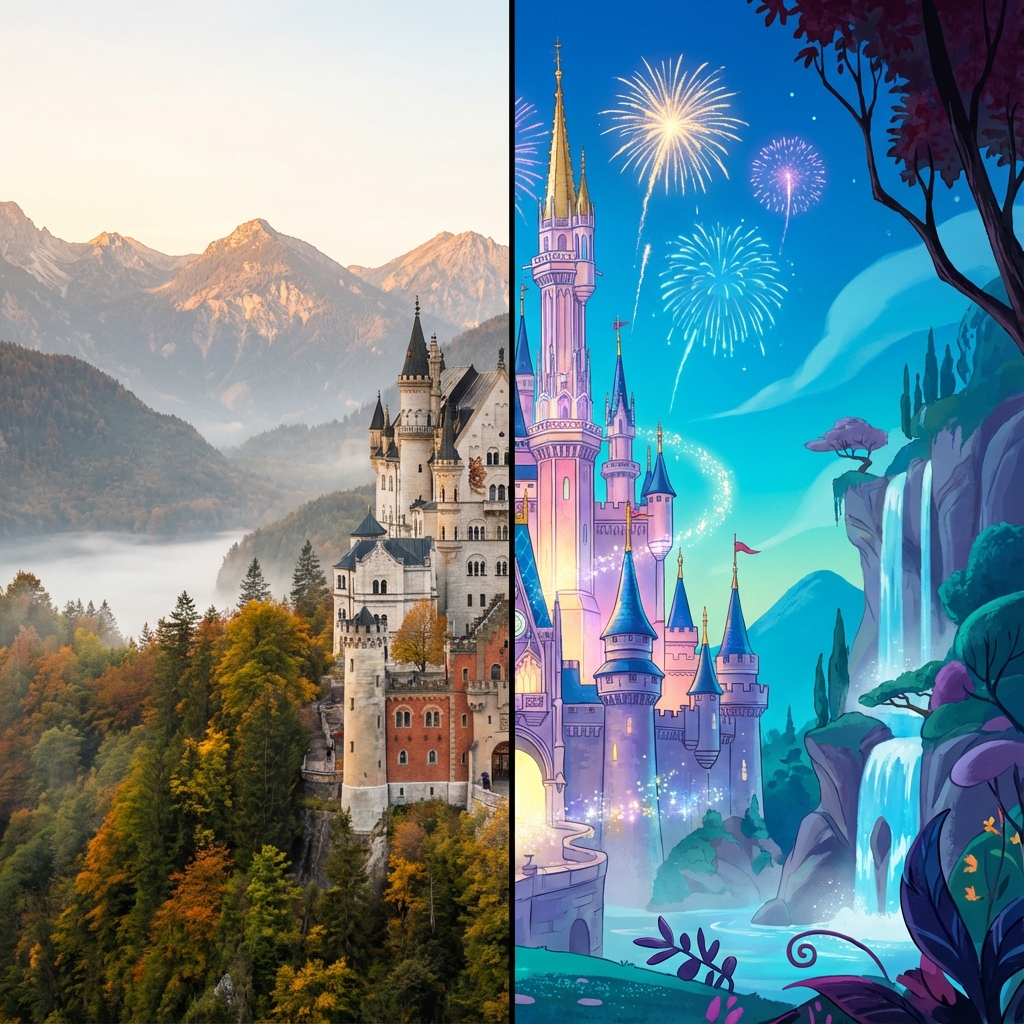
Ever wondered if Disney’s magical castles are based on real places? Spoiler alert: they absolutely are! Walt Disney was a known Francophile and European traveler. He and his team of “Imagineers” (and early animators) traveled extensively across Europe, sketching, photographing, and soaking in the architecture of real castles to create the iconic animated fortresses we know and love.
But the real stories behind these castles are often more dramatic, romantic, and surprising than the movies they inspired. From mad kings to medieval sieges, here is a deep dive into the 5 real castles that inspired Disney’s most famous movies—and exactly how you can visit them today.
1. Neuschwanstein Castle → Sleeping Beauty Castle 🏰💤
The Movie: Sleeping Beauty (1959) The Real Castle: Neuschwanstein Castle, Bavaria, Germany
The Disney Connection: This is the big one. The grandfather of all Disney castles. Walt Disney visited Neuschwanstein in the 1950s during a trip to Europe and was captivated by its dramatic silhouette against the Alps. It became the direct visual model for Sleeping Beauty’s castle in the 1959 film. Later, when designing Disneyland in California, the central castle was modeled after Neuschwanstein’s tall, slender towers and white limestone façade.
The True Story: Built by King Ludwig II of Bavaria (known as the “Fairy Tale King” or “Mad King Ludwig”) starting in 1869, Neuschwanstein was never a medieval fortress. It was a romanticized fantasy—a stage set built of brick and encased in limestone. Ludwig was obsessed with the operas of Richard Wagner and medieval legends of knights and the Holy Grail. He built the castle as a private retreat to withdraw from public life. Tragically, he only lived in the castle for 11 nights before he was deposed on grounds of insanity and died under mysterious circumstances in Lake Starnberg just days later.
Architecture Geek-Out: Notice the cylindrical towers and the Romanesque arched windows. The castle’s interior is even more “extra” than the exterior, featuring a throne room designed like a Byzantine church (minus the throne, which was never built) and an artificial grotto (cave) next to the living room.
How to Visit:
- Location: Hohenschwangau, near Füssen, Germany (about 2 hours from Munich).
- Getting There: Take a train to Füssen, then a bus to the castle ticket center. From there, it’s a steep uphill walk or a horse-drawn carriage ride.
- Photo Spot: The Marienbrücke (Mary’s Bridge) spans a gorge behind the castle and offers that classic postcard view you see on Instagram.
- Tip: Tickets sell out weeks in advance. Book online as soon as your dates are confirmed.
2. Alcázar of Segovia → Cinderella Castle 👸✨
The Movie: Cinderella (1950) The Real Castle: Alcázar of Segovia, Spain
The Disney Connection: While Cinderella’s castle is a composite of several French and German châteaux, the Alcázar of Segovia provided the crucial inspiration for its overall shape—specifically the ship-like prow that juts out over the cliff and the distinct slate-topped witch’s hat turrets.
The True Story: Rising out of a rocky crag above the confluence of two rivers, the Alcázar looks like the bow of a massive stone ship. It dates back to Roman times but took its current shape in the 12th century. It was a favorite residence of the Kings of Castile. This is where the famous Queen Isabella I (who funded Columbus) was crowned. It has served as a royal palace, a state prison, a Royal Artillery College, and a military academy. A fire in 1862 destroyed much of the roof, but it was restored to its romantic style shortly after.
Architecture Geek-Out: The deep blue/grey color of the turret roofs comes from the local slate used in the region. The interior features “Mudejar” style decoration—a unique mix of Christian and Islamic artistic traditions found in Spain, characterized by intricate geometric patterns and coffered ceilings.
How to Visit:
- Location: Segovia, Spain (about 90km north of Madrid).
- Getting There: A high-speed AVANT train from Madrid’s Chamartín station gets you there in just under 30 minutes.
- Photo Spot: Head to the grassy field below the castle (near the river) to capture the “ship” shape towering above you.
- Tip: Climb the 152 steps of the Tower of John II for incredible panoramic views of the city and the Sierra de Guadarrama mountains.
3. Mont Saint-Michel → Tangled (Corona Castle) 🏝️💜
The Movie: Tangled (2010) The Real Castle: Mont Saint-Michel, Normandy, France
The Disney Connection: When the artists at Disney created the Kingdom of Corona for Tangled, they needed a castle that felt isolated yet majestic. They looked to Mont Saint-Michel, a tidal island commune in Normandy. The visual parallels are undeniable: a fortified town spiraling up a rocky island, crowned by a soaring abbey (or castle) at the very top, separated from the mainland by water.
The True Story: This UNESCO World Heritage Site has been a pilgrimage destination since the 8th century, when legend says the Archangel Michael ordered a bishop to build a church on the rock. It became a Benedictine abbey and a fortress that the English failed to capture during the entire Hundred Years’ War. At high tide, it is completely surrounded by the sea; at low tide, it is surrounded by vast sandbanks. It also served as a prison during the French Revolution.
Architecture Geek-Out: The “Merveille” (Marvel) is the Gothic part of the abbey built in the 13th century, a masterpiece of gravity-defying medieval engineering. The layout of the island reflects the feudal society: God (the abbey) at the top, the nobility and knights below that, and the merchants and farmers at the bottom near the water.
How to Visit:
- Location: Normandy, France (about 4 hours from Paris).
- Getting There: Train to Rennes or Pontorson, then a shuttle bus.
- Photo Spot: Walk out onto the modern bridge/causeway during high tide to see the reflection of the mount in the water.
- Tip: Try the famous fluffy omelets at La Mère Poulard, a restaurant that has been open since 1888. But be warned: they are pricey!
4. Château de Chambord → Beauty and the Beast 🌹📚
The Movie: Beauty and the Beast (1991) The Real Castle: Château de Chambord, Loire Valley, France
The Disney Connection: Animator Glen Keane visited the Loire Valley for research and was struck by the ominous yet impressive scale of Chambord. Its massive roofline, covered in a forest of chimneys, spires, and dormers, became the inspiration for the Beast’s castle. The dark, brooding atmosphere of the film matches the sheer overwhelming size of this French Renaissance giant.
The True Story: King Francis I ordered the construction of Chambord in 1519 as a hunting lodge (yes, just a “lodge”). It is the largest château in the Loire Valley, with 440 rooms, 282 fireplaces, and 84 staircases. Despite its size, it was barely used; the King spent a total of only 7 weeks there. It was cold, drafty, and too big to furnish. During WWII, it was used to hide artwork from the Louvre, including the Mona Lisa, to protect them from the Nazis.
Architecture Geek-Out: The center of the keep features a famous double-helix staircase. It consists of two spiral stairs winding around each other without ever meeting. It is widely believed (though not proven) that Leonardo da Vinci, who was a guest of King Francis I at the time, designed it. The idea was that the King could ascend while servants descended without crossing paths.
How to Visit:
- Location: Loir-et-Cher, France (about 2 hours south of Paris).
- Getting There: Car is best, or a train to Blois-Chambord followed by a shuttle.
- Photo Spot: The view from the “Grand Canal” offers a perfect reflection of the castle facade.
- Tip: Rent a bike. The estate is enclosed by a 32km wall (the longest in France) and is the size of inner-city Paris. Biking the forest trails is the best way to see the park.
5. Eilean Donan Castle → Brave (DunBroch Castle) 🏴🎯
The Movie: Brave (2012) The Real Castle: Eilean Donan, Scottish Highlands
The Disney Connection: Pixar’s team spent significant time in Scotland to get the textures and landscapes right for Brave. The family home of Merida, Castle DunBroch, is a compilation of several Scottish castles (including Dunnottar), but its location on a small tidal island connected by a stone bridge is pure Eilean Donan. The banquet hall in the movie also closely resembles the great hall of Eilean Donan.
The True Story: The original castle was built in the 13th century to defend against Viking raids. It played a key role in the Jacobite risings of the 17th and 18th centuries. In 1719, it was garrisoned by Spanish soldiers supporting the Jacobites. The English Royal Navy sent three frigates to bombard the castle, blowing it to smithereens with gunpowder. It lay in ruins for 200 years until Colonel John Macrae-Gilstrap bought the island in 1911 and spent 20 years restoring it to its former glory.
Architecture Geek-Out: The restoration is controversial among purists because it’s a “romantic” reconstruction rather than an archaeologically exact one, but it created the icon we see today. The thick walls (up to 14 feet in some places) were designed to withstand medieval weaponry.
How to Visit:
- Location: Dornie, Kyle of Lochalsh, Scotland.
- Getting There: It is a key stop on the road to the Isle of Skye. Most people drive the North Coast 500 route or take a tour bus from Inverness or Edinburgh.
- Photo Spot: From the parking lot looking across the stone bridge. It is arguably the most photographed view in Scotland.
- Tip: Visit at high tide if possible. At low tide, the castle sits on mudflats, which is less scenic (but historically accurate for defensive purposes!).
Why Disney Chose Real Castles
Walt Disney believed in a concept called “plussing”—taking something good and making it better, or taking reality and making it more magical. But he knew that for fantasy to work, it had to be grounded in reality.
By basing his animated castles on actual European fortresses, he gave his movies a sense of weight, history, and architectural logic. These weren’t just random drawings; they were buildings that looked like they could actually stand up (mostly).
Fun Fact: Disney Imagineers still travel to Europe today. When designing the “Be Our Guest” restaurant in Florida, they went back to Chambord to study the tapestries and stone patterns to ensure the dining experience felt like a real French castle.
Planning Your Ultimate “Disney Castle” European Tour
If you wanted to see all of these in one epic trip, you would be crossing a significant chunk of Europe. Here is a suggested 10-day “Fairytale Itinerary”:
- Days 1-3: Germany. Fly into Munich. Visit Neuschwanstein (Sleeping Beauty).
- Days 4-6: France. Take the train to Paris, then down to the Loire Valley for Chambord (Beauty and the Beast). Then head west to Normandy for Mont Saint-Michel (Tangled).
- Days 7-8: Spain. Fly from Paris to Madrid. Take the high-speed train to Segovia (Cinderella).
- Days 9-10: Scotland. Fly to Edinburgh/Inverness. Drive to the Highlands for Eilean Donan (Brave).
Ready to step into a real-life fairy tale? These castles prove that sometimes, reality is even more magical than animation. Just remember: unlike in the movies, you usually have to pay for parking! 🏰✨