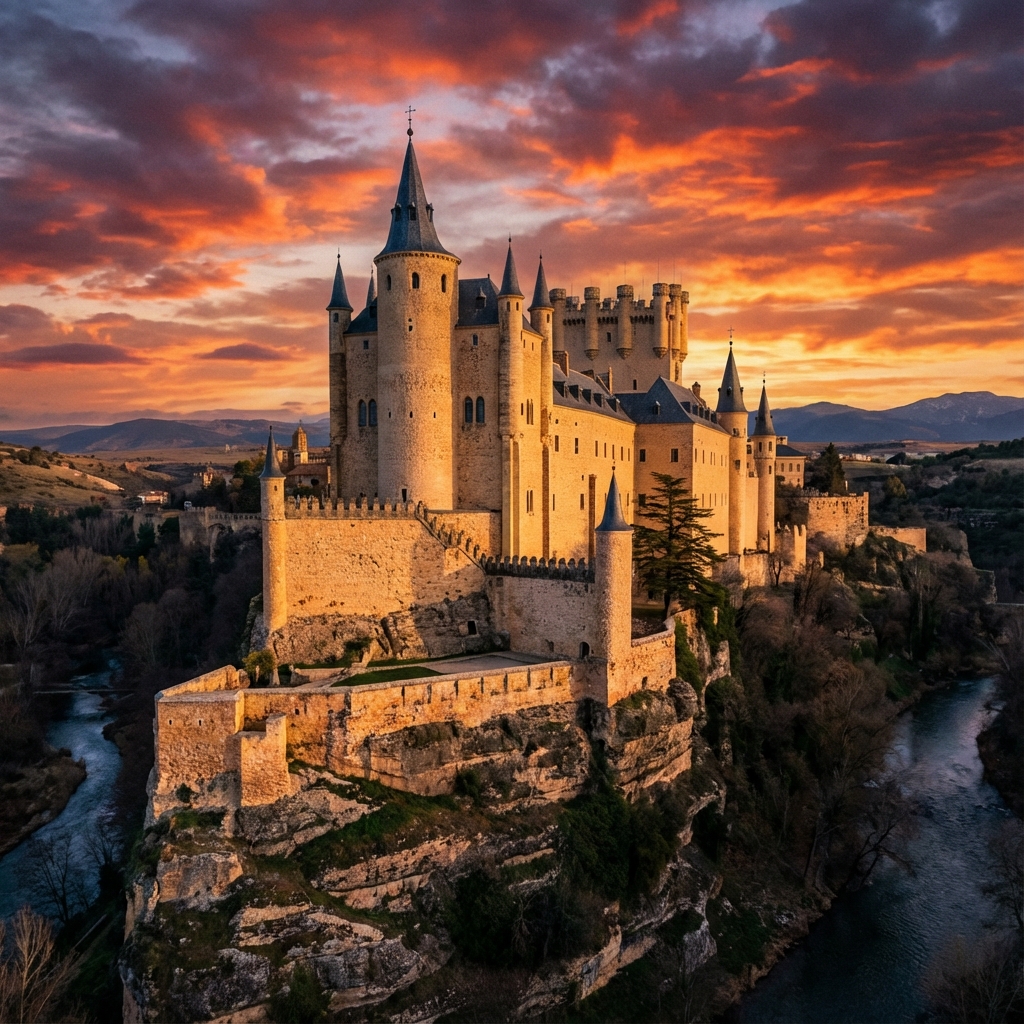
The Stone Giant of Toledo
Dominating the skyline of Toledo, the Imperial City, stands the Alcázar. It is a building of immense proportions, a square fortress with a tower at each corner, rising from the highest rock in the city. For over two thousand years, this site has been the seat of power in central Spain. Romans, Visigoths, Moors, and Christian Kings have all looked out from these heights, surveying the Tagus River that winds around the city like a natural moat.
The Alcázar is not just a palace; it is a survivor. It has been destroyed and rebuilt so many times that it has become a symbol of Spanish resilience. Fire, war, and revolution have all claimed it, yet it always rises from the ashes, grander and more imposing than before. Today, it houses the Spanish Army Museum (Museo del Ejército), guarding the nation's history within its thick stone walls.
From Prehistory to Empire
The strategic value of the Alcázar's hill was recognized long before the first stone was laid. The Romans established a praetorium here in the 3rd century, controlling the crossroads of the Iberian Peninsula. When the Visigoths made Toledo their capital in the 6th century, they fortified the site, turning it into a royal citadel. The Moors, who ruled Toledo for nearly 400 years, expanded it into an 'Al-Qasr' (the fortress), giving the building its modern name.
After the Reconquista in 1085, King Alfonso VI and his successors used it as a bulwark against the south. But the Alcázar we see today is largely the vision of Emperor Charles V (Charles I of Spain). In 1535, he commissioned the architects Alonso de Covarrubias and Juan de Herrera to transform the medieval fortress into a Renaissance palace worthy of the ruler of a global empire. The result was a masterpiece of austerity and power, with a magnificent central courtyard surrounded by a double-decker arcade of Corinthian columns.
The Fires of History
Despite its stone strength, the Alcázar has been plagued by fire. During the War of the Spanish Succession in 1710, it was set ablaze by Austrian and Portuguese troops. It lay in ruins for decades until King Charles III ordered its restoration. Then, in 1810, during the Peninsular War against Napoleon, French troops occupied the building. When they retreated, they set fire to it again, destroying the library and many artistic treasures.
It was rebuilt once more in the late 19th century to serve as a military academy, only to face its greatest trial in the 20th century.
The Siege of 1936
The most famous—and controversial—chapter in the Alcázar's history occurred during the Spanish Civil War. In July 1936, at the outbreak of the conflict, Colonel José Moscardó Ituarte barricaded himself in the Alcázar with a motley force of Civil Guards, cadets, and civilians (including women and children), totaling nearly 2,000 people. They were besieged by Republican forces for 70 days.
The siege became a legend of endurance. The Republicans shelled the building relentlessly, reducing it to a pile of rubble. They burrowed under the walls and detonated mines, blowing up entire towers. Yet, the defenders held on in the cellars, surviving on meager rations of horse meat and wheat. The propaganda war was as fierce as the fighting, with the Nationalists hailing the defenders as heroes of a new Crusade, while the Republicans saw them as stubborn fascists.
The siege was lifted on September 27, 1936, when Franco's troops arrived from the south. The ruined Alcázar became a shrine to the Francoist regime. Today, while the political context has changed, the military history of the siege remains a focal point of the site, with Moscardó's office preserved exactly as it was during the battle.
Architecture: A Renaissance Box
The exterior of the Alcázar is deceptive. From a distance, it looks like a severe, unadorned box. But up close, the details reveal its Renaissance sophistication. The main façade, designed by Covarrubias, is a study in symmetry, featuring a rusticated portal and rows of classical windows. The four corner towers, topped with slate spires, give the building its distinctive silhouette.
Inside, the central courtyard (Patio de Armas) is the architectural jewel. It features a two-story gallery with semi-circular arches, supported by granite columns. At the center stands a statue of Charles V, dominating the space just as he dominated Europe.
The Army Museum
Since 2010, the Alcázar has been the home of the Army Museum. The collection is vast, covering the military history of Spain from the Bronze Age to the present day. Highlights include:
- The Boabdil Collection: Weapons and clothing belonging to Boabdil, the last Moorish King of Granada, surrendered in 1492.
- The Tizona: A sword traditionally attributed to El Cid, the legendary medieval hero.
- The Crypt: The final resting place of Colonel Moscardó and other defenders of the siege.
- The Tent of Charles V: A magnificent campaign tent used by the Emperor, made of silk and gold thread.
Legends of the Cid
Toledo is steeped in legend, and the Alcázar has its share. It is said that El Cid, the great Castilian knight, served as the first warden (Alcaide) of the fortress after the Christian conquest. Legend tells that his horse, Babieca, led him to a hidden wall in the city where a Visigothic church had been bricked up to protect it from the Moors. While the Alcázar was his military base, his spirit is said to permeate the entire city.
Another darker legend concerns the "Phone Call of the Alcázar." During the 1936 siege, the Republican militia captured Colonel Moscardó's son, Luis. They phoned the Colonel and told him that if he did not surrender, his son would be shot. Moscardó spoke to his son on the phone, telling him, "Commend your soul to God, shout 'Viva España,' and die like a patriot." His son was executed (though historians debate the exact timing). The room where this phone call took place remains preserved as a shrine to sacrifice.
Planning Your Visit
The Alcázar is located in the highest part of Toledo, a short walk from the Plaza de Zocodover.
- The Views: Before entering, walk around the exterior terrace. The view of the Tagus River gorge and the Puente de Alcántara bridge is spectacular. The adjacent library (Biblioteca de Castilla-La Mancha), located on the top floor of one of the towers, offers perhaps the best panoramic view in the city—and it's free to enter the reading room (silence required!).
- The Museum: The museum is huge. Plan for at least 2-3 hours if you want to see everything. The route takes you through the archaeological remains of the Roman and Moorish foundations in the basement before moving up to the modern history.
- Accessibility: Despite being a fortress, the museum is fully accessible with elevators and ramps.
- Heat Warning: Toledo gets incredibly hot in the summer. The stone walls of the Alcázar offer a cool refuge, making it a perfect mid-day activity in July or August.
The Alcázar of Toledo is a stern building for a stern history. It does not have the fairytale charm of Segovia or the lush gardens of the Alhambra. Instead, it offers a raw, powerful encounter with the military soul of Spain—a place where stone and steel tell the story of a nation.