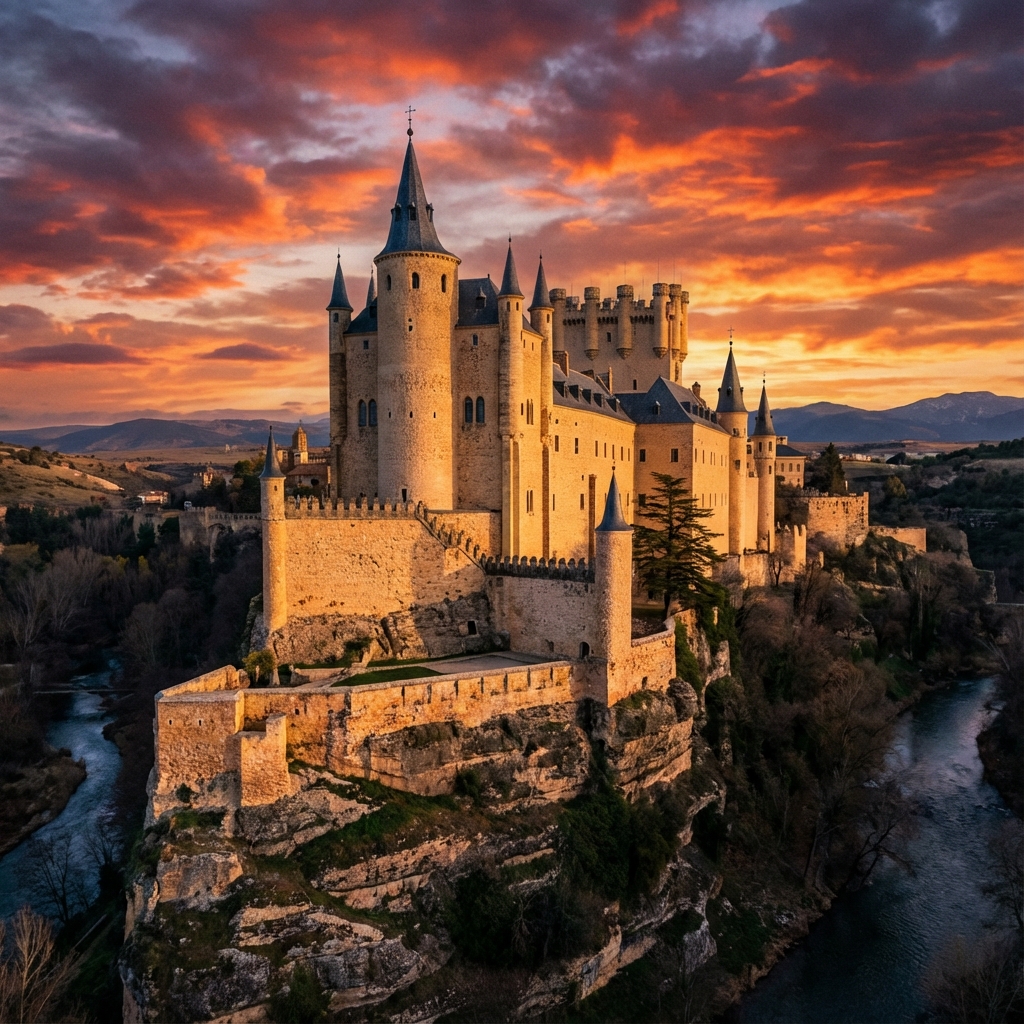
The Alcázar of Segovia is a castle straight out of a fairy tale. Located in the UNESCO World Heritage city of Segovia, it rises from a rocky crag at the confluence of the Eresma and Clamores rivers. Its sharp slate spires and shape, often described as resembling the prow of a ship cutting through the land, make it one of the most distinctive castles in Spain. Along with Neuschwanstein, it is cited as a primary inspiration for Walt Disney's Cinderella Castle.
History: Fortress, Palace, Prison, Academy
The Alcázar has worn many hats throughout history.
The Roman Origins
Like many Spanish fortifications, the site was originally a Roman fort. The Moors built a wooden fortress here, but the stone castle we see today began to take shape after the Christian Reconquista of the city in the 12th century. The first mention of it as an "Alcázar" (a Moorish loanword for "fortress") dates to 1155.
The Royal Palace
During the Middle Ages, the Alcázar was a favorite residence of the Castilian monarchs. It was here, on December 13, 1474, that Isabella I of Castile left the castle and was proclaimed Queen of Castile in the city square—a pivotal moment that would lead to the unification of Spain and the discovery of the Americas.
The Prison and Academy
When the royal court moved to Madrid, the castle became a state prison for two centuries. Then, in 1764, King Charles III founded the Royal College of Artillery here. The castle was transformed into a military academy, a role it played for almost 100 years until a devastating fire in 1862 destroyed the roofs and interiors. The spires were rebuilt in a romantic style, giving the castle its current fantastic silhouette.
Architecture: The Mudejar Masterpiece
While the exterior is Gothic and Renaissance, the interiors are a stunning example of Mudejar art (Islamic style created by Moorish craftsmen under Christian rule).
- The Hall of the Galley (Sala de la Galera): Named because its ceiling is shaped like the inverted hull of a ship. The plasterwork frieze contains a double inscription: the Lord's Prayer in Latin and verses from the Quran in Arabic, a symbol of the complex cultural history of Spain.
- The Hall of Kings (Sala de los Reyes): A magnificent room featuring a frieze with 52 seated statues of the Kings of Asturias, León, and Castile, starting from the legendary Pelagius. It is a 3D history book of the Spanish monarchy.
- The Tower of John II: This massive tower was used as a state prison. Visitors can climb the 152 steps of the spiral staircase for a panoramic view of Segovia, the cathedral, and the surrounding countryside.
The Throne Room
The Sala del Trono preserves the decoration from the time of the Catholic Monarchs. The two thrones sit under a canopy bearing the coat of arms of Isabella and Ferdinand and their famous motto: "Tanto monta" (They amount to the same)—signifying their equal power.
The Armory and Archives
The Royal College of Artillery left a legacy of weaponry. The armory houses a collection of suits of armor, swords, and crossbows. Although the original royal collection is now in the Royal Armory in Madrid, these pieces authentically recreate the atmosphere of the castle's military past. Additionally, the castle houses the General Military Archive of Segovia, the oldest historical archive of the Spanish Armed Forces, containing over 75,000 files.
The Well of the Alcázar
Hidden in the courtyard is the entrance to a well that is over 70 meters deep, cut directly into the rock. This engineering marvel ensured that the castle had access to water from the river below, even during long sieges. The well is associated with secret passages and subterranean tunnels that are said to connect the castle to other parts of the city, feeding into the mysterious atmosphere of the fortress.
The Legend of the Prince
Like any good castle, the Alcázar has its dark legends. One story tells of a nursemaid who was holding the infant Prince Pedro, son of King Henry II. While standing by a window in the Hall of Kings, the baby slipped from her arms and fell to his death on the rocks below. Distraught and fearing the King's wrath, the nursemaid immediately jumped out the window after him. This tragic event is often cited in local folklore.
The Chemical Laboratory
A lesser-known fact is that the Royal College of Artillery housed one of the most advanced chemical laboratories in Europe during the 18th century. It was here that the French chemist Louis Proust, while working as a professor, formulated the Law of Definite Proportions, a fundamental principle of modern chemistry. The castle was not just a place of war, but a center of scientific enlightenment.
Visitor Tips
- Climb the Tower: The ticket to the castle has an optional add-on for the Tower of John II. It is worth the extra euros for the view, but be warned: the spiral staircase is narrow and dizzying.
- The View from Below: After visiting the inside, drive or walk down to the park in the valley (Pradera de San Marcos). Looking up at the castle from below is the best way to see the "ship prow" shape.
- Segovia's Trinity: A visit to Segovia usually involves the "Trinity": The Roman Aqueduct (one of the best-preserved in the world), the massive Gothic Cathedral, and the Alcázar. You can walk between them in about 20 minutes.
- Cochinillo: Segovia is famous for its roast suckling pig (Cochinillo). Many restaurants near the castle serve this local delicacy.
Frequently Asked Questions
- Is it accessible?
- The ground floor of the castle is accessible to wheelchair users, but the Tower of John II is not, as it only has a spiral staircase.
- How do I get there from Madrid?
- The high-speed train (AVE) takes only 30 minutes from Madrid Chamartín station to Segovia-Guiomar. From the station, take a bus (Line 11) to the Aqueduct and walk through the old town to the castle.
- Can I take photos?
- Yes, photography is allowed in all rooms, but flash and tripods are not permitted.