The Windsor of the North
Alnwick Castle (pronounced 'Ann-ick') is the ultimate fortress. It is the second-largest inhabited castle in the United Kingdom, second only to Windsor Castle, and has been the home of the Percy family, the Dukes of Northumberland, for over 700 years. If you ask a child to draw a castle, they will draw Alnwick: massive stone towers, crenellated battlements, and stone warriors standing guard on the roof.
But for millions of people around the world, this isn't just a castle. It is **Hogwarts School of Witchcraft and Wizardry**. Alnwick played a starring role in the first two Harry Potter films, cementing its place in pop culture history. It is a unique destination where you can learn about medieval warfare in the morning and learn to fly a broomstick in the afternoon.
Hogwarts: Scene by Scene
For Potterheads, Alnwick is hallowed ground. Unlike many film sets which were built in a studio, you can physically stand in the exact spots where Daniel Radcliffe and Emma Watson filmed iconic scenes from *The Philosopher's Stone* and *The Chamber of Secrets*.
- The Flying Lesson (The Outer Bailey): This huge, flat green courtyard is instantly recognizable. It is where Madam Hooch (Zoë Wanamaker) taught the first-year students to fly. It is where Neville Longbottom lost control of his broom and Harry caught the Remembrall. Today, the castle's "Broomstick Training" sessions take place on this exact spot. It is a chaotic, hilarious sight to see grown adults jumping in the air while a 'professor' takes photos to make it look like they are flying.
- The Crash Landing (The Inner Bailey): In *The Chamber of Secrets*, Harry and Ron miss the Hogwarts Express and fly the enchanted Ford Anglia to school. They crash-land into the Whomping Willow. While the tree itself was CGI, the walls they nearly hit are the real walls of the Inner Bailey.
- The Lion Arch: This magnificent stone gateway, flanked by stone lions, was the main exit used by Harry, Ron, and Hermione to get to Hagrid's Hut and the Forbidden Forest. It is a popular photo spot for fans recreating the trio's walks.
The Poison Garden: Plants That Kill
Just a short walk from the castle is **The Alnwick Garden**, a modern masterpiece created by the current Duchess of Northumberland. Its most famous feature is the **Poison Garden**.
Behind black iron gates decorated with skull-and-crossbones signs that read "These Plants Can Kill," lies a deadly collection of over 100 toxic, intoxicating, and narcotic plants. This is not a gimmick. Visitors are strictly commanded: **"Do not touch, do not smell, do not taste."** In the summer months, people frequently faint from inhaling the toxic fumes while walking through.
The garden contains:
- Ricin (Castor Bean): The Guinness World Record holder for the world's most poisonous plant. A single seed can kill a child.
- Strychnine (Strychnos nux-vomica): The favorite poison of Agatha Christie villains. It causes violent muscle spasms and a terrifying death.
- Wolfsbane (Aconitum): Historically used to poison the tips of arrows for hunting wolves. In folklore, it is the only defense against werewolves.
- Cannabis, Opium Poppies & Magic Mushrooms: These are grown in the garden under a special license from the UK Home Office for educational purposes. They are often kept inside large cages to prevent theft (or accidental ingestion).
- The Suicide Plant (Gympie-Gympie): An Australian plant kept in a glass display case. Its tiny stinging hairs deliver a neurotoxin so painful that victims have been known to kill themselves just to stop the pain.
The Real Game of Thrones: The Percy Family
The history of the Percy family is bloodier and more dramatic than any fiction. For centuries, they were the Kings of the North in all but name. They were the primary defenders of the Scottish border, and their power often threatened the Crown itself.
The most famous family member was **Harry "Hotspur" Percy** (born at Alnwick in 1364). He was the most feared knight of his generation, famous for his speed and aggression in battle (hence the nickname given to him by his Scottish enemies). He helped put King Henry IV on the throne but later rebelled against him. He was killed at the Battle of Shrewsbury in 1403. Legend says he was so brave that the King wept over his body before having him quartered and his head put on a stake at York. Shakespeare immortalized him as the fiery rival to Prince Hal in *Henry IV, Part 1*.
Downton Abbey & Transformers
Alnwick's film career didn't end with Harry Potter. It starred as **Brancaster Castle** in two Christmas specials of *Downton Abbey* (Series 5 and 6). The Crawley family visited for the grouse shooting season. The lavish State Rooms you see in the show are the real rooms of the castle.
It also appeared in *Transformers: The Last Knight* as the home of Sir Edmund Burton (Anthony Hopkins). Seeing giant Autobots standing in the castle library was a surreal moment for cinema history. The library itself is a showstopper, housing nearly 14,000 books and a ceiling that glows with gold leaf.
The State Rooms: An Italian Palace
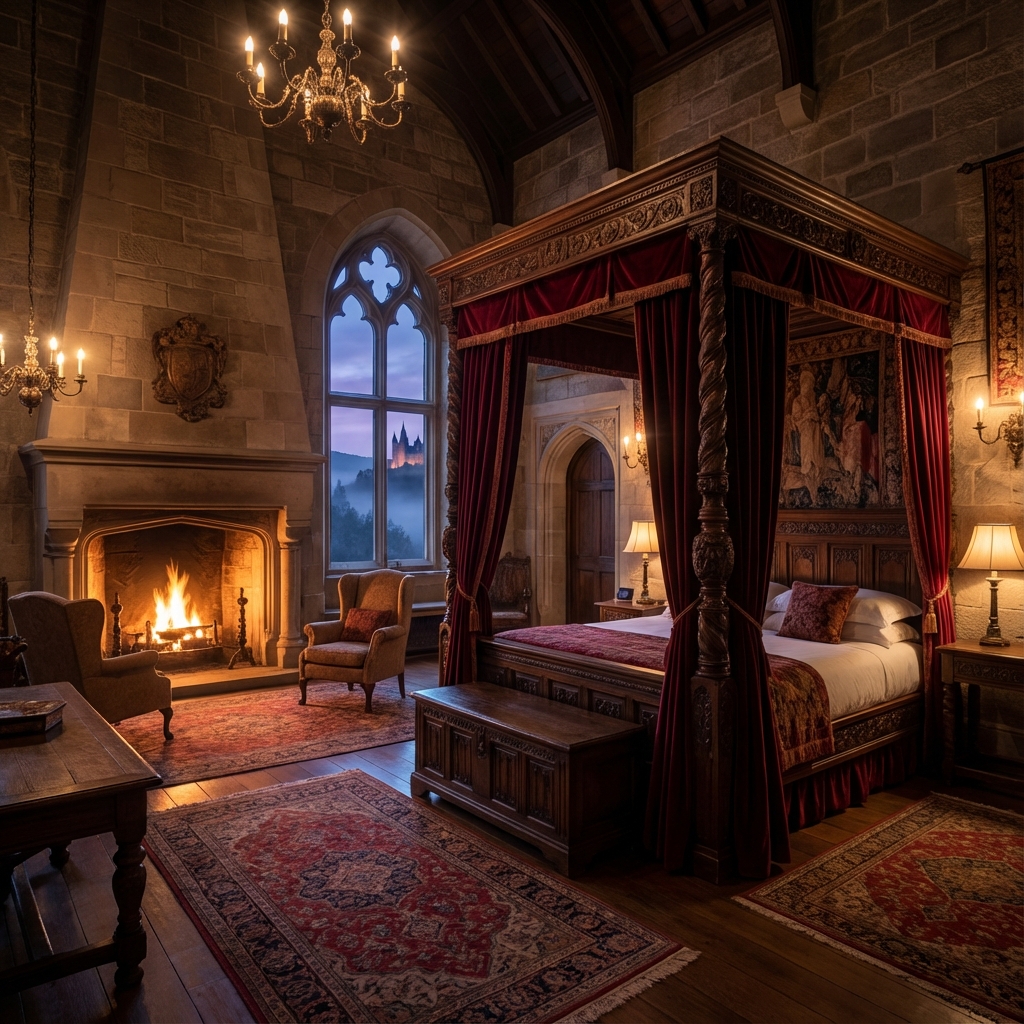
Walking from the rugged, wind-battered courtyards into the State Rooms is a shock to the system. While the outside says "Medieval Fortress," the inside says "Italian Renaissance Palace."
In the 19th century, the 4th Duke decided he was tired of living in a cold, drafty castle. He hired Italian craftsmen to transform the interior. The walls are covered in silk, the ceilings are coffered and gilded, and the rooms are filled with one of the finest private art collections in the country. You will see masterpieces by **Titian, Van Dyck, Canaletto, and Tintoretto**. Look out for the **Cucci Cabinets**—magnificent inlaid cabinets originally made for King Louis XIV of France at Versailles.
Visitor Tips
- Broomstick Training: This is free with your entry ticket, but it operates on a first-come, first-served basis. As soon as you arrive, head to the Outer Bailey to get a time slot. It is incredibly popular.
- The Treehouse Restaurant: Located in The Alnwick Garden, this is the largest wooden treehouse in the world. It has a restaurant with a roaring log fire in the center, built around living lime trees. Booking is essential weeks in advance.
- Combined Tickets: The Castle and The Garden are run by separate trusts. Buying a combined ticket saves money, but be warned: you need a full day (5-6 hours) to see both properly. If you only have half a day, pick one.