The King of Castles
Sprawling across nine acres of a dolerite outcrop that rises 150 feet above the North Sea dunes, Bamburgh Castle is one of the most powerful images of England's northern frontier. It is often called the "King of Castles," and for good reason. For over 1,400 years, this site has been a center of royal power. It was the capital of the Anglo-Saxon kingdom of Northumbria, a target for Viking raiders, a Norman stronghold, and the first castle in England to fall to gunpowder artillery. Today, its massive keep and red sandstone walls dominate the coastline, visible for miles around.
To stand on the battlements of Bamburgh is to feel the weight of history. Below you lie the golden sands of one of Britain's best beaches; out to sea are the Farne Islands and the Holy Island of Lindisfarne. It is a scenery of saints and warriors, and Bamburgh is its heart. The wind whipping off the North Sea serves as a constant reminder of the harsh environment that forged the people of this region.
History: The Throne of the North
The history of Bamburgh begins long before the Normans. In the 6th century, the Anglo-Saxon king Ida the Flamebearer captured the rock and built a wooden fortress. It became the royal seat of the Kings of Northumbria, the most powerful kingdom in Britain at the time. It was known as Bebbanburg (named after Queen Bebba). Fans of Bernard Cornwell's The Last Kingdom (and the hit TV series) will recognize it as the ancestral home of Uhtred of Bebbanburg, the hero who fights to reclaim his birthright.
The castle suffered terribly during the Viking raids (being destroyed in 993) but was rebuilt by the Normans. The great stone Keep, which still stands, was constructed by Henry II in the 12th century. The castle's military impregnability ended in 1464 during the Wars of the Roses, when it became the first castle in England to be smashed into submission by cannons. It fell into ruin for centuries until it was bought in 1894 by the wealthy Victorian industrialist William Armstrong (Lord Armstrong). He spent a fortune restoring it to the magnificent state we see today, intending it to be a convalescent home for retired gentlemen.
Architecture: Norman Might and Victorian Splendor
Bamburgh is a combination of medieval strength and Victorian luxury. The exterior is pure fortress, with its curtain walls and towers. The Keep is the oldest surviving part, a massive square tower with walls 11 feet thick. It was the final refuge for the garrison and stands as proof of Norman engineering.
The King's Hall
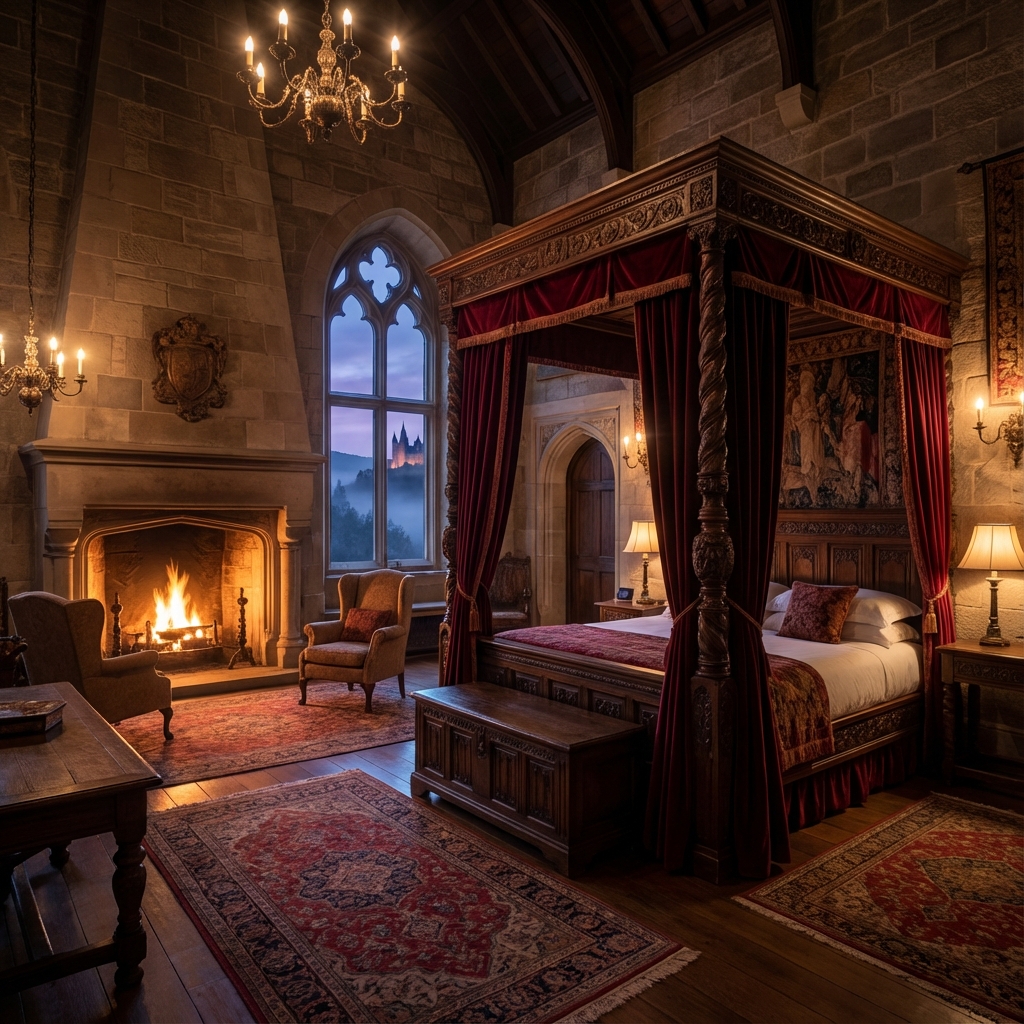
Inside, the restoration by Lord Armstrong created a series of grand state rooms. The King's Hall is the centerpiece. It is a Victorian reimagining of a medieval great hall, with a magnificent teak hammer-beam roof (made by the same craftsmen who repaired Westminster Hall). It is used for weddings and events today. The Cross Hall and the Library are filled with fine art, tapestries, and porcelain, showing the castle's transition from a fortress to a stately home. The contrast between the rugged exterior and the opulent interior is striking.
The Armstrong Museum
The castle also houses the Armstrong and Aviation Museum. Lord Armstrong was an inventor, scientist, and arms manufacturer (the "Magician of the North"). The museum displays his inventions, including early hydraulic machinery and the famous Armstrong guns that armed battleships around the world. It also features artifacts from the two World Wars, highlighting the strategic importance of the Northumberland coast.
Legends: The Laidly Worm and the Toad
Bamburgh is steeped in folklore. The most famous tale is the "Laidly Worm of Spindleston Heugh." It tells of a princess of Bamburgh who was turned into a dragon (a "worm") by her wicked stepmother. She terrorized the countryside until her brother, the Childe Wynd, returned from overseas. He kissed the dragon, breaking the spell and returning her to human form. The wicked stepmother was turned into a toad and is said to still live in a cave at the base of the castle rock, spitting venom. This ballad is one of the oldest in the region, passed down through generations.
Another legend concerns the "Pink Lady," a princess who threw herself from the battlements in grief after her lover was sent away. Her ghost, dressed in a pink gown, is said to wander the castle corridors, forever sorrowful. Visitors have reported cold spots and strange sensations in the stairwells. The beach below is also said to be haunted by Dr. John Sharp, an 18th-century trustee who saved the castle from ruin.
Visitor Information
Getting There
Bamburgh Castle is located in the village of Bamburgh, Northumberland. It is about an hour's drive north of Newcastle upon Tyne. The nearest train station is Berwick-upon-Tweed (to the north) or Alnmouth (to the south), from where you can take a bus (Arriva X18) to the castle. The drive along the coast offers spectacular views.
The Beach
A visit to the castle should always include a walk on Bamburgh Beach below. The view of the castle rising from the dunes is one of the most photographed scenes in the UK. At low tide, you can explore the rock pools. It is a perfect spot for a picnic, weather permitting.
Facilities
The castle is open daily. There is a tea room in the Victorian stables and a gift shop. The site is large, so allow at least 2-3 hours. The state rooms are accessible, but the Keep involves stairs. The castle is still the private home of the Armstrong family, giving it a lived-in feel despite its monumental scale. Special events, such as outdoor cinema screenings and re-enactments, are held throughout the year, bringing the history of the fortress to life.
A Cinematic Icon and the Coastal Ecology
Because of its dramatic silhouette and stunning coastal location, Bamburgh Castle has unsurprisingly become a favorite location for filmmakers and television producers seeking the ultimate medieval backdrop. The castle’s imposing walls and sweeping vistas have featured in numerous blockbuster films and acclaimed historical dramas, from the epic 1970 film Macbeth directed by Roman Polanski to modern television phenomena like The Last Kingdom and Transformers: The Last Knight. Whenever a director needs a fortress that radiates ancient, unyielding power, Bamburgh is often the first choice, cementing its status as a global icon of British heritage in popular culture. Equally cinematic is the wild, fragile ecosystem that surrounds the castle. The pristine sand dunes that roll gently down to the North Sea are recognized as a Site of Special Scientific Interest (SSSI), providing a vital habitat for a diverse array of coastal flora and fauna. Birdwatchers flock to the area to spot eider ducks, fulmars, and even the occasional puffin visiting from the nearby Farne Islands. The relentless crash of the waves and the cry of the seabirds provide a timeless soundtrack, ensuring that the imposing stone fortress is forever intertwined with the raw, untamed beauty of the Northumberland coast.