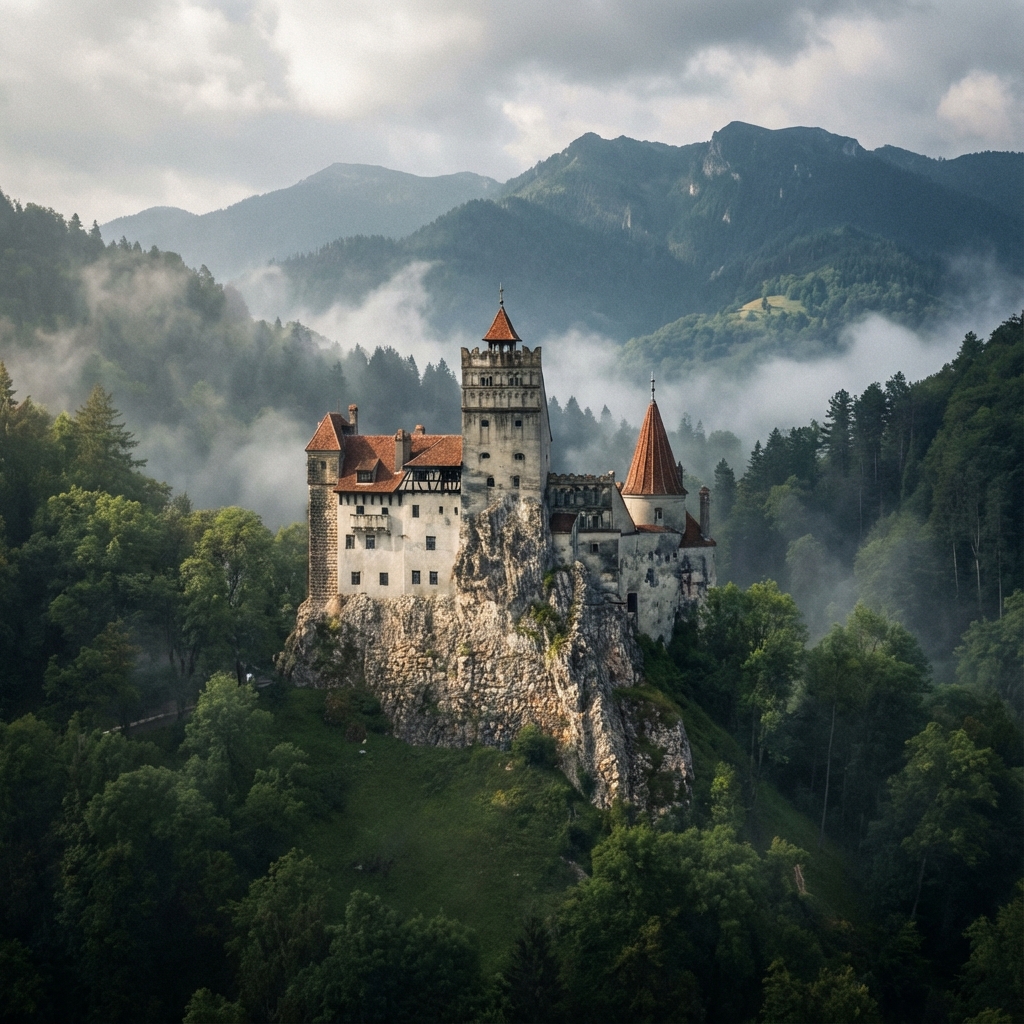
Origins: The Teutonic Knights and The Saxons
The history of **Bran Castle** begins long before Dracula or Queen Marie. In 1211, the **Teutonic Knights**, a Catholic religious military order, were invited by King Andrew II of Hungary to settle in the Burzenland (the region around modern-day Brașov). Their mission was to defend the southeastern border of Transylvania against the Cumans and Pechenegs. They built a wooden fortress called *Dietrichstein* on the site of the current castle. However, the Knights were expelled in 1226, and the wooden fortress was destroyed by the Mongols in 1242.
The stone castle we see today owes its existence to the **Saxons of Kronstadt** (Brașov). On November 19, 1377, King Louis I of Hungary issued a privilege allowing the Saxons to build a stone citadel at their own expense and using their own labor. In exchange, they were exempted from taxes for centuries. Completed in 1388, the castle served a dual purpose: it was a **customs house**, collecting 3% of the value of goods moving between Transylvania and Wallachia, and a **fortress** to stop the expanding Ottoman Empire.
Architecture: A Fortress on the Rock
Bran Castle is a masterpiece of medieval defensive architecture, adapted to the dramatic geography of the Carpathians. It sits perched on a precipitous cliff, rising 60 meters (200 feet) above the valley floor. This natural elevation made it nearly impossible to conquer with medieval siege engines.
The castle's layout is irregular, determined entirely by the shape of the massive rock it stands on. It features four distinct towers:
- The Donjon (North Tower): The oldest part of the structure, providing the main lookout point.
- The Stone Tower (East): Facing the customs house and the old border.
- The Round Tower: Added later to house gunpowder and firearms.
- The Gate Tower: The original entrance, which was once accessible only by a drawbridge.
Inside, the central courtyard is the heart of the castle. Under Queen Marie’s renovation, this military space was softened with half-timbered walls, geranium-filled balconies, and winding wooden galleries that give it a fairytale, almost labyrinthine quality. The castle has 57 rooms, ranging from armories to music salons.
The Myth: Dracula's Lair
Bran is globally famous as **Dracula's Castle**, but the connection is more literary than historical. Bram Stoker, the Irish author of *Dracula* (1897), never visited Romania. He researched the region at the British Library and likely saw an illustration of Bran in Charles Boner’s book *Transylvania: Its Products and Its People*. The castle's dramatic position on a "precipice" perfectly matched Stoker's description of the Count's home.
As for the real Dracula, **Vlad the Impaler** (Vlad Țepeș), his relationship with Bran was hostile. Vlad was the Voivode (Prince) of Wallachia, the region south of the castle. He engaged in a brutal trade war with the Saxons of Brașov, who owned Bran. In 1459, he invaded the region, burning villages and impaling Saxon merchants who refused to pay his taxes. He passed through the Bran Gorge, but he never lived in the castle. Legend says he may have been imprisoned in the castle's dungeon for two months in 1462 after being captured by the Hungarian King Matei Corvin, though historical consensus suggests his imprisonment was actually at Visegrád near Budapest.
The Reality: Queen Marie's Dream Home
The *real* spirit of Bran Castle is not a vampire, but a Queen. In 1920, the city of Brașov gifted the castle to **Queen Marie of Romania** (a granddaughter of Queen Victoria and a first cousin to King George V and Tsar Nicholas II) as a thank you for her relentless diplomatic efforts in unifying Romania after World War I.
When she arrived, it was a cold, derelict fortress used for storage. Marie fell in love with it. She described it as having a "savage beauty." She hired the royal architect **Karel Liman** (who restored Peleş Castle) to transform it into a warm, bohemian summer residence. They added modern amenities like running water, electricity, and even an elevator carved into the rock. The interior is a reflection of Marie’s artistic soul: dark carved wood, heavy Romanian rugs, icons, and traditional ceramics. She turned a weapon of war into a home.
The Heart of the Queen
Queen Marie loved Bran so intensely that she left a shocking instruction in her will: her **heart** was to be removed from her body and buried at the castle.
When she died in 1938, her body was buried at Curtea de Argeș Monastery alongside her husband, King Ferdinand. Her heart, however, was placed in a small golden casket encrusted with gems. It was initially placed in the Stella Maris chapel at her palace in Balchik (on the Black Sea). When that territory was ceded to Bulgaria in 1940, her daughter Princess Ileana rescued the heart and brought it to Bran.
For decades, the heart was hidden in a niche in the rock near the castle to protect it from the Communist regime. It was later seized by the National Museum of Romanian History and spent years in a plastic box in a basement. In 2015, after a long legal battle, the heart was returned to Bran. It now rests in the room where the Queen died at nearby Pelișor Castle (temporarily), but its spiritual home remains the chapel at Bran.
The Communist Seizure and Return
In 1948, the new Communist government seized the castle and forcibly expelled the royal family. Princess Ileana, who had been running a hospital in the village, was given just a few hours to leave the country. The castle was turned into a state museum of "feudal history," deliberately stripped of its royal connection.
In 2006, following the fall of Communism and years of complex lawsuits, the Romanian government returned the castle to Princess Ileana's son, **Archduke Dominic von Habsburg**, and his sisters. He now owns and runs it as a private museum. It is one of the few places in the world where you can visit a major medieval castle that is still owned and managed by the direct descendants of the Queen who saved it.
Legends: Strigoi and The Violet Scent
Beyond Dracula, the village of Bran is steeped in authentic Romanian folklore. Local legends speak of **Strigoi**—troubled souls of the dead who rise from the grave to haunt the living. These myths, which involve drinking blood and fearing garlic, are the real root of the vampire legend that Stoker borrowed.
There is also a gentler haunting. Staff and visitors have reported smelling the strong, distinct scent of **violets** in the empty corridors of the upper floors. Violets were Queen Marie’s favorite flower, and she used a signature violet perfume. Many believe it is the Queen checking on her beloved home.
The Secret Staircase & The Time Tunnel
One of the castle's most popular features is the **Secret Staircase**. Hidden behind a false fireplace in the library, this narrow passage connects the first floor to the third floor. It was built in the 14th century as an escape route for soldiers but was forgotten for generations until Queen Marie rediscovered it during renovations. It is claustrophobic and steep, offering a real sense of medieval secrecy.
In 2018, a new attraction opened: **The Time Tunnel**. This is a multimedia trip located in the old elevator shaft dug for the Queen in the 1930s. Visitors ride a glass elevator 30 meters down into the bedrock while a sound-and-light show depicts the history of the castle. It exits into the Royal Park below, completing the tour.
Visitor Tips
- Getting There: The castle is 30km from Brașov. Take a train from Bucharest to Brașov (approx. 2.5 hours), then take a bus from Autogara 2 (Bus Terminal 2). Buses run every 30 minutes on weekdays and cost very little.
- Beat the Crowds: Bran is Romania’s #1 tourist attraction. In summer (July-August), queues can take 2-3 hours. Arrive at 9:00 AM sharp or visit after 4:00 PM.
- The Halloween Party: The castle hosts a massive, world-famous Halloween party in the courtyard. It sells out months in advance and features costumes, DJs, and "vampire vodka."
- Local Flavors: In the market at the foot of the castle, ignore the plastic fangs and look for Brânză de burduf—a spicy, salty sheep cheese aged in pine bark. It is a local delicacy.
- Photography: The best view of the castle is not from the entrance, but from the cross on the hill in the park across the road. It offers the iconic shot of the castle rising out of the mist.