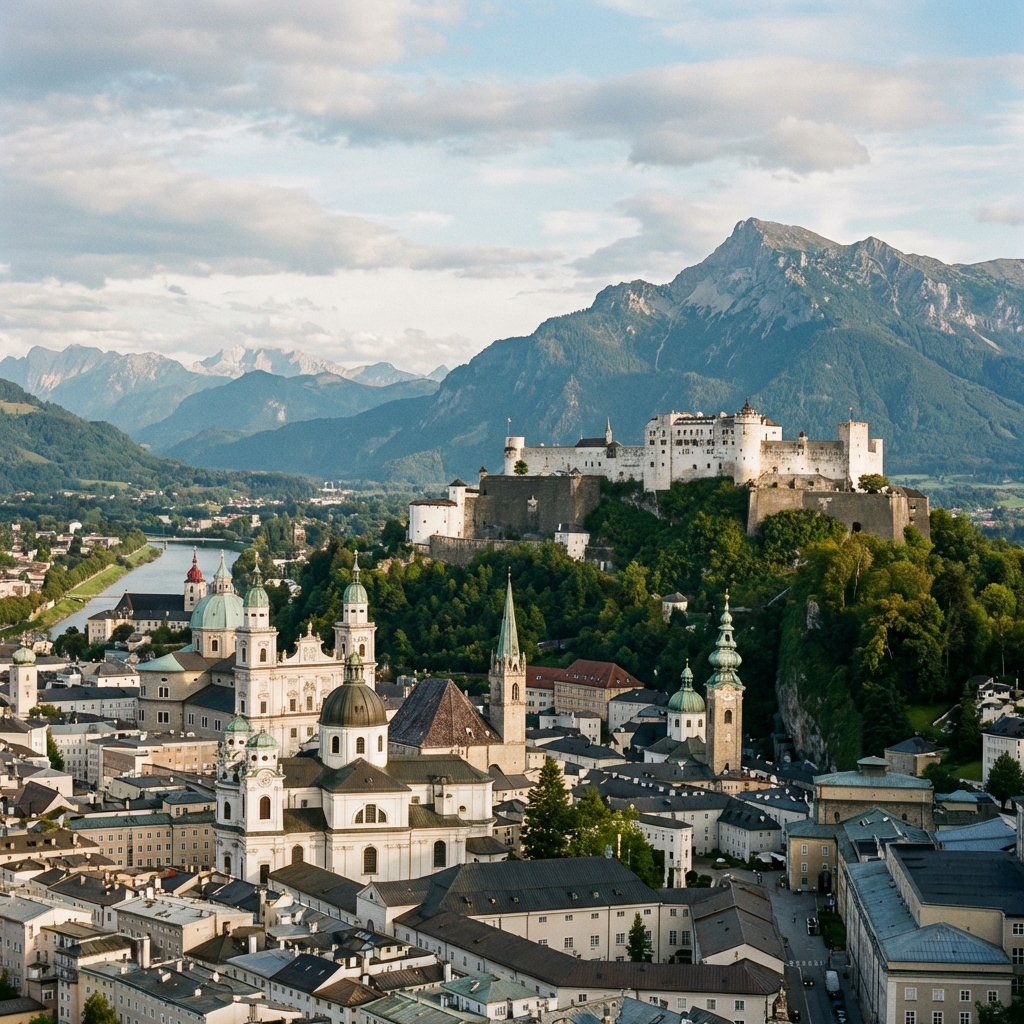
The Fortress in the Clouds
Standing like an impenetrable sentinel on a sheer 155-meter rock cone high above the Salzach Valley, Burg Hohenwerfen is the quintessential Alpine fortress. Surrounded by the towering peaks of the Tennengebirge and the Berchtesgaden Alps, it commands the scenery with a brooding majesty. Unlike its sister castle, the Hohensalzburg Fortress in Salzburg, which evolved into a prince-archiepiscopal residence, Hohenwerfen remained a true military stronghold for nearly 900 years. Its walls have witnessed peasant uprisings, religious wars, and the imprisonment of archbishops. Today, it is famous not only for its history but as a spectacular stage for falconry and as a cinematic icon, immortalized as the "Schloss Adler" in the classic war movie Where Eagles Dare.
The castle's silhouette is unmistakable, a jagged extension of the rock itself. It dominates the pass, controlling the vital trade route that linked Salzburg to Italy and the south. For centuries, merchants, pilgrims, and armies had to pass under its watchful gaze, paying tolls and homage to the power of the Prince-Archbishops.
History: A Bulwark of the Archbishops
The history of Hohenwerfen is inextricably linked to the Investiture Controversy, a power struggle between the Pope and the Holy Roman Emperor in the 11th century. In 1077, Archbishop Gebhard of Salzburg, a loyal supporter of the Pope, hurriedly built three fortresses to secure his territory against the Emperor's troops: Hohensalzburg, Friesach, and Hohenwerfen. This hasty construction formed the core of the castle.
In the centuries that followed, the castle was expanded and strengthened by successive archbishops. However, its darkest hour came during the German Peasants' War in 1525. Miners and farmers from the surrounding Pongau region stormed the castle, looting and burning it. Archbishop Matthäus Lang was forced to flee. After the uprising was crushed, the peasants were forced to rebuild the very castle they had destroyed as punishment, a labor that took decades and cemented the archbishop's authority.
Throughout the 17th and 18th centuries, Hohenwerfen served a dual purpose: a hunting retreat for the archbishops and a state prison. It was considered an inescapable dungeon. Its most famous prisoner was Archbishop Wolf Dietrich von Raitenau, who died here in 1617 after being overthrown by his own nephew. The castle fell into decay in the 19th century but was restored by Archduke Eugen of Austria-Teschen, who also owned nearby Hochosterwitz, in a romantic style. A fire in 1931 caused significant damage, but it was once again rebuilt, serving as a police training center during the Nazi era before finally opening to the public.
Architecture: The Art of Fortification
Hohenwerfen is a masterclass in defensive architecture. Its layout is dictated by the steep rock it stands on. Visitors approach via a winding path that leads through a series of defensive gates, each designed to slow down and trap attackers. The outer ward (Vorburg) houses the stables and the brewery.
The Upper Castle
The heart of the complex is the Upper Castle, centered around a courtyard with a cistern. The Bell Tower offers a commanding view of the valley, essential for early warning. The Chapel of St. Sigismund is one of the oldest parts of the castle, featuring Romanesque foundations. The defensive walls are up to 5 meters thick in places, equipped with machicolations and arrow slits.
The Pitch Kitchen and Dungeons
A tour of the interior reveals the grim reality of castle life. The "Pitch Kitchen" was used to boil pitch and oil to pour on attackers. The torture chamber contains replicas of instruments used during the witch trials that plagued the region in the 17th century. The deepest dungeon, a 4-meter deep hole in the floor of the prison tower, was known as the "Oubliette" (the place of forgetting), where prisoners were lowered and left in darkness.
The Falconry Centre
Since ancient times, the castle was used for hunting, particularly with birds of prey. This tradition is kept alive today by the Historic Falconry Centre of Salzburg, located in the castle's outer ward. It is one of the few places in Europe where the art of medieval falconry is practiced authentically. Daily flight demonstrations feature eagles, falcons, red kites, and vultures soaring on the thermal currents above the castle walls. Seeing a golden eagle dive from the high towers to the lure in the courtyard is a stunning spectacle that connects the visitor directly to the sport of kings. The museum within the castle also details the history of falconry, showcasing hoods, gloves, and historical treatises on the training of birds.
Legends: The Clockmaker of Hohenwerfen
One local legend tells of a clockmaker who was imprisoned in the castle for a crime he didn't commit. To prove his worth and beg for mercy, he offered to build a magnificent clock for the tower. He worked for years, creating a masterpiece of gears and chimes. When it was finished, the lord of the castle was so impressed that he decided he didn't want the clockmaker to build such a clock for anyone else. He ordered the man to be blinded. In revenge, the blind clockmaker asked to touch his creation one last time. He reached into the mechanism and removed a single, vital pin. The clock stopped forever, and no one was ever able to repair it.
Visitor Information
Getting There
Burg Hohenwerfen is located in the town of Werfen, about 40 km south of Salzburg. It is easily accessible by train (Werfen station) or via the A10 Tauern Autobahn. From the parking lot, visitors can choose to hike up the steep forest path (approx. 20 minutes) or take the modern funicular lift which whisks you straight into the courtyard.
Tours and Events
The castle is open from April to November. The interior can be visited by guided tour only (available in German with audio guides in many languages, including English). The tour takes visitors through the chapel, the pitch kitchen, the armoury, and the princely chambers. The falconry demonstration is included in the ticket price and takes place several times a day (check the schedule as it varies by season). The castle also hosts special events like medieval festivals, falconry academies, and mystical night tours.
The "Where Eagles Dare" Connection
Movie buffs will recognize the castle immediately. While the cable car scenes were filmed elsewhere (at the Feuerkogel cable car), the exterior shots of the "Schloss Adler" are unmistakably Hohenwerfen. It remains a pilgrimage site for fans of the film. Visitors can often find merchandise and information relating to the movie in the gift shop, celebrating the castle's role in Hollywood history.