The Giant of Wales
Caerphilly Castle (Castell Caerffili) dominates the town that bears its name. It is a fortress of superlatives: the largest castle in Wales, the second largest in Britain (after Windsor), and one of the greatest examples of medieval military architecture in Europe. Covering 30 acres, it is three times the size of the principality's other famous castles like Caernarfon or Conwy. It was built not by a king, but by a powerful Marcher Lord, Gilbert de Clare (known as "Red Gilbert" because of his hair and his fiery temper), to secure his grip on the region against the Welsh prince Llywelyn ap Gruffudd.
A Revolution in Defense
Built rapidly between 1268 and 1271, Caerphilly introduced a revolutionary new defense concept to Britain: the "concentric" design. This means it has walls within walls—an outer ward and an inner ward—allowing defenders to retreat to a stronger position if the first line was breached. But its most terrifying defense was water.
De Clare dammed the local streams to create huge artificial lakes (moats) on all sides of the castle. These water defenses made it impossible for enemies to tunnel under the walls (mining) or bring up siege towers. The castle effectively became an island fortress, floating in a defensive sea. The massive dam platform that holds back the southern lake is an engineering marvel in itself, fortified with a huge gatehouse and a mill. It showcased the cutting-edge technology of the 13th century.
The Leaning Tower
One of Caerphilly's most famous features is the Leaning Tower of the southeast corner. It stands about 20 meters high and leans over 3 meters out of the perpendicular. This makes it lean more, angle-wise, than the famous Leaning Tower of Pisa. The lean was caused by the castle's destruction during the English Civil War. Parliamentarian troops attempted to blow it up with gunpowder to prevent it from being used again. The explosion shattered the tower's base, but incredibly, the upper part slid down onto the rubble and stayed standing, frozen in its fall for over 350 years. It is a favorite spot for visitors to take photos pretending to hold it up.
History: War and Ruin
The castle saw fierce fighting almost immediately. Llywelyn ap Gruffudd tried to burn it down while it was still being built. It was attacked again during the revolt of Madog ap Llywelyn in 1294 and the rebellion of Llywelyn Bren in 1316. In the early 14th century, it was remodeled as a palace for the Despenser family, favorites of King Edward II. However, by the 15th century, it fell into decline. The stones were robbed to build houses in the town, and the lakes drained away. It was only in the late 19th and 20th centuries, thanks to the wealthy Bute family (who made their fortune in coal), that the castle was restored. They re-flooded the lakes, rebuilt the towers, and saved the giant from oblivion.
Inside the Fortress
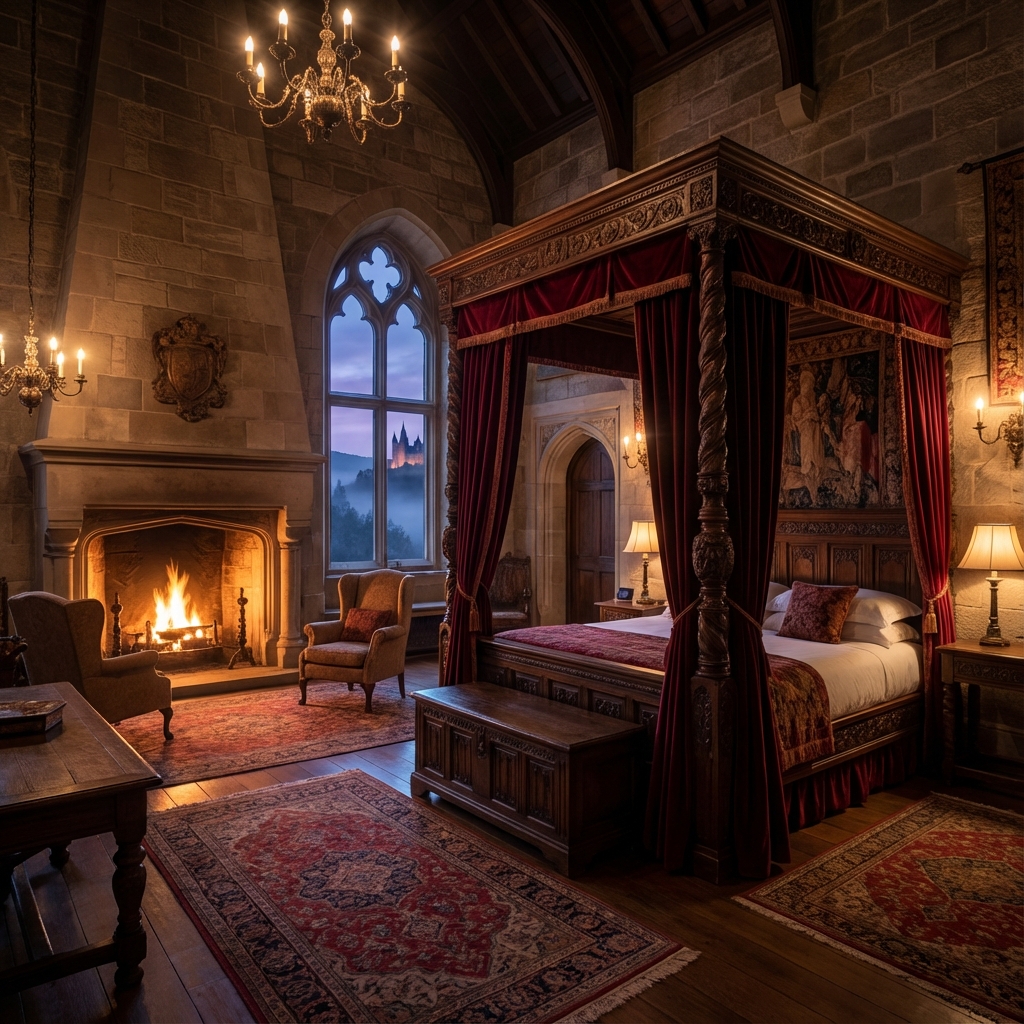
Entering Caerphilly is an adventure. You cross two drawbridges to reach the massive East Gatehouse, which served as the constable's residence. The Great Hall has been magnificently restored and is used for weddings and banquets. It features tall gothic windows and a wooden roof, giving a sense of the luxury the lords enjoyed amidst the war. Wooden hoardings (fighting platforms) have been reconstructed on some of the walls to show how archers would have defended the battlements.
The Siege Engines
On the "dam" platform, visitors can see full-scale working replicas of medieval siege engines. There is a trebuchet, a mangonel, and a ballista. These terrifying machines demonstrate the power of medieval artillery and are often fired during special event days, launching missiles into the moat.
The Green Lady Ghost
Like any good castle, Caerphilly has a ghost. The "Green Lady" is said to be the spirit of Alice de la Marche, the niece of Henry II and wife of Gilbert de Clare. Legend says she fell in love with a Welsh prince, Gruffudd the Fair. When Gilbert discovered the affair, he had Gruffudd executed. Alice died of a broken heart and now haunts the castle, appearing as a green figure on the ramparts, waiting for her lost lover. Her presence adds a spooky dimension to the massive stone walls.
Visitor Information
Opening Hours
Caerphilly Castle is open daily. Hours are generally 9:30 AM to 5:00 PM (or 6:00 PM in summer), and 10:00 AM to 4:00 PM in winter. Last admission is 30 minutes before closing.
Getting There
The castle is in the center of Caerphilly town, just north of Cardiff. It is easily reached by train from Cardiff Central (about 15-20 minutes). The station is a 5-minute walk from the castle entrance. There is also a large car park nearby.
Accessibility
Because of its moat and towers, some parts of the castle are difficult to access for wheelchair users, but the lower levels, the Great Hall, and the grounds are generally accessible. The combination of the massive water defenses, the ruined leaning tower, and the restored hall makes Caerphilly a unique and impressive site.
Events and Living History
Caerphilly Castle is one of the most active event venues in the Cadw portfolio. Throughout the year it hosts medieval re-enactment weekends where costumed performers demonstrate 13th-century siege warfare, archery, and castle life. The trebuchet and other siege engines on the dam platform are fired on these days—an experience that gives visitors a visceral understanding of medieval warfare that no museum exhibit can replicate. The Great Hall is regularly used for evening banquets, and the castle grounds provide the dramatic backdrop for the town's annual Big Cheese Festival, celebrating Welsh food culture and drawing tens of thousands of visitors each July.
The Bute Legacy
The restoration of Caerphilly is inseparable from the story of the Bute family—specifically the 3rd Marquess of Bute and his son the 4th Marquess. The 3rd Marquess, one of the wealthiest men in the world thanks to Cardiff's coal trade, had an obsessive passion for medieval architecture. He restored Cardiff Castle and Castell Coch in flamboyant Gothic style with the architect William Burges. After his death, his son turned his attention to Caerphilly—a larger, more authentic restoration project that took decades and involved re-flooding the medieval lakes from scratch. Without the Bute family's money and scholarly commitment, Caerphilly would today be a drained, heavily quarried ruin. Their intervention saved one of Europe's finest medieval fortresses for future generations.