A Renaissance Dream
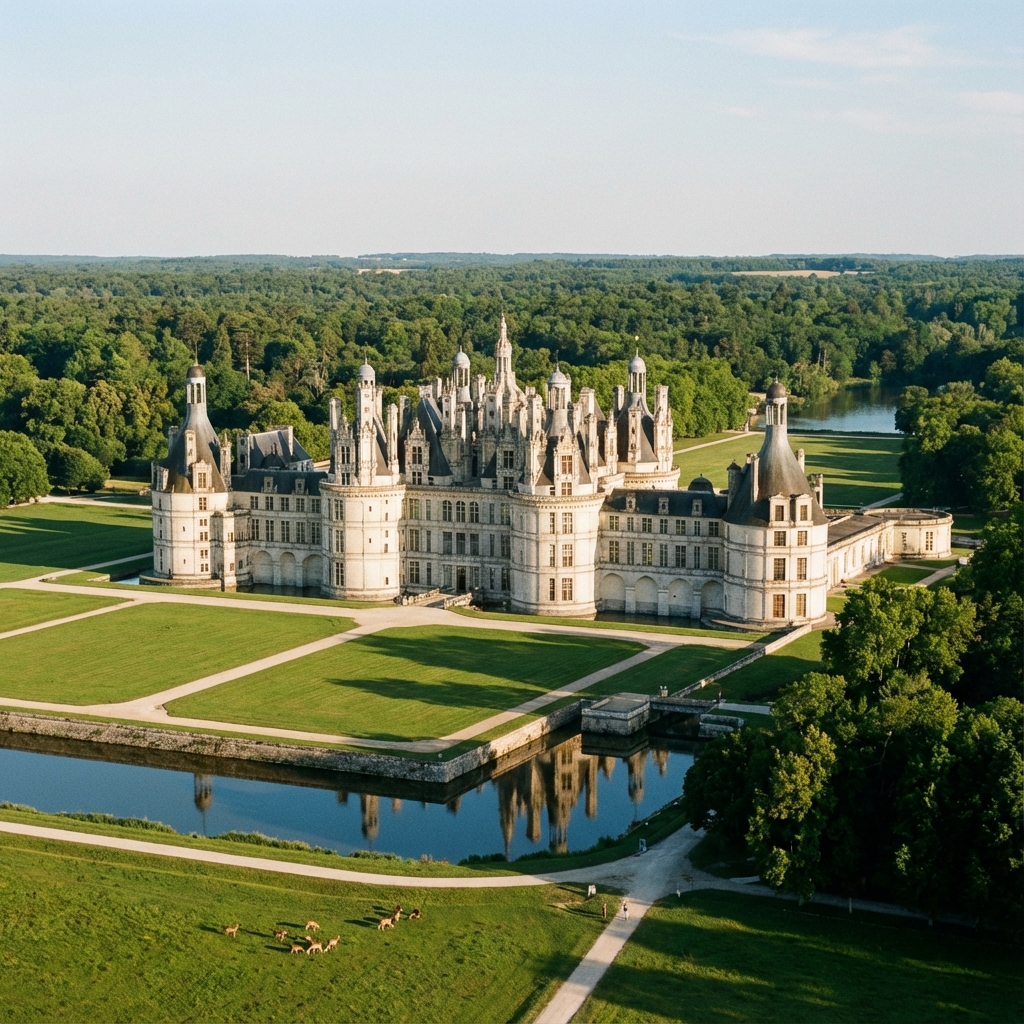
Château de Chambord is not just a castle; it is the architectural manifestation of a king's dream. It is the largest and most majestic château in the Loire Valley, a UNESCO World Heritage site that embodies the extravagance of the French Renaissance. Commissioned by King Francis I in 1519, it was never intended to be a permanent residence. Instead, it was built as a hunting lodge—a symbol of his power and a place to display his wealth to foreign rivals, particularly Charles V, the Holy Roman Emperor.
The scale of Chambord is staggering. It sits in a walled park of over 5,000 hectares (roughly the size of central Paris), enclosed by a 32-kilometer wall. The château itself boasts 440 rooms, 282 fireplaces, and 84 staircases. Its distinctive roofline, a chaotic forest of chimneys, lanterns, and turrets, was compared by the writer Chateaubriand to "a woman whose hair is blown by the wind."
The Rivalry That Built a Castle
To truly understand Chambord, you need to understand the extraordinary personal rivalry between Francis I and Charles V, the Holy Roman Emperor. These two men, born within two years of each other, fought over the same territories, the same papal allegiances, and ultimately the same claim to being the most powerful monarch in Christendom. Every element of Chambord was designed as a statement in this contest. The sheer scale—440 rooms, a park the size of central Paris—was calculated to overwhelm any visitor and to report back to Charles's court that the King of France was richer, more cultured, and more magnificent. The double-helix staircase, the sculpted roofline, the integration of Italian Renaissance ideas into French Gothic structure: all of it was propaganda in stone. When Charles V finally visited Chambord in 1539, he is recorded as calling it "a summary of what human industry can achieve." For Francis, who spent only 72 days at the château during his entire reign, that single compliment may have justified the entire expense.
The Mystery of the Architect
The original architect of Chambord remains unknown, but the design is heavily influenced by the Italian Renaissance and the genius of Leonardo da Vinci. Leonardo was a guest of King Francis I at the nearby Château of Clos Lucé and died just months before construction began. His fingerprints are all over the château's innovative features.
The Double-Helix Staircase
The most famous feature of Chambord is the double-helix staircase at the center of the keep. It consists of two spiral staircases twisting around a central hollow core, illuminated by a lantern at the top. The brilliance of the design is that two people can ascend and descend at the same time without ever meeting, although they can see each other through the open windows in the core. It was a playful, theatrical invention, likely designed to prevent the King's wife and his mistress from crossing paths, or simply to amuse the court.
The Roof Terrace
Unlike medieval castles where the roof was for defense, the roof of Chambord was designed for pleasure. The terrace offers a panoramic view of the park and the intricate details of the roof's architecture. It was here that the ladies of the court would stand to watch the King and his men return from the hunt. The chimneys and lanterns are decorated with slate and sculptures, creating a skyline that looks like a miniature city in the sky.
History: A Castle for a Few Days
Despite its grandeur, Chambord was rarely inhabited. Francis I spent only 72 days there in his entire 32-year reign. The castle was massive, drafty, and impossible to heat. Because it was not a permanent home, it stood empty and unfurnished for long periods. When the King visited, thousands of servants, courtiers, and furniture had to travel with him in a massive logistical operation. After his death, the castle was neglected for nearly a century until Louis XIV, the Sun King, took an interest in it. He finished the construction, furnished the royal apartments, and even had Molière perform plays there.
During the French Revolution, the furniture was sold and the timber stripped, but the building survived. In the 20th century, it was used to store thousands of art treasures from the Louvre, including the Mona Lisa, to protect them from bombing during World War II.
The Royal Apartments
Today, visitors can explore over 60 rooms that have been restored and furnished. The King's Apartment and the Queen's Apartment are located in the keep and are connected by a gallery. They are decorated with tapestries and period furniture, giving a glimpse into the mobile life of the Renaissance court. Another highlight is the Chapel, the largest room in the castle, which was begun by Francis I but not completed until the reign of Louis XIV.
The Park and Gardens
The park surrounding Chambord is the largest enclosed forest park in Europe. It is home to wild boars and deer, the descendants of the game that Francis I hunted. In 2017, the French Formal Gardens were restored to their 18th-century glory based on original plans. They provide a magnificent structured foreground to the wild forest beyond, featuring 600 trees, 800 shrubs, and 15,000 plants.
Visitor Information
Opening Hours
Château de Chambord is open all year round, except for January 1st and December 25th. Opening times vary by season, generally 9:00 AM to 5:00 PM or 6:00 PM. Last entry is 30 minutes before closing.
Tickets and Tours
Tickets can be bought online to skip the queue. There are audio guides available, as well as the "HistoPad," a tablet that uses augmented reality to show you what the rooms looked like in the 16th century, furnished and inhabited. This is highly recommended to understand the scale and life of the castle.
Getting There
Chambord is located in the Loir-et-Cher department, about 2 hours south of Paris. By car, take the A10 motorway. By train, take a train from Paris Austerlitz to Blois-Chambord (about 1 hour 20 minutes) and then a shuttle bus (running April to November) or taxi to the château. There are also many organized day trips from Paris.
Events
The château hosts numerous events, including a music festival in July, equestrian shows in the stables, and a Christmas market in December where the castle is beautifully illuminated. Seeing Chambord lit up at night is an unforgettable experience.