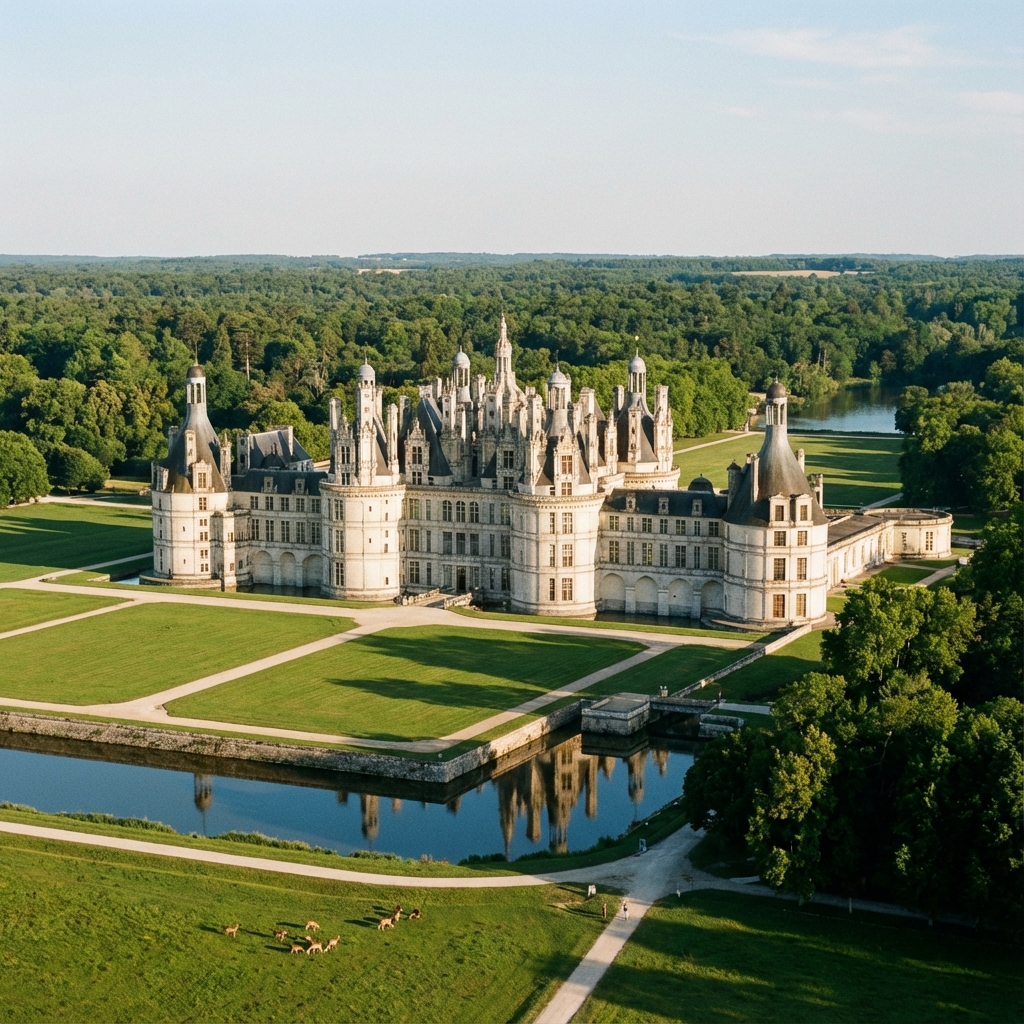
The Castle from the Manuscript
If you have ever looked at a book of medieval art, you have likely seen the Château de Saumur. It is the castle depicted in the month of September in the Très Riches Heures du Duc de Berry, the most famous illuminated manuscript of the 15th century. Remarkably, the castle you see today standing above the Loire River looks almost identical to the one painted over 600 years ago. With its creamy white tuffeau stone, blue slate roofs, and whimsical weather vanes gilded with gold leaf, it is the archetype of the fairytale castle.
But Saumur is more than just a pretty picture. It is a survivor. It has been a fortress, a lavish palace for royalty, a grim prison for enemies of the state, and an arsenal for weapons. Today, it is a UNESCO World Heritage site and a landmark of the Loire Valley, watching over the town of Saumur and its famous vineyards.
The Dukes of Anjou and the Golden Age
While the site has been fortified since the 10th century (originally by Thibault le Tricheur, Count of Blois), the castle we admire today is largely the work of the Dukes of Anjou in the 14th and 15th centuries. Duke Louis I of Anjou began the transformation, turning the old fortress into a comfortable palace. But it was his grandson, "Good King René" (King René of Anjou), who truly left his mark.
René was a man of culture—a writer, a painter, and a lover of the arts. Under his rule, Saumur became a "castle of love" (château d'amour), a place of tournaments, festivals, and royal romance. He finished the construction, ensuring the castle was as beautiful as it was strong. The octagonal corner towers and the intricate window traceries date from this period, reflecting the transition from the defensive military architecture of the Middle Ages to the decorative style of the early Renaissance.
The Darker Years: The Bastille of the West
The golden age did not last. After the death of King René, the castle became property of the French Crown. By the 17th century, under Louis XIV, its glory days were over. It was converted into a prison, a role it would play for two centuries. High-ranking prisoners were held here under lettres de cachet (royal arrest warrants that required no trial). Among its most infamous residents was the Marquis de Sade, who was imprisoned here briefly in 1768.
During the Napoleonic Wars, the castle's dungeons were filled with British sailors and soldiers captured in battle. Graffitied names and drawings of ships scratched into the soft limestone walls by these prisoners can still be seen today, a haunting reminder of their long confinement.
Following its time as a prison, the castle served as an arms depot and barracks for the French army. While this saved it from ruin, it also meant the beautiful interiors were gutted or neglected. It wasn't until the early 20th century that the City of Saumur bought the castle and began the long process of restoration.
The Museum of the Horse
Saumur is known worldwide as the equestrian capital of France, home to the prestigious Cadre Noir riding school. It is fitting, then, that the castle houses the Museum of the Horse (Musée du Cheval). Located in the upper floors, this museum displays a unique collection gathered by Count Charles Lair in the early 1900s.
The collection traces the history of horsemanship across the globe. You can see saddles from Japan, Russia, Africa, and the Americas, as well as bits, stirrups, and spurs from every era. It explores the relationship between horse and human, from warfare and agriculture to sport and leisure. Even if you are not a rider, the craftsmanship of the leather and metalwork is extraordinary.
The Museum of Decorative Arts
The castle is also home to the Municipal Museum of Decorative Arts. This collection features one of France's finest assortments of ceramics (faience) and tapestries. The rooms, though stripped of their original royal furniture, are now filled with treasures that evoke the lifestyle of the Anjou court. The history collection is particularly notable, with huge woven scenes from the 15th to 18th centuries that help warm the cold stone walls.
Architecture and Restoration
One of the most dramatic events in the castle's recent history occurred in 2001, when a large section of the northern rampart collapsed. This disaster revealed the fragility of the tuffeau stone and the unstable nature of the hill itself. It triggered a massive, decade-long restoration project.
The restoration was extensive. Masons used medieval techniques to replace the stone, and the roofs were re-slated. A highlight of the restoration was the re-gilding of the weather vanes. The epi de faîtage (roof finial) on the Duke's tower is a golden tree, symbolizing the genealogy of the House of Anjou.
Legends of Saumur
Like any good castle, Saumur has its legends. One story tells of a secret tunnel that runs from the castle well, deep under the Loire River, connecting to a monastery on the other side. While many tunnels exist in the soft limestone (tufa) of the region—often used for growing mushrooms or storing wine—no trans-river tunnel has ever been found.
Another legend concerns the "Room of the Kings." It is said that three Kings of France—Charles VII, Louis XI, and Charles VIII—all slept in the same chamber during visits to the castle, though not at the same time! The room is supposedly haunted by the restless spirit of a servant who was walled up alive for eavesdropping on royal secrets.
Planning Your Visit
The Château de Saumur sits high above the town and offers one of the best panoramic views in the Loire Valley.
- The View: From the castle terrace (the "Belvedere"), you can see the sweep of the Loire River, the bridges, and the slate roofs of the town below. It is a perfect spot for sunset.
- Access: You can drive up to the castle (there is a parking lot), but the walk up from the town center, while steep, takes you through charming narrow streets and gardens.
- The Cadre Noir: Combine your visit with a tour of the nearby Cadre Noir riding school to fully appreciate Saumur's equestrian heritage.
- Events: In the summer, the castle hosts "sound and light" shows and medieval festivals. The vintage grape harvest festival in September is also a highlight, bringing the manuscript illumination to life.
Château de Saumur stands as a fine example of Valois-era elegance. It is a castle that has worn many masks—palace, prison, fortress—but has never lost its dignity. It remains the proud guardian of the Loire, inviting visitors to step into the pages of a history book.