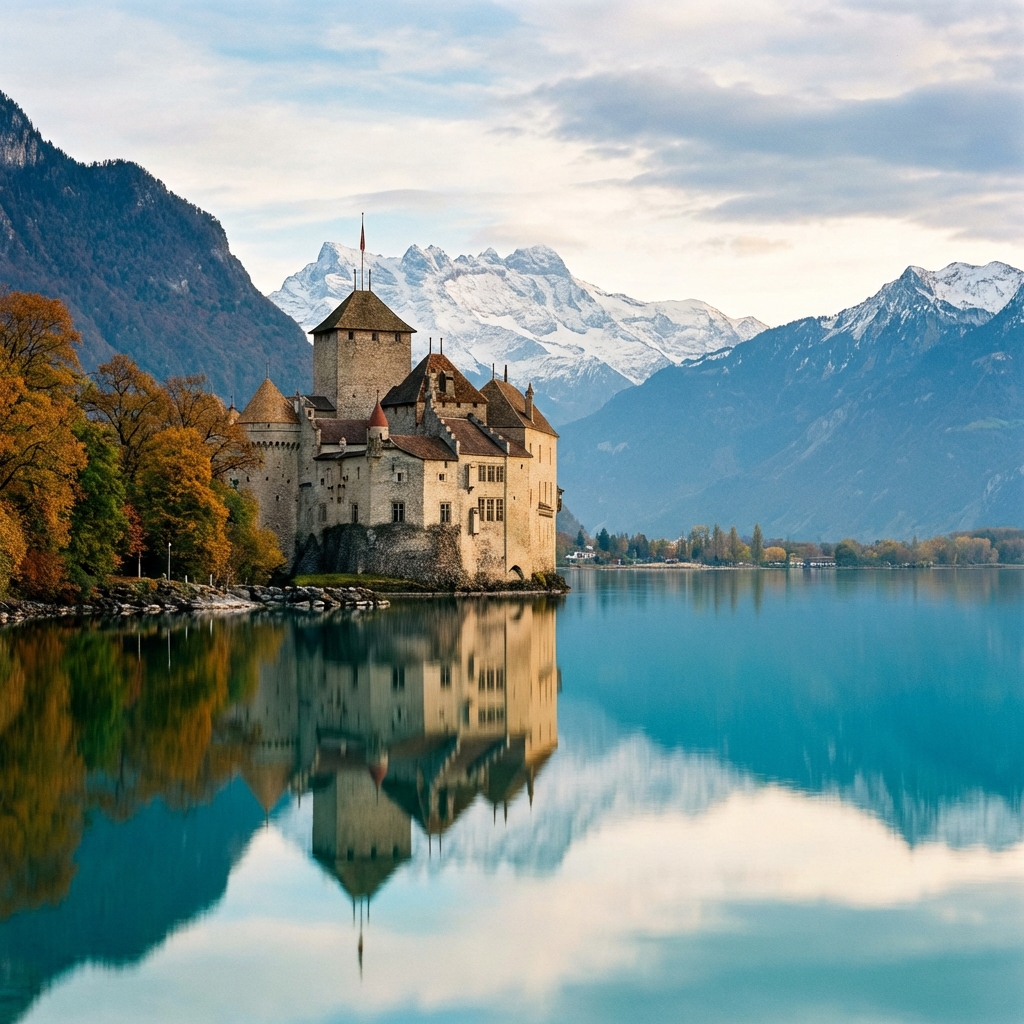
The Jewel of Lake Geneva
Resting on a rocky island just off the shore of Lake Geneva (Lac Léman), Chillon Castle (Château de Chillon) seems to float on the water's surface like a stone ship anchored at the foot of the Alps. It is Switzerland's most visited historic monument and arguably one of the most romantic castles in Europe. For nearly a thousand years, this fortress has controlled the strategic passage between northern and southern Europe, serving as a toll station, a princely residence, and a feared prison.
The castle's position is not merely scenic; it is strategic. The rock on which it stands forms a natural island that protects the narrow road between the steep mountains and the deep lake. Whoever held Chillon held the key to the Great St. Bernard Pass, the main route from Burgundy to Italy.
The Lords of Savoy
While the site has been occupied since the Bronze Age, the castle we see today is largely the work of the Counts of Savoy. In the 12th and 13th centuries, this powerful dynasty expanded their territory across the Alps. Count Peter II of Savoy, known as the 'Little Charlemagne', transformed Chillon into a sumptuous summer residence. He hired the architect Pierre Mainier to build the defensive towers and the elegant ceremonial halls that face the lake.
Water Side vs. Mountain Side
Chillon is a castle with a dual personality. The side facing the mountain is built for war: it features three massive semicircular towers, arrow slits, and machicolations designed to repel invaders from the road. In contrast, the side facing the lake is built for peace and pleasure: it features large Gothic windows, beautiful reception halls, and private apartments with stunning views across the water to the Dents du Midi mountains.
The Prisoner of Chillon
Chillon's most famous chapter is undeniably its darkest. Its underground vaults, carved directly into the bedrock on which the castle stands, served as a terrifying prison. The most famous inmate was François Bonivard, a libertine monk and prior of St. Victor in Geneva. Bonivard was a fierce opponent of the Dukes of Savoy and a champion of Geneva's independence. In 1530, the Duke locked him in the dungeon of Chillon.
For six years, Bonivard was chained to a pillar. His chain was short enough that he could only walk a few steps in a semi-circle. It is said that his footprints wore a groove into the solid rock floor. He was only freed in 1536 when the Bernese army conquered the castle, forcing the Savoyards to flee.
Lord Byron's Mark
In 1816, the English Romantic poet Lord Byron visited Chillon during a boat tour of Lake Geneva with Percy Bysshe Shelley. Deeply moved by the story of Bonivard, Byron wrote his famous narrative poem, *The Prisoner of Chillon*. The poem turned Bonivard into a martyr of liberty and made Chillon a pilgrimage site for romantics from around the world. Byron even carved his own name into the third pillar in the dungeon, graffiti that can still be seen today (protected under glass).
Inside the Castle
A visit to Chillon typically takes you through several distinct areas:
- The Courtyards: Three courtyards form the spine of the castle. The first was for soldiers and servants, the second for the castellan (governor), and the third was the private domain of the Count and his family.
- The Great Halls: The 'Aula Magna' or Great Hall of the Count features a massive fireplace and windows overlooking the lake. It was here that feasts and judicial hearings took place. The walls still bear traces of the original medieval savory-themed paintings.
- The Camera Domini: The Count's bedroom is one of the most intimate rooms. It contains a 14th-century mural of animals and birds and a remarkably short bed (people slept sitting up back then). Crucially, it has a private latrine that emptied directly into the lake—a luxury in the Middle Ages!
- The Chapel: A private place of worship for the dukes, this small room contains some of the few surviving religious paintings from the Reformation era, which largely destroyed such art elsewhere in the region.
The Bernese Era and Revolution
After the Bernese captured the castle in 1536, it served as the residence for their bailiffs (governors) for over 260 years. They adapted the castle to their needs, adding their own coats of arms and converting the chapel into a grain store. In 1798, during the Vaudois Revolution inspired by events in France, patriots from Vevey and Montreux captured the castle without a fight. Today, it belongs to the Canton of Vaud.
The Wine of Chillon
The castle is surrounded by the famous Lavaux vineyard terraces, a UNESCO World Heritage site. But Chillon has its own vineyard, too. The 'Clos de Chillon' is a 12,500 square meter plot producing a white wine (Chasselas) and a red mix. The wine is aged in oak barrels stored in the castle's cool underground cellars. It is sold exclusively at the castle shop to support conservation efforts.
Visiting Chillon
Chillon is located 4km south of Montreux.
- Arrival by Boat: The most spectacular way to arrive is by the belle époque paddle steamers operated by CGN. The boat dock is just 200 meters from the castle entrance.
- Arrival by Foot: There is a beautiful flower-lined promenade along the lakefront from Montreux to the castle. It takes about 45 minutes to walk and is flat and easy.
- Audio Guide: The castle is vast, with 40-50 rooms open to the public. The excellent audioguide is highly recommended to understand the complex history.
Frequently Asked Questions
- Is the dungeon scary?
- It is atmospheric and dim, but not terrifying. The high vaulted ceilings actually make it look like a Gothic cathedral. However, imagining being chained there for six years is sobering.
- Can we swim near the castle?
- Yes! There is a small public beach just next to the castle. Swimming in the lake with the view of the castle towers above you is a unique experience.
- How long to visit?
- Allow at least 2 hours. There is a lot of walking and many stairs.