The Dutch Versailles
Looking like a fairytale vision from a Disney movie, **De Haar Castle** (Kasteel de Haar) is the largest and most luxurious castle in the Netherlands. Its silhouette of pointed towers, ramparts, moats, and drawbridges is the very definition of a medieval fortress. However, what you see today is largely a 19th-century recreation—a "perfect" medieval castle that is actually a masterpiece of modern luxury. While a fortress has stood on this spot since 1391, it had fallen into ruin by the 19th century. In 1890, the desolate ruins were inherited by Baron **Etienne van Zuylen van Nijevelt**. He married **Hélène de Rothschild**, an heiress of the fabulously wealthy French banking family, and together they decided to rebuild the ancestral home—sparing no expense.
The Cuypers Restoration
To realize their vision, the Baron and Baroness hired the most famous Dutch architect of the time, **Pierre Cuypers** (the mastermind behind the Rijksmuseum and Amsterdam Central Station). The project took 20 years (1892–1912) and was a monumental undertaking. Cuypers didn't just restore the castle; he reimagined it as a Neo-Gothic fantasy, bigger and grander than it ever was in the Middle Ages. He added new towers, expanded wings, and covered every inch of the interior with intricate carving and decoration.
Crucially, the castle was equipped with the most modern technologies available at the turn of the century, including electrical lighting (with its own generator), steam central heating, and a modern industrial kitchen. However, Cuypers cleverly hid these conveniences to preserve the medieval illusion. The result is a house that offers the romantic look of the 15th century with the comfort of the 20th century, comparable to the 'Gilded Age' mansions of the Vanderbilts in America.
A House of Parties
For most of the 20th century, the Van Zuylen family used De Haar strictly as a holiday home for one month a year: **September**. During this time, the castle came alive. They hosted lavish house parties for the international jet set, royalty, and Hollywood stars. Guests included **Coco Chanel**, **Maria Callas**, **Gregory Peck**, **Roger Moore**, and **Brigitte Bardot**. It was a place of unbridled luxury and relaxed protocol, where the rich and famous could escape the public eye.
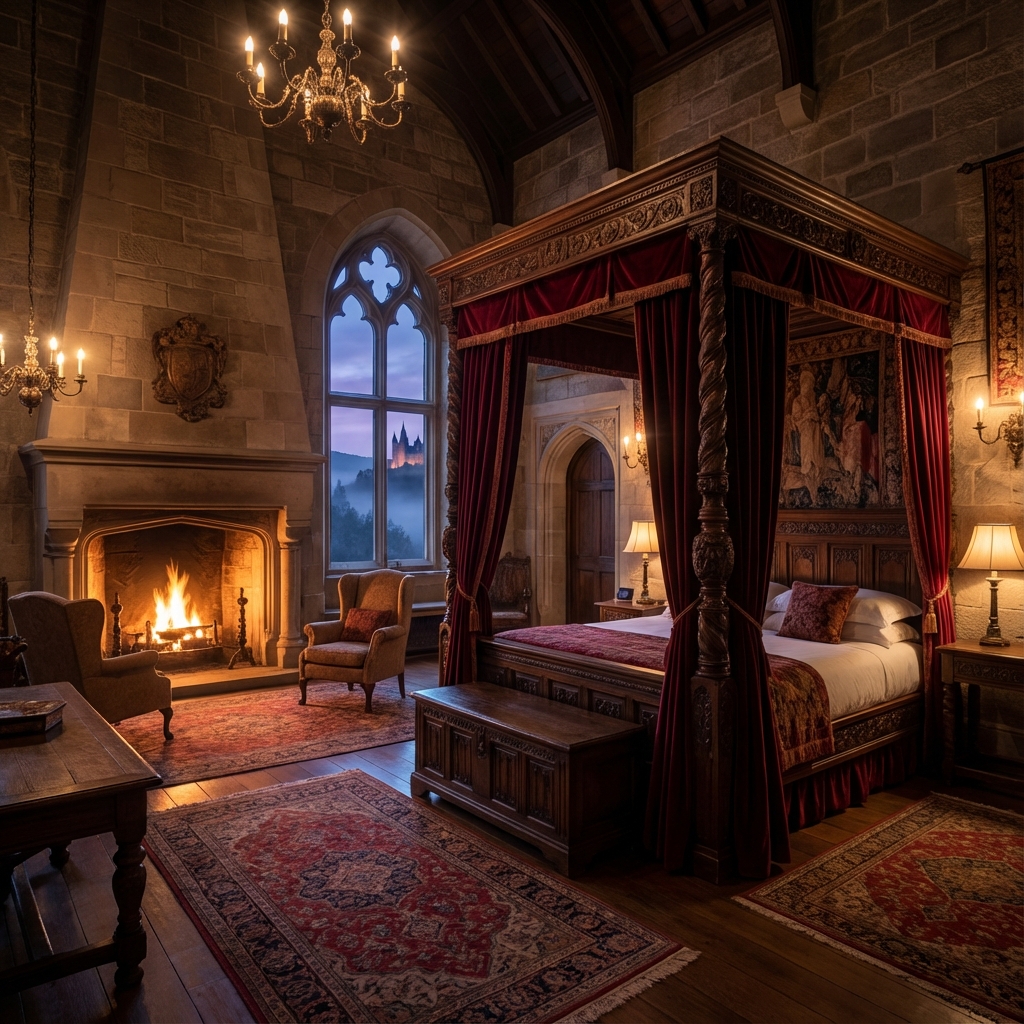
The interior reflects this cosmopolitan lifestyle. The **Main Hall** is a cathedral-like space with a carved wooden ceiling, stained glass windows, and Flemish tapestries. The bedrooms and guest suites are decorated with an eclectic mix of antiques, from Japanese ceramics to Louis XVI furniture, collected by the Baron and Baroness on their travels. A curious detail is the Baron's obsession with his family crest (three columns); it appears thousands of times throughout the castle, on everything from the wallpaper to the cutlery. In the kitchen, the massive copper pots and pans are all monogrammed, and the roasting spit is large enough to feed an army. The kitchen also features a massive coal-fired stove (Drouet) that is one of the largest preserved in Europe, a beast of iron that could cook for hundreds.
The Stables & Coach House
Just across the bridge from the castle lies the **Stalplein** (Stable Square), a complex of buildings that housed the estate's horses and carriages. The Coach House is now a museum displaying the Baron's collection of luxury carriages and early automobiles. The Baron was a pioneer of motoring and was one of the founders of the Automobile Club de France. The stables themselves are grander than most human houses, featuring tiled walls and mahogany woodwork, reflecting the high value placed on the horses in aristocratic life.
The Moving of the Village
The scale of the rebuilding project was so immense that it required moving an entire village. The original village of **Haarzuilens** stood right next to the castle walls, spoiling the Baron's view and preventing him from building the vast English scenery park he desired. So, he simply bought the village and demolished it. He rebuilt it about a mile further west. The new village was designed in an imitation-medieval style to match the castle. To this day, all the shutters and doors in Haarzuilens are painted in the **red and white** heraldic colors of the Van Zuylen family. It is a rare example of a 'model village' built entirely for aesthetic reasons, a demonstration of the absolute power of wealth in that era.
The Park and Gardens
The park surrounding the castle covers 135 acres (55 hectares). It was designed by scenery architect Hendrik Copijn. To give the garden an instantly mature look, the Baron ordered **7,000 fully grown trees** (some 40 years old) to be dug up and transported across the city of Utrecht by horse and cart. This logistical nightmare caused chaos in the city—streetlights had to be removed to let the trees pass—but the Baron paid for all the damage. Within a few years, the castle looked as if it had been surrounded by an ancient forest for centuries.
Today, visitors can wander through the **Rose Garden** (with over 1,200 rose bushes dedicated to Hélène de Rothschild), the formal Roman Garden, and the deer park. The contrast between the rigid, geometric French gardens near the castle and the wilder, romantic English parkland further out creates a striking range of garden styles. The park is also the venue for **Elfia**, the largest costume fantasy fair in Europe. Once a year, the grounds are filled with thousands of visitors dressed as elves, orcs, steampunk inventors, and historical figures, fitting perfectly with the castle's storybook appearance.
Visitor Information
De Haar Castle is located just outside Utrecht and is easily accessible by car or public transport (bus from Utrecht Centraal).
- Ownership: Since 2000, the castle has been owned by a foundation (Kasteel de Haar) to ensure its preservation. However, the Van Zuylen family retains the right to stay in the Châtelet (a separate wing) for one month a year, continuing the September tradition.
- Tours: You can visit the castle on a self-guided tour or join a guided tour for more depth. The park requires a separate (cheaper) ticket if you don't want to enter the castle.
- The Maze: The historic hedge maze, once a feature of the original garden, has been restored and is a favorite for children.