The Key to England
Perched high atop the iconic White Cliffs of Kent, staring defiantly across the narrow strip of sea towards France, sits Dover Castle. For two thousand years, this site has been the front line of England's defense. It has been described as the "Key to England" because for centuries, whoever controlled Dover controlled the gateway to the kingdom. It is not just a castle; it is a timeline of British history carved in stone and chalk. From a Roman lighthouse guiding ancient galleys to a Cold War bunker prepared for nuclear winter, Dover has seen it all.
It is the largest castle in England, a sprawling complex that can take a full day to explore. Its massive keep, built by Henry II, is a symbol of royal power, while its miles of secret wartime tunnels tell stories of Dunkirk and the Battle of Britain. It is a place where you can touch the Roman bricks, walk the medieval battlements, and smell the 1940s hospital disinfectant all in one afternoon.
History: Two Millennia of Watchfulness
The strategic importance of this site was recognized long before the Normans arrived. The Romans built a lighthouse (Pharos) here in the 1st century AD to guide their fleet into the harbor below. Remarkably, this structure still stands, the tallest surviving Roman building in Britain, later converted into a bell tower for the Saxon church of St Mary in Castro next to it.
William the Conqueror strengthened the defenses after 1066, but the castle we see today is largely the work of Henry II in the late 12th century. He spent a fortune transforming Dover into a palace-fortress to impress pilgrims traveling to the shrine of Thomas Becket in Canterbury. In 1216, the castle withstood a grueling siege by Prince Louis of France. The French miners successfully undermined the gatehouse, bringing a tower crashing down, but the English garrison held the breach, saving the crown for the young Henry III.
The castle remained a vital military garrison until 1958. It was reshaped by the Napoleonic Wars, when massive earthworks were added, and again during the two World Wars, when it became the headquarters for the Dover Patrol.
Architecture: The Great Tower and Inner Bailey
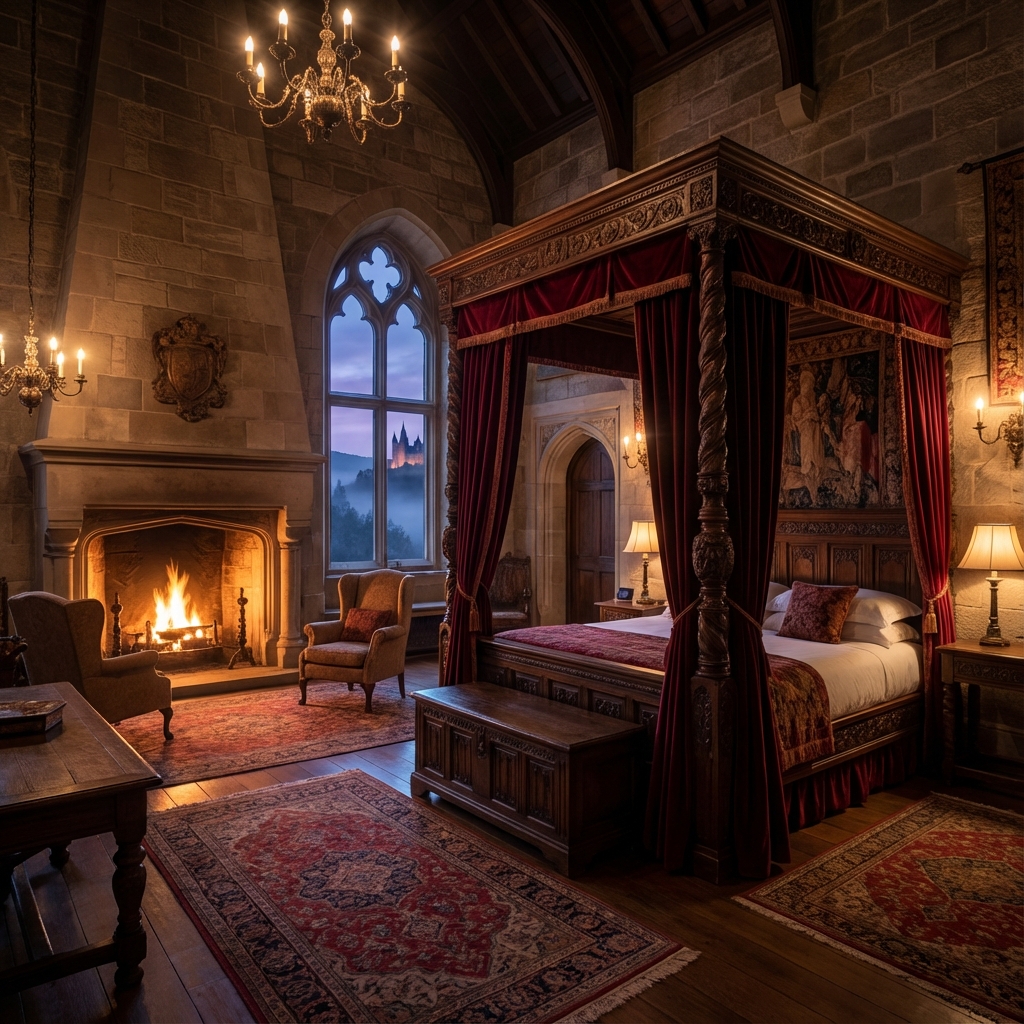
The heart of the castle is the Great Tower (Keep), a massive cube of stone rising 83 feet high. Henry II designed it to be a showpiece. The walls are up to 21 feet thick. Inside, English Heritage has carefully recreated the royal court of the 12th century. The rooms are painted in bold colors (as they would have been, dispelling the myth of drab medieval stone), hung with rich tapestries, and furnished with thrones and beds. Holographic projections and soundscapes bring the court of Henry II to life.
Surrounding the keep is the Inner Bailey and the concentric ring of the Outer Curtain Wall, studded with towers like the Avranches Tower and the Constable's Gate. The medieval tunnels (medieval mines) dug during the siege of 1216 are still accessible, a claustrophobic reminder of the subterranean warfare of the Middle Ages.
The Secret Wartime Tunnels
Perhaps the most famous feature of Dover Castle lies beneath the ground. During the Napoleonic Wars, a network of tunnels was carved into the soft chalk cliffs to house soldiers. In 1939, these tunnels became the headquarters of Operation Dynamo. From a small room deep inside the cliff, Vice-Admiral Bertram Ramsay masterminded the evacuation of 338,000 British and French troops from the beaches of Dunkirk. Visitors can walk through these tunnels today, seeing the map room, the repeater station, and the underground hospital where injured pilots were treated while bombs fell overhead. The "Operation Dynamo" experience uses special effects and original newsreels to recreate the tension of those critical days in May 1940.
Legends: The Headless Drummer
With such a violent history, Dover is inevitably haunted. The most persistent legend is that of the Headless Drummer Boy. He is said to have been a teenage drummer in the Napoleonic era who was murdered by two soldiers for money he was carrying. His body was decapitated and hidden. On quiet nights, the sound of a drum beating a slow, rhythmic tattoo is said to be heard on the battlements. Some guards have reported seeing a headless figure in a red uniform fading into the mist.
Another ghost is believed to be a woman in a red dress who haunts the King's Bedroom in the Great Tower, and the "lower levels" of the tunnels are notoriously active with reports of spectral soldiers and unexplained footsteps.
Visitor Information
Getting There
Dover Castle is located in the town of Dover, Kent. It is well signposted from the A2 and A20. Dover Priory train station is about a mile away; you can walk (it's a steep climb) or take a taxi/bus. The castle overlooks the ferry port, so you can watch the ships crossing the Channel from the battlements.
Tours and Tips
The site is managed by English Heritage. It is open daily for most of the year. Due to the sheer size of the site, allow at least 3-4 hours. The tunnel tours (Wartime Tunnels and Underground Hospital) are guided and can have long queues in summer, so head there first upon arrival. There are cafes and picnic areas within the grounds. Be prepared for a lot of walking, including steep slopes and spiral staircases.
The Fire Command Post
Don't miss the Fire Command Post on the cliff edge, an anti-aircraft gun emplacement from WWI and WWII. It offers the best view of the White Cliffs and, on a clear day, the coast of France is clearly visible, reminding you just how close the enemy was.
The Coastal Defenses and the modern era
While the Great Tower and the Wartime Tunnels rightfully draw immense attention, the broader coastal defense network surrounding Dover Castle is equally fascinating. The cliffs themselves were militarized to an astonishing degree, evolving continuously to meet the changing threats across the English Channel. During the Victorian era, as fears of a French invasion under Napoleon III escalated, the defenses were heavily modernized with huge rifled muzzle-loading guns placed in newly constructed casemates. As the 20th century dawned, these positions were adapted for the rapid-fire artillery needed to counter fast motor torpedo boats and early aircraft. The Port War Signal Station, perched precariously on the cliff edge, coordinated the movement of all allied shipping during WWII, acting as the eyes and ears of the harbor. Even today, walking along the sprawling outer earthworks, one can find the concrete remnants of searchlight batteries and anti-aircraft emplacements. These scattered, brutalist structures provide a stark contrast to the medieval masonry, yet they are a crucial chapter in Dover's story. Together, they illustrate a relentless, two-thousand-year saga of military engineering, proving that the 'Key to England' was never static, but always adapting to protect the domain from whatever dangers loomed on the horizon.