The Archetype of the Alpine Castle
When you close your eyes and imagine a medieval castle, you are likely picturing Fénis Castle (Castello di Fénis). With its many towers, crenellated double walls, and dramatic Alpine backdrop, it is the most famous and photogenic castle in the Aosta Valley. Unlike other fortresses in the region, which sit atop rugged cliffs for defense, Fénis sits on a gentle hill surrounded by green meadows. This is because it was built not strictly for war, but for prestige—a luxurious residence designed to display the power and wealth of the Challant family.
Today, it is one of the best-preserved medieval castles in Italy. Its interiors, rich with Gothic frescoes and period furniture, offer a direct window into the life of the feudal nobility in the 14th and 15th centuries. It is a place where the roughness of stone meets the refinement of art.
The Rise and Fall of the Challants
The history of Fénis is the history of the House of Challant, the most powerful noble family in the Aosta Valley. The castle is first mentioned in documents in 1242, but it was Aimone of Challant who, around 1340, began transforming the simple keep into the complex structure we see today. His goal was to create a residence that reflected his status as a diplomat and military leader.
The castle reached its golden age under Aimone's son, Boniface I of Challant. Boniface was a man of the world, a Marshal of Savoy who had traveled to the courts of France and Burgundy. He brought back with him a taste for the "International Gothic" style. He added the elegant courtyard staircases, the wooden balconies, and, most importantly, commissioned the stunning frescoes that adorn the walls. Under his rule, Fénis was a lively court, filled with knights, artists, and diplomats.
However, the glory did not last forever. By the 18th century, the family's fortunes had declined. In 1716, the castle was sold to pay off debts and fell into ruin. It was used as a farmhouse; the grand halls became barns for cattle, and the courtyard was used to store hay. It wasn't until 1895 that the castle was purchased by the Italian state and restored to its former glory by the architect Alfredo d'Andrade.
Architecture: A Fortress of Prestige
Fénis Castle is unique in its pentagonal layout. It is surrounded by a double ring of defensive walls, equipped with watchtowers and a walkway for guards. These defenses, while formidable in appearance, were largely symbolic by the time they were built—more about deterring local rivals than withstanding a siege by a royal army.
The inner courtyard is the architectural heart of the castle. It features a semi-circular stone staircase and wooden balconies that overlook a central space. The walls of the courtyard are covered in frescoes, including a famous depiction of St. George killing the dragon—a popular motif for a warrior class that prided itself on chivalry. The contrast between the severe, defensive exterior and the warm, decorated interior is striking.
The Masterpiece of Giacomo Jaquerio
The true treasure of Fénis lies on its walls. The frescoes, painted around 1415, are attributed to the workshop of Giacomo Jaquerio, a master of the International Gothic style. These are not just religious icons; they are lively, storytelling paintings.
- The Chapel: The castle's private chapel is a masterpiece of color. The walls depict the Madonna of Mercy (Madonna della Misericordia), sheltering the faithful under her cloak—including portraits of the Challant family themselves, kneeling in prayer. This was a powerful political statement, showing the family's direct line to the divine.
- The Court of Sages: In the courtyard, a series of frescoes depicts sages and prophets holding scrolls with proverbs written in Old French. These served as a moral guide for the inhabitants, reminding them of the virtues of justice and wisdom. One famous scroll reads (in translation): "He who speaks much often errs," a timeless piece of advice for any courtier.
Life Inside the Castle
Visiting Fénis is a chance to see how a medieval household actually functioned. The tour takes you through the Salle Basse (Lower Hall), which served as a guardroom and armory, and the kitchen with its enormous fireplace, large enough to roast a whole ox. You can almost smell the woodsmoke and the roasting meat.
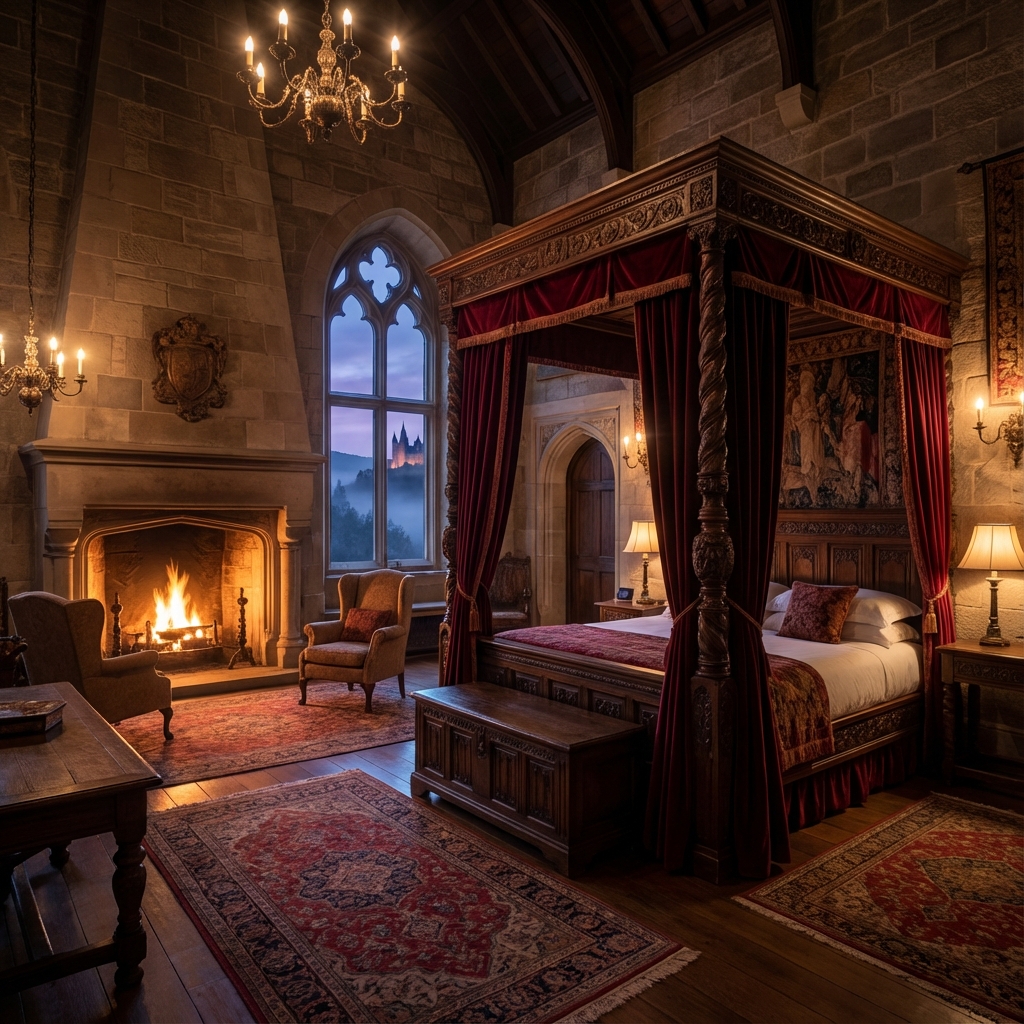
Upstairs, the "Chambre Domini" (Lord's Room) and the "Chambre Dominae" (Lady's Room) show the more private side of castle life. The rooms are furnished with heavy wooden chests, four-poster beds, and large credenzas. Although the original furniture was lost during the years of neglect, the current pieces are authentic antiques from the Aosta Valley, carefully selected to recreate the atmosphere of the 15th century.
Legends of the Ghost
Like any self-respecting castle, Fénis has a ghost. Legend tells of a stepmother who, jealous of her stepson's inheritance, murdered the child in the castle. The boy's spirit is said to haunt the corridors, moving objects and crying in the night. While the identity of the ghost is debated, the atmosphere in the darkened rooms on a winter afternoon is certainly enough to spark the imagination.
Planning Your Visit
Fénis is located about 15 km east of Aosta. It is one of the most popular sites in the region, so planning ahead is wise.
- Tickets and Tours: Access to the castle is by guided tour only. Tours are typically in Italian, but audio guides or information sheets in English are usually available. It is highly recommended to book your time slot in advance, especially in the summer or on weekends, as groups are small and fill up quickly.
- Photography: Photography (without flash) is generally permitted, but tripods are not. The courtyard is a photographer's dream, but the low light in the frescoed rooms can be challenging.
- MAV - Museum of Valdostan Craftsmanship: Just a short walk from the castle is the MAV (Museo dell'Artigianato Valdostano). It is worth a visit to see the traditional woodcarving and stone working skills that built castles like Fénis.
Fénis Castle is a rare survivor. It escaped the wars that destroyed so many of its neighbors and survived centuries of neglect to tell its story. It stands as a monument to the ambition of the Challant family and the enduring beauty of Gothic art in the Alps.