The Symbol of German Romanticism
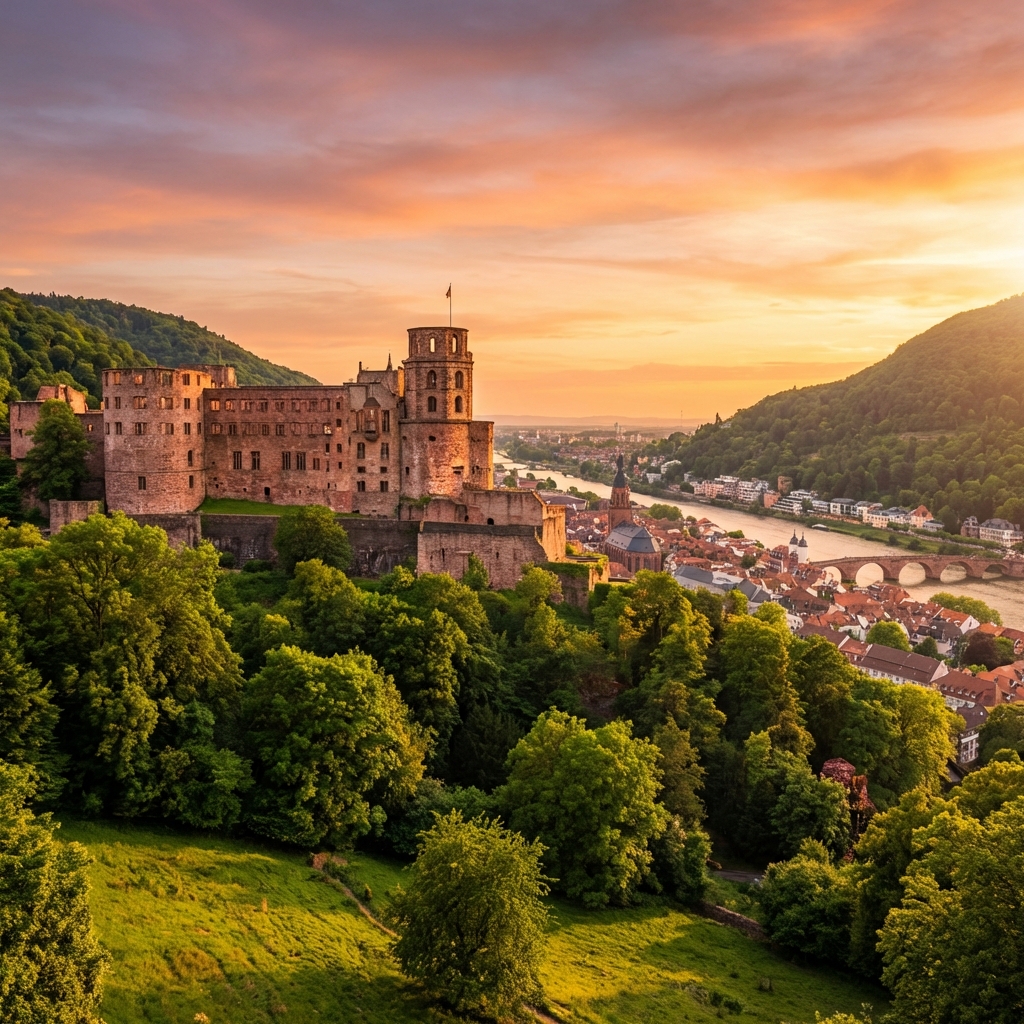
Few sights in Germany are as evocative as the red sandstone ruins of Heidelberg Castle (Schloss Heidelberg) glowing in the sunset above the Neckar River. Perched 80 meters up the Königstuhl hillside, the castle dominates the skyline of the university town below. It is not just a castle; it is a defining image of the German Romantic movement, where the beauty of nature and the melancholy of decay meet in one place. For centuries, poets, artists, and travelers (including Mark Twain and J.M.W. Turner) have been drawn to its crumbling towers and overgrown terraces, finding in them a poignant reminder of the passage of time.
A Masterpiece Ravaged by War and Nature
The history of Heidelberg Castle is a tragedy of epic proportions. Origins of the castle date back to the early 13th century, and for 500 years, it was the residence of the Prince Electors (Kurfürsten) of the Palatinate, one of the most powerful regions in the Holy Roman Empire. Over the centuries, it evolved from a medieval fortress into a magnificent Renaissance palace. The Ottheinrichsbau (Ottheinrich Building), with its ornate facade of statues and biblical scenes, is considered one of the finest examples of German Renaissance architecture.
However, the castle's glory was shattered in the 17th century. During the Thirty Years' War and the subsequent War of the Palatine Succession, the castle was besieged, captured, and bombarded. In 1689 and again in 1693, French troops under Louis XIV deliberately blew up the fortifications and set the palace on fire. As if man's destruction wasn't enough, nature delivered the final blow. In 1764, a massive lightning strike hit the castle, igniting a fire that consumed what little had been rebuilt. The Electors abandoned Heidelberg for Mannheim, and the castle was left to ruin.
In the 19th century, rather than rebuilding the castle to its former glory, conservationists decided to preserve it as a ruin. This decision was heavily influenced by the Romantic belief that the ruin itself possessed a unique aesthetic and historical value.
The Great Tun (Das Große Fass)
One of the castle's most famous and eccentric attractions is the Great Tun, an enormous wine barrel located in the castle cellars. Built in 1751, it stands seven meters high and eight meters wide, with a capacity of over 220,000 liters (approx. 58,000 gallons). It was used to store the tithe wine—taxes paid by wine growers in the region.
A movement floor was even built on top of the barrel for visitors to enjoy. The barrel is forever associated with Perkeo, the court jester of Elector Charles Philip. Legend has it that Perkeo, a dwarf from Tyrol, could drink vast quantities of wine without ever getting drunk. When asked if he could drink the contents of the Great Tun, he famously replied, 'Perché no?' (Why not?). He lived to a ripe old age, but the story goes that he died after mistakenly drinking a glass of water, which his system couldn't handle. A statue of Perkeo stands guard next to the barrel today.
The Hortus Palatinus: The Lost Wonder
In the early 17th century, Elector Friedrich V commissioned the creation of the Hortus Palatinus (Palatinate Garden) as a gift for his English wife, Elizabeth Stuart (daughter of King James I). It was designed to be the 'Eighth Wonder of the World,' a masterpiece of terraces, grottos, fountains, and exotic plants that symbolized man's mastery over nature. Although the garden was never fully completed and was largely destroyed during the wars, the surviving terraces still offer the finest views of the castle, the red roofs of the Old Town, and the winding Neckar Valley.
The Elizabeth Gate
A touching story of romance is attached to the Elizabeth Gate (Elisabethentor) in the castle gardens. It is said that Friedrich V had this triumphal arch built in a single night in 1615 as a surprise birthday gift for his beloved wife, Elizabeth. The inscription dedicates the gate to the 'most beloved wife.' It remains a popular spot for couples to take photos, symbolizing enduring love amidst the ruins.
The German Apothecary Museum
Set within the castle walls is the Deutsches Apotheken-Museum (German Apothecary Museum). This fascinating museum showcases the history of pharmacy and medicine. Visitors can explore complete interiors of historical pharmacies from the 17th to the 19th centuries, filled with ceramic jars, drying herbs, and strange instruments. It also features a fully reconstructed alchemy laboratory, offering a glimpse into the mystical side of early science.
Literary and Cultural Impact
Heidelberg Castle has left an indelible mark on literature and culture. Mark Twain wrote extensively about the castle in his travelogue A Tramp Abroad, describing its ruin as 'noble, impressive, and scenic.' He was particularly fascinated by the blown-up Powder Tower (Gesprengter Turm), half of which slid down into the moat in one piece and remains there today.
The castle also features in the operetta The Student Prince, cementing its image as a place of youthful romance and nostalgia. Every summer, the castle courtyard becomes the stage for the Heidelberg Castle Festival, hosting open-air theatre performances and concerts.
Visitor Information
Heidelberg Castle attracts over a million visitors a year. It can be reached by a steep walk up the Burgweg or, more comfortably, by taking the Heidelberg Funicular Railway (Bergbahn) from the Kornmarkt in the Old Town. The funicular continues up to the Königstuhl summit for even wider views.
Access to the castle courtyard, the Great Tun, and the Apothecary Museum requires a ticket. Guided tours are available to see the interior of the palace buildings and the castle chapel. In the summer, the 'Castle Illuminations' (Schlossbeleuchtung) take place several times a year, where fireworks and Bengal lights recreate the burning of the castle in 1693, turning the tragedy of the past into a spectacular celebration of the present. Watching the red light flicker against the ancient walls before the fireworks erupt over the river is an unforgettable experience.
The Enduring Influence on Education and Science
While Heidelberg Castle is globally celebrated as a romantic ruin, it is also deeply intertwined with the intellectual history of the city, primarily through its connection to Heidelberg University, Germany's oldest institution of higher learning. For centuries, the Prince Electors residing in the castle acted as powerful patrons of the university, fostering an environment where theology, law, and medicine could flourish. The castle’s extensive libraries and the intellectual court life it supported drew brilliant scholars from across Europe, making Heidelberg a shining symbol of Renaissance humanism and early scientific inquiry. This scholarly legacy is profoundly visible today within the walls of the German Apothecary Museum housed inside the castle. Beyond its fascinating displays of historic medical instruments and rare botanicals, the museum highlights the crucial transition from medieval alchemy to modern pharmacology. It showcases how the quest for knowledge, once sponsored by the Electors in their palace laboratories, eventually laid the groundwork for sophisticated medical science. The enduring presence of this museum within the romantic ruins serves as a powerful reminder that Heidelberg Castle was not only a stage for political drama and legendary romance, but also a vital crucible for the intellectual and scientific advancement of Europe.