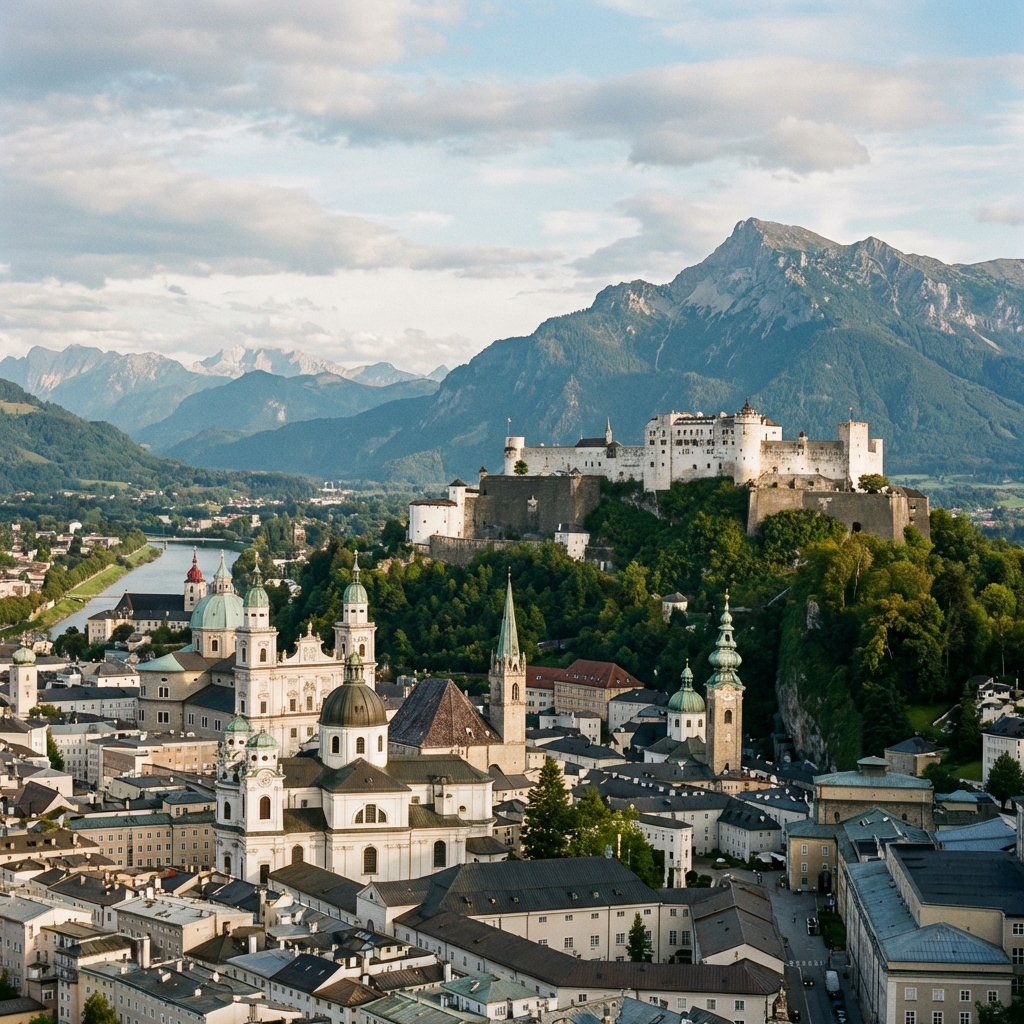
The Fortress Above the City
Hohensalzburg Fortress (Festung Hohensalzburg) is not just a castle; it is a skyline. Perched high on the Festungsberg, a dolomite rock rising 120 meters above the Salzach River, it dominates the city of Salzburg like a white crown. It is one of the largest fully preserved medieval castles in Europe. Unlike many other fortresses that were destroyed or fell into ruin, Hohensalzburg has stood firm for over 900 years, a symbol of the immense power of the Prince-Archbishops who ruled Salzburg as an independent ecclesiastical state. From its ramparts, visitors are treated to a 360-degree panorama that encompasses the baroque spires of the Old Town (a UNESCO World Heritage site) and the jagged, snow-capped peaks of the Alps.
It is a complex of courtyards, bastions, and palaces that tells the story of a city that was rich in salt (Salzburg means "Salt Castle") and ruled by men who carried a cross in one hand and a sword in the other. It is a visible reminder of the conflict between spiritual authority and worldly power.
History: The Unconquered Citadel
Construction began in 1077 under Archbishop Gebhard during the Investiture Controversy, a conflict between the Pope and the Holy Roman Emperor. Gebhard, loyal to the Pope, needed a stronghold. Over the centuries, successive archbishops expanded and strengthened the fortress, particularly Leonhard von Keutschach (ruled 1495–1519), whose symbol—the turnip—can be seen carved into walls and gateways throughout the complex (he was proud of his humble roots).
The fortress was never conquered by military force. Its only surrender came in 1800 during the Napoleonic Wars, when it was handed over to the French without a fight to save the city from destruction. In the 16th century, during the German Peasants' War, the fortress was besieged by miners and farmers. The Archbishop held out, and legend says he deceived the attackers by painting his last bull in different colors and parading it along the walls every day, making them believe he had endless food supplies. This trick, known as the "Washer of the Bull" (Stierwäscher), disheartened the rebels and saved the castle.
The fortress was not just a military stronghold; it was a symbol of absolute power. The Prince-Archbishops of Salzburg were not merely religious leaders; they were sovereign rulers with the power of life and death over their subjects. This dual role is reflected in the architecture: the stark, forbidding walls designed to intimidate the rebellious citizens below, contrasted with the opulent, gold-drenched interiors where the Archbishops lived in princely splendor. The fortress was a clear message to the people of Salzburg: God and the Archbishop are watching you from above.
The Reisszug is another engineering marvel hidden within the walls. It is a cable railway used to transport goods (food, wine, weapons) up to the fortress. Dating back to 1495 or 1504, it is considered the oldest cable railway in the world still in existence. Originally powered by horses (or prisoners) walking in a treadmill, it is now motorized but still follows the original route, a proof of the logistical genius of the medieval builders.
Architecture: Gothic Luxury
While the exterior is martial and imposing, the interior residences of the Archbishops are surprisingly luxurious. The Golden Hall (Goldener Saal) and the Golden Chamber (Goldene Stube), built around 1500, are among the finest examples of late Gothic secular architecture in Europe.
- The Golden Hall: The ceiling is a masterpiece, designed to mimic a starry night sky with gold spheres set against an azure background. This hall was used for grand banquets and festivities.
- The Golden Chamber: This was the Archbishop's private audience room. It features a massive ceramic tile stove (Kachelofen) from 1501, which is a work of art in itself, decorated with colorful tiles depicting saints, evangelists, and heraldic coats of arms. It is considered the finest Gothic tiled stove in the world.
The Salzburg Bull
One of the fortress's most unique features is the Salzburg Bull (Salzburger Stier). It is a large mechanical organ (aerophone) built in 1502. Located in the Krautturm (Powder Tower), it was used to wake up the citizens of Salzburg and signal the closing of the city gates. It consists of over 200 pipes and still plays daily (usually at 7 AM, 11 AM, and 6 PM), its booming chords echoing across the rooftops. It is believed to be the oldest hornwork of its kind in the world still in operation.
Legends: The Turnip
Archbishop Leonhard von Keutschach is associated with the turnip symbol found everywhere (there are said to be 58 turnips carved in the castle!). Legend says that in his youth, he was a wild and lazy student. One day, his uncle scolded him and threw a turnip at his head, saying, "If you don't change, you'll amount to nothing more than this turnip!" Leonhard kept the turnip as a reminder, reformed his ways, and rose to become the most powerful ruler in Salzburg's history, adopting the vegetable as his coat of arms to show that greatness can grow from humble earth. It serves as a lesson in humility and ambition.
Visitor Information
Getting There
The fortress is located in the heart of Salzburg's Altstadt (Old Town). The most popular way to reach it is by the Festungsbahn, a modern funicular railway that whisks you up the steep cliff in under a minute. Originally built in 1892, it is the oldest funicular in Austria, though the carriages are modern. It runs from the Festungsgasse. Alternatively, energetic visitors can walk up via the winding footpaths, which takes about 15-20 minutes and offers great views along the way.
Tours and Museums
The fortress is open daily year-round. The "Basic Ticket" includes the ascent/descent, the courtyards, the bastions, and the fortress museum. The "All-Inclusive Ticket" is highly recommended as it grants access to the princely chambers (Golden Hall) and the Magic Theater multimedia show. The museum displays weapons, instruments of torture, and historical artifacts. The Marionette Museum inside is also a delight, featuring puppets from the famous Salzburg Marionette Theatre (including characters from The Sound of Music).
Concerts
In the evenings, the Golden Hall hosts the "Salzburg Fortress Concerts." Listening to Mozart (who was born in Salzburg) in a medieval castle high above the city lights is an unforgettable cultural experience. The fortress restaurant also offers dinner concerts with panoramic views, combining Austrian cuisine with classical music.