The Royal Villa: A Rococo Jewel Box
Hidden deep in the Graswang Valley of the Bavarian Alps, **Linderhof Palace** (Schloss Linderhof) stands as a dazzling monument to the eccentric genius of King Ludwig II. Unlike his other monumental projects—the medieval fantasy of Neuschwanstein or the Versailles replica of Herrenchiemsee—Linderhof is intimate, focused, and completely finished. It was the only one of his palaces that the King lived to see completed, and it became his favorite retreat, a place where he could withdraw from the world and live out his absolutist fantasies.
While often described as a "villa," the term belies the sheer opulence contained within its white façade. Linderhof is a masterpiece of the **Neo-Rococo** style, a revival of the ornate, playful, and asymmetrical designs of the 18th century. Every inch of the interior is covered in gold leaf, mirrors, velvet, and porcelain, creating an atmosphere of overwhelming richness. It was designed not for holding court, but for the solitary life of a reclusive king who preferred the company of historical figures and myths to his own ministers.
History: The King's Private World
The site of Linderhof originally housed a simple hunting lodge belonging to Ludwig's father, Maximilian II. Ludwig, who had spent happy days there as a child, conceived the idea of transforming it into a "Royal Villa" in the late 1860s. Between 1869 and 1878, he systematically rebuilt and expanded the structure under the guidance of architect Georg von Dollmann.
Ludwig's inspiration was the "Sun King," Louis XIV of France. Ludwig saw himself as a spectral moon king to Louis's sun, a monarch out of time. This obsession is evident everywhere, from the sunburst motifs on the ceilings to the portraits of the French court that line the walls. Yet, Linderhof is not a copy of Versailles; it is a creative reimagining, a theater stage built for an audience of one.
Inside the Palace
The Vestibule and Staircase
Entering the palace, visitors are immediately struck by the contrast between the relatively modest size of the building and the grandeur of its decoration. The vestibule features a bronze statue of Louis XIV on horseback, setting the thematic tone. The staircase, clad in blue velvet, leads up to the main apartments on the upper floor.
The Hall of Mirrors
The **Hall of Mirrors** is the heart of the palace and arguably its most spectacular room. Modeled after a similar room in the Munich Residenz, it uses mirrors to dissolve the walls, creating an illusion of infinite space—a perfect metaphor for Ludwig's desire to escape the boundaries of reality. During the night, when the King was most active, the room was lit by hundreds of candles, their light reflected thousands of times in the glass, creating a brilliant, otherworldly glow. This is where Ludwig would spend hours reading, often sitting in a niche lined with ostrich plumes.
The Royal Bedroom
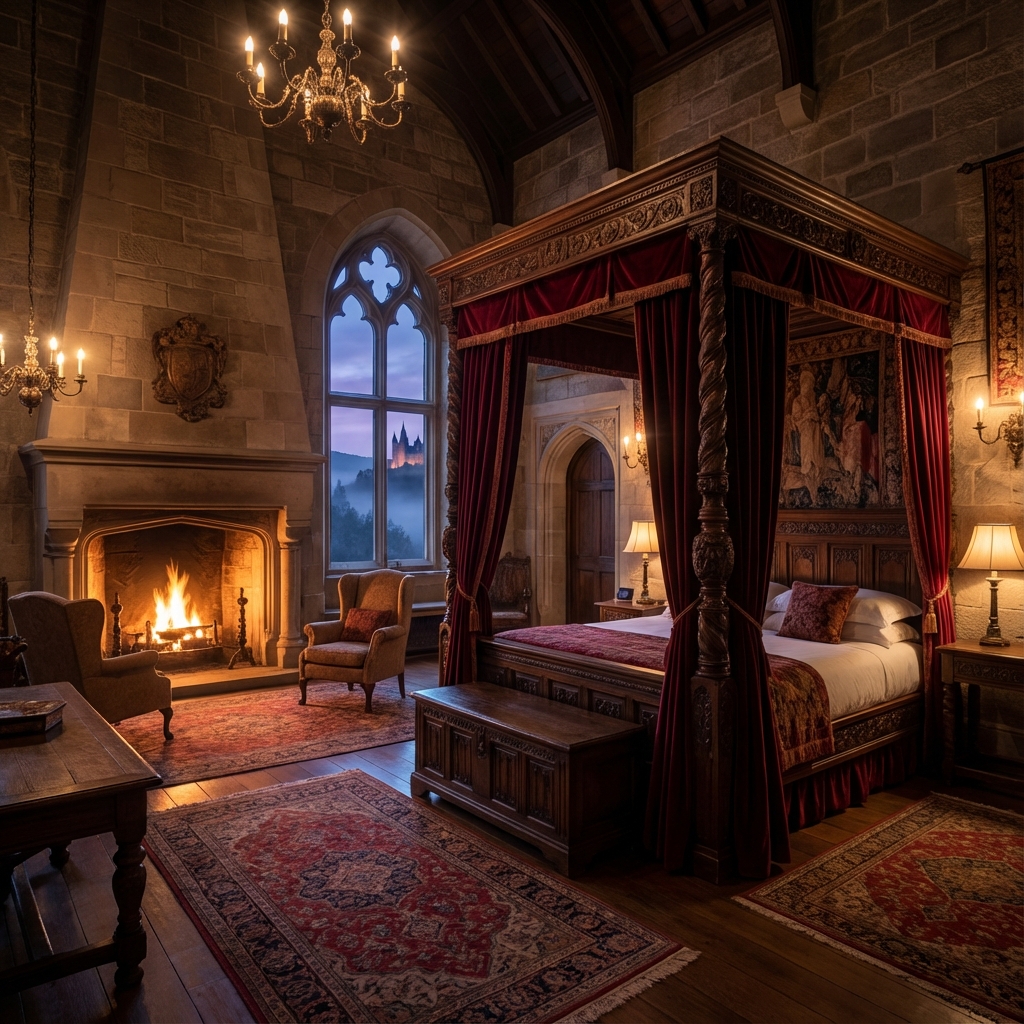
For Ludwig, the bedroom was a sacred space, mimicking the *Lever* and *Coucher* ceremonies of the French court (though no one watched Ludwig wake or sleep). The bed itself is an enormous blue velvet affair, separated from the rest of the room by a gilded balustrade. The room is so large and the bed so high that steps are required to reach it. Above, the ceiling is a kaleidoscope of frescoes depicting the apotheosis of Louis XIV.
The Dining Room and the Magic Table
Ludwig's severe social anxiety and desire for solitude led to one of Linderhof's most famous engineering marvels: the **"Tischlein-deck-dich"** (The Wishing Table). Located in the dining room, the dining table sits on a mechanical platform connected to the kitchen directly below. When the King was ready to eat, the floor would open, and the table would be lowered down to the servants, who would set it with food and wine. It would then be winched back up, allowing Ludwig to dine completely alone, without ever seeing a servant. He often ordered meals for three or four people, holding imaginary conversations with Louis XIV, Marie Antoinette, and Madame de Pompadour as he ate.
The Park and Gardens
The gardens of Linderhof are as elaborate as the palace itself, combining strict French formal gardens (geometric flower beds, fountains, and hedges) with an English garden park that merges naturally into the surrounding Alpine forest. The park is home to several architectural "follies" that reflect Ludwig's other great passion: the operas of Richard Wagner.
The Venus Grotto
Perhaps the most famous structure in the park is the **Venus Grotto**. Built in 1876-1877, this is an entirely artificial cave designed to illustrate the first act of Wagner's *Tannhäuser*. It features a subterranean lake, a golden swan boat, and a fake waterfall. The lighting system was revolutionary for its time, using the first electricity power station in Bavaria (24 dynamos driven by a steam engine) to illuminate the cave in changing colors of red, blue, and green. It was, effectively, a private theater where the King could be rowed across the lake while listening to opera music.
The Moorish Kiosk
Always fascinated by the exotic, Ludwig purchased the **Moorish Kiosk** from the Paris World Exhibition of 1867. Originally built for a Prussian railroad magnate, it was reassembled in the Linderhof park and redecorated with dazzling colored glass, intricate wood carvings, and a peacock throne. Here, Ludwig would dress in Oriental robes, smoke a chemically scented water pipe, and read poetry, imagining himself a Sultan.
The Moroccan House and Hunding's Hut
Further into the park lie other curiosities. The **Moroccan House** was another exhibition purchase, a wooden structure originally built in Vienna. **Hunding's Hut** (Hundinghütte) is a rustic log cabin built around a massive ash tree, recreating a set from Wagner's *Die Walküre*. It represents the rough, Germanic, mythical world that contrasted with the refined French Rococo of the main palace.
Visiting Linderhof
Linderhof Palace is located near the village of Ettal, approximately 100 kilometers southwest of Munich. It is a popular day trip, often combined with a visit to the nearby Ettal Abbey or the larger Neuschwanstein Castle.
- Tours: The interior of the palace can only be visited via a guided tour, which lasts about 25 minutes. Tours are available in English and German.
- The Park: Admission to the park itself is free, but tickets are required for the park buildings (Grotto, Kiosk, etc.).
- Seasonal Closures: While the palace is open year-round, the park buildings are generally closed in winter (mid-October to mid-April). The fountains typically operate from April to October.
- Venus Grotto Restoration: Note that the Venus Grotto is currently undergoing a massive restoration project to stabilize its structure and restore its original lighting effects. It is expected to remain closed to visitors until at least 2025.
- Access: There is no train station directly at Linderhof. Visitors usually take a train to Oberammergau and then a connecting bus to the palace.
A visit to Linderhof offers a unique glimpse into the mind of the "Fairy Tale King." It is a place of beauty, sadness, and incredible imagination—a silent witness to a monarch who built a world of dreams because reality was too harsh to bear.