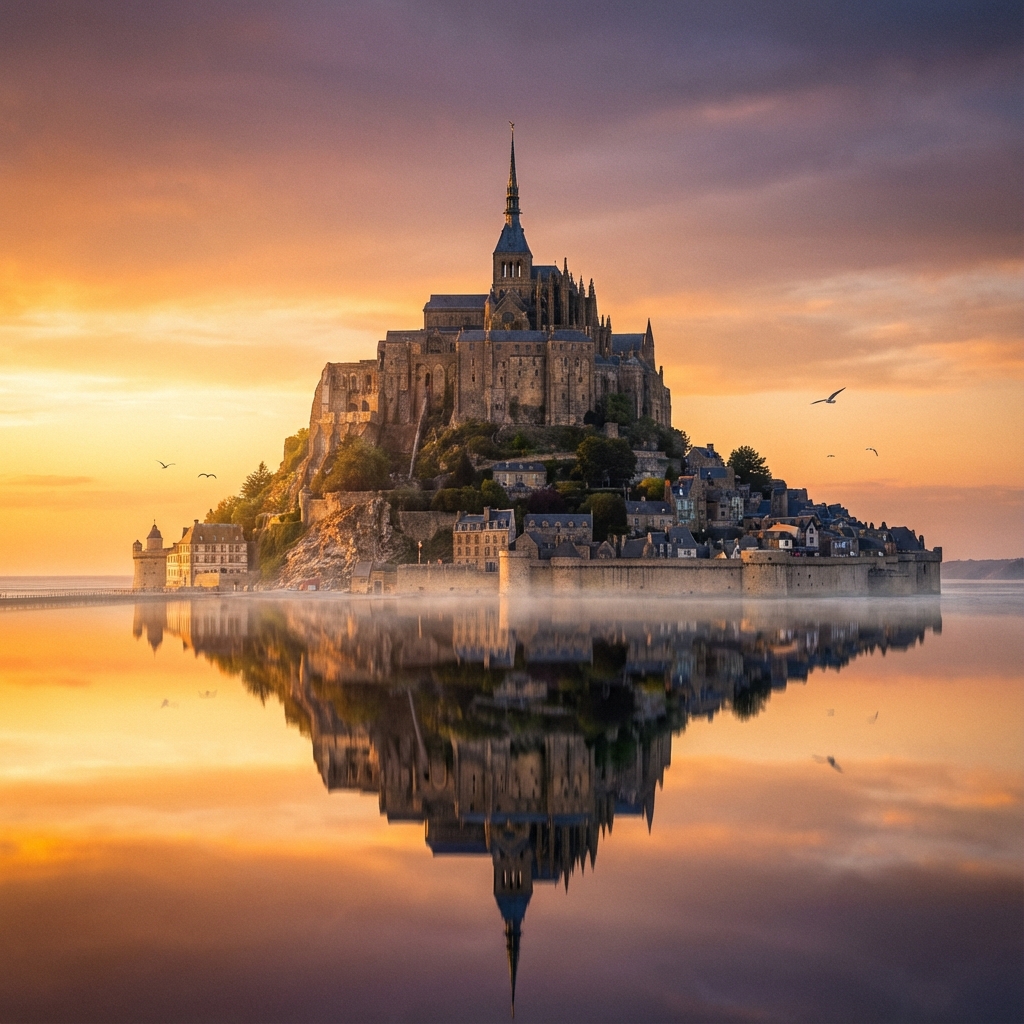
Mont Saint-Michel is not just a castle or a church; it is a vision. Rising from the vast mudflats of the bay between Brittany and Normandy, this rocky islet is crowned by a gravity-defying medieval abbey. Victor Hugo called it "a pyramid in the sea." It is one of France's most stunning landmarks, a UNESCO World Heritage site, and a monument to medieval engineering and faith.
The Nature: The Tides
The Mont is famous for its extreme tides, which are the highest in Europe (up to 15 meters difference between low and high tide). At low tide, the Mont is surrounded by kilometers of sand, allowing pilgrims to walk to it. At high tide, it becomes an island, completely cut off from the mainland (though a modern bridge now maintains access). Legend warns that the tide rushes in "at the speed of a galloping horse," which is an exaggeration, but it is dangerously fast.
History: The Archangel and the Rock
The history of the Mont began in 708 AD, when Archangel Michael appeared to Aubert, the Bishop of Avranches, in a dream and told him to build a sanctuary on the rock. Aubert ignored the dream until the Archangel poked a hole in the bishop's skull with his finger (the skull with the hole is still preserved in Avranches). The first chapel was built, and it became a major pilgrimage site.
The Merveille (The Wonder)
In the 13th century, the French King Philip Augustus conquered Normandy. To show his support, he financed the construction of the Gothic masterpiece known as "La Merveille". These are the tall, slender buildings on the north side of the rock, housing the cloister and the refectory. They seem to cling precariously to the cliff, a marvel of vertical architecture.
The Hundred Years' War
During the Hundred Years' War against England, Mont Saint-Michel was a fortress. The English besieged it for 30 years but never conquered it. The small garrison repelled every attack, making the Mont a symbol of French national identity and resistance. The ramparts and fortifications you see at the base were built during this time.
The Prison
After the French Revolution, the monks were expelled, and the abbey was turned into a prison for political opponents. It was nicknamed the "Bastille of the Seas." It remained a prison until 1863, when influential figures like Victor Hugo campaigned for its restoration as a national monument.
Architecture: A Hierarchy in Stone
The architecture of the Mont reflects the feudal society of the Middle Ages:
- Top: God and the Church (The Abbey and Spire).
- Middle: The Nobility and Knights (The Great Halls and Merveille).
- Bottom: The Common People (The village, fishermen, and pilgrims' houses).
At the very top, 157 meters above the sea, stands the golden statue of Archangel Michael slaying the dragon, serving as a lightning rod and a guiding light. The statue was sculpted by Emmanuel Frémiet in 1897 and had to be airlifted by helicopter during its restoration.
The Culinary Heritage: Salt Meadow Lamb
The bay surrounding Mont Saint-Michel is not just mud; it is a unique ecosystem. The vegetation that grows here is periodically submerged by the salty tides, creating "prés salés" (salt meadows). The sheep that graze on this salty grass produce meat with a distinct, naturally seasoned flavor known as Agneau de pré-salé (Salt Meadow Lamb). This delicacy is protected by an AOC designation (Appellation d'Origine Contrôlée) and is a must-try dish in the local restaurants, often served roasted to highlight its unique terroir.
The Restoration of Maritime Character
Over the centuries, the accumulation of silt and the construction of a causeway in the 19th century threatened to turn the Mont permanently into part of the mainland. A massive hydraulic project was launched in 2005 to reverse this process. A new dam was built on the Couesnon River to flush away the silt, and the old causeway was replaced by a light, elevated bridge on stilts. Completed in 2015, these works have successfully restored the maritime character of the site, ensuring that Mont Saint-Michel remains an island during high tides.
The Monastic Life
While millions of tourists visit the Mont, it remains a spiritual place. Since 2001, the Monastic Fraternities of Jerusalem have lived in the abbey. This mixed community of monks and nuns ensures that the abbey is not just a museum but a living house of prayer. They wear blue-grey habits and can often be seen going about their daily chores or singing polyphonic liturgy in the church. Their presence adds a layer of tranquility to the hustle and bustle of the tourist crowds, reminding visitors of the site's original purpose.
Visitor Tips
- The Climb: Visiting the abbey requires climbing the "Grand Degré," a steep staircase of 350 steps. There is no elevator. Wear good walking shoes.
- La Mère Poulard: The most famous restaurant on the Mont is La Mère Poulard, known since 1888 for its fluffy, soufflé-like omelets cooked over an open fire. They are expensive, but legendary.
- Crossing the Bay: You can take a guided walk across the sands at low tide. Do not attempt this alone. The bay is full of quicksand and the tides are treacherous. Always go with a certified guide.
- Night Visit: In July and August, the abbey is open at night for the "Chronicles of the Mount," a light and sound show that is incredibly atmospheric.
Frequently Asked Questions
- How do I get there?
- A shuttle bus ("Le Passeur") runs from the mainland parking lot to the Mont. It is free and takes 12 minutes. You can also walk across the bridge (approx. 40 minutes) to enjoy the view.
- Do people live there?
- Yes, there is a small permanent population of about 30 people, including the monks and nuns of the Monastic Fraternities of Jerusalem who returned in 2001 to ensure daily prayer continues in the abbey.
- Can I bring luggage?
- No. There are no lockers on the Mont, and dragging a suitcase up the cobblestone streets is impossible. Leave luggage in your car or at the Tourist Information Center on the mainland.