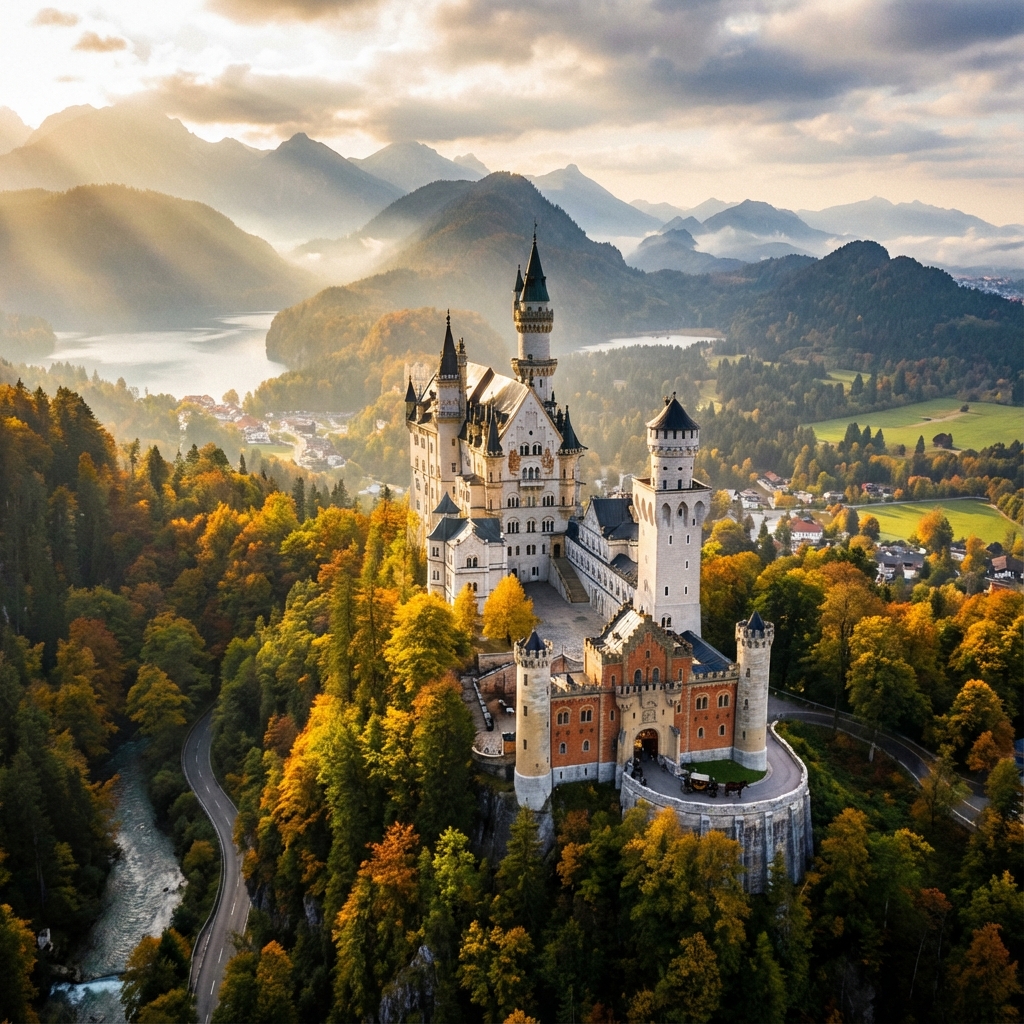
The Real Sleeping Beauty Castle
Neuschwanstein is the ultimate fairytale castle. With its soaring white limestone towers, blue turrets, and dramatic location perched on a rugged hill above the village of Hohenschwangau, it looks like a stage set. And that is exactly what it was meant to be.
It was never built for defense. It was built as a private refuge for **King Ludwig II of Bavaria**, a shy, romantic dreamer who wanted to retreat from the real world into the myths of the Middle Ages. Ironically, the castle built for a hermit is now one of the most visited places on Earth, attracting 1.5 million people a year.
In the 1930s, a young **Walt Disney** visited Bavaria and was so struck by Neuschwanstein's beauty that he used it as the direct inspiration for **Sleeping Beauty's Castle** in Disneyland. The silhouette of Neuschwanstein is now stamped on the beginning of every Disney movie.
The Mad King: Ludwig II
To understand the castle, you must understand the King. Ludwig II became King of Bavaria at just 18. He was tall, handsome, and hated politics. He was obsessed with the operas of **Richard Wagner** and the legends of the Holy Grail.
As he grew older, he became increasingly reclusive, sleeping during the day and going for sleigh rides in the mountains at night, earning him the nickname "The Moon King." He spent his private fortune (and borrowed heavily) to build his dream castles—Neuschwanstein, Linderhof, and Herrenchiemsee. His ministers, worried about his spending and his eccentricity, conspired to remove him from the throne. On June 10, 1886, a government commission arrived at Neuschwanstein to arrest him. He was declared insane (by a doctor who had never examined him) and deposed.
The Murder Mystery: Lake Starnberg
The tragedy of Ludwig II ended just three days later in a mystery that has never been solved. He was taken to Berg Castle on the shores of **Lake Starnberg**. On the evening of June 13, 1886, he went for a walk in the castle park with his psychiatrist, Dr. Bernhard von Gudden. They were last seen at 6:30 PM. They never returned.
Later that night, their bodies were found floating in shallow water near the shore. Characteristics of the scene did not add up:
- The King: Ludwig was a strong swimmer. The autopsy revealed **no water in his lungs**, suggesting he was dead before he entered the water.
- The Doctor: Dr. Gudden's body showed signs of a violent struggle, with blows to the head and signs of strangulation.
- The Theory: The official verdict was suicide by drowning. But many historians believe Ludwig was murdered. Some theories suggest he was shot while trying to escape to a waiting boat. A coat belonging to the King, which supposedly had two bullet holes in the back, was rumored to be held by the family for years but was destroyed in a fire.
A Temple to Wagner
Neuschwanstein was designed as a habitable stage set for the operas of Richard Wagner. Every room is a homage to a different Germanic legend.
- The Singers' Hall: This is the largest and most magnificent room in the castle. It was designed for private performances of Wagner's *Parsifal* and *Tannhäuser*. Ironically, the acoustics were never perfect, and Ludwig never heard a concert here before his death. The walls are covered in frescoes depicting the legend of Parzival and the Holy Grail.
- The Artificial Grotto: In a surreal touch, there is a man-made cave (made of plaster over a steel framework) located between the salon and the study. It was designed to resemble the Venus Grotto from Wagner's *Tannhäuser*. Originally, it had a waterfall and a "rainbow machine" to create moody lighting.
- The Bedroom: Dedicated to the tragic romance of *Tristan and Isolde*. The room is a masterpiece of Neo-Gothic woodcarving. It took 14 woodcarvers more than four years to complete the intricate oak paneling and the canopy over the King's bed.
Hidden High-Tech
Despite its medieval appearance, Neuschwanstein was a marvel of 19th-century technology. Ludwig II loved modern gadgets.
- Central Heating: The castle was equipped with a sophisticated hot-air heating system (calorifère) that piped warm air into the rooms.
- Running Water: Every floor had running water. The kitchen had hot and cold taps, fed by a natural spring in the mountains.
- The Flush: The King's toilet had an automatic flushing system.
- The Telephone: The castle had a telephone line connecting it to the King's other palaces, one of the very first in Bavaria.
- The Elevator: No, the King didn't use it, but his food did. A hand-cranked dumbwaiter lift carried meals from the kitchen (three floors down) up to the dining room so that the King could eat without seeing servants.
The Unfinished Dream
It is important to realize that Neuschwanstein was never finished. What visitors see today is only about one-third of the original plan. A massive 90-meter tall Keep (Donjon) was supposed to stand in the main courtyard, which would have dwarfed the rest of the castle. A chapel and more guest rooms were also planned.
When Ludwig died, all construction stopped immediately. The unfinished sections were simply bricked up or left empty. Six weeks after his death, the government opened the castle to the paying public to clear the King's debts. The man who built the castle to be alone is now visited by 6,000 people a day.
Visitor Tips
- The Marienbrücke (Mary's Bridge): This is THE photo spot. It is a bridge that spans the Pöllat Gorge, suspended 300 feet over a waterfall. It offers the iconic side-profile view of the castle that you see on postcards. Be warned: it is narrow, high, and crowded.
- Tickets: Tickets sell out months in advance. You **cannot** buy tickets at the castle entrance. You must buy them online or at the Ticket Center in the village of Hohenschwangau.
- The Walk: It is a steep 30-40 minute hike from the ticket center to the castle. There are horse-drawn carriages and a shuttle bus, but queues for these can be long. Walking is often faster.