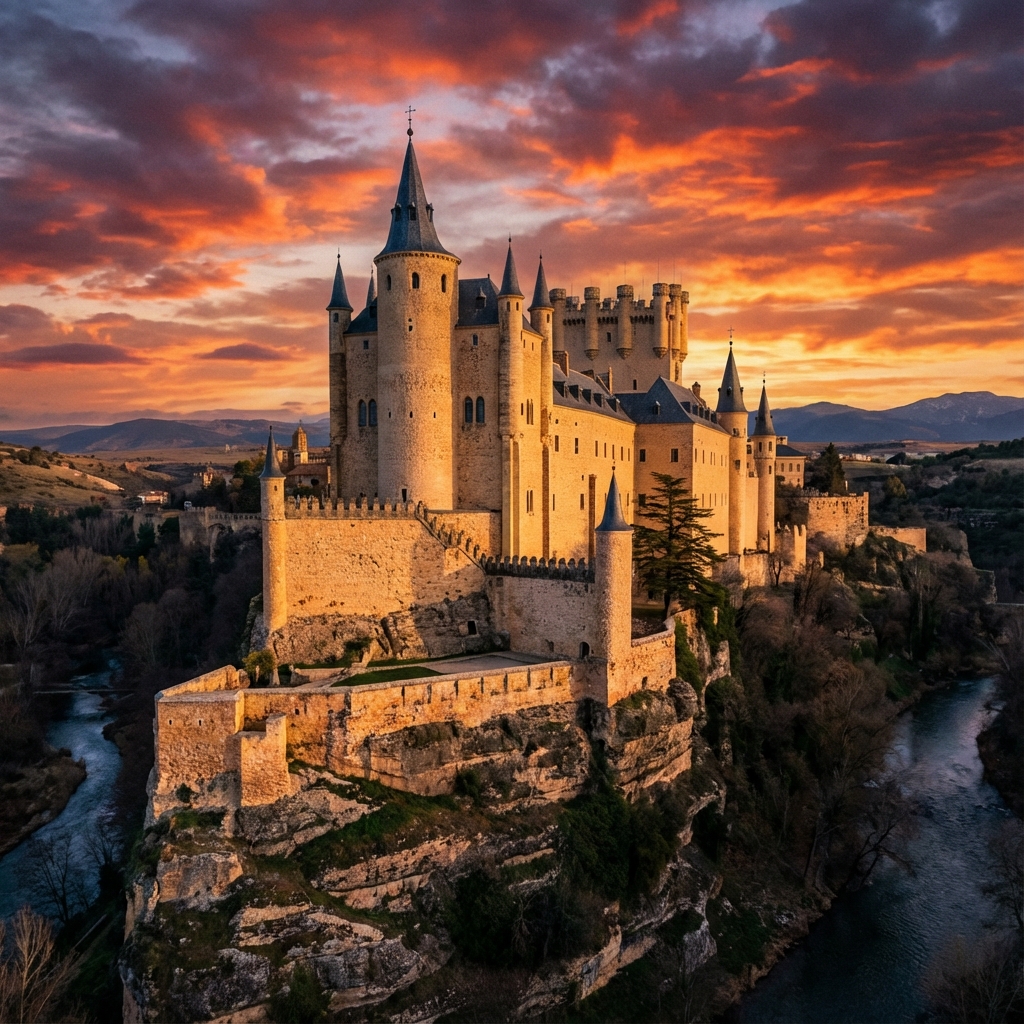
The Vatican of Provence
Dominating the city of Avignon and the Rhône River like a colossal stone crown, the Palais des Papes (Palace of the Popes) is the largest Gothic palace in the world. It is a monument to a unique and turbulent chapter in the history of Christendom: the Avignon Papacy. For nearly 70 years in the 14th century, the Popes abandoned Rome and ruled the Catholic Church from this fortress in Provence. It is a building of overwhelming scale and severity, a physical manifestation of the temporal and spiritual power of the Church at its zenith.
With its sheer walls rising 50 meters high, its crenellated towers, and its narrow arrow slits, it looks more like a citadel than a house of God. Yet inside, it was a court of unmatched luxury, attracting artists, scholars, and diplomats from across the known world. Today, as a UNESCO World Heritage site, it allows visitors to walk through the halls where the fate of kings and empires was decided.
History: The Babylonian Captivity
The story begins in 1309, when Pope Clement V, a Frenchman, refused to move to Rome, citing the dangerous factional violence in Italy. He settled the papal court in Avignon, which was then part of the Holy Roman Empire but under the influence of the French King. This period, known as the "Babylonian Captivity" of the Church, lasted until 1377.
The palace was built in two main phases by two different Popes, reflecting their personalities. The Old Palace (Palais Vieux) was built by Benedict XII (1334–1342). He was a Cistercian monk, austere and frugal. His palace is sober, severe, and fortified. The *New Palace (Palais Neuf) was built by his successor, Clement VI (1342–1352). He was a prince of the Church, a lover of art and luxury. His additions were flamboyant, filled with light, frescoes, and grand halls for feasting. In total, seven Popes and two Anti-Popes reigned from Avignon before the court finally returned to Rome.
After the departure of the Popes, the palace remained a papal fortress for centuries. During the French Revolution, it was seized, sacked, and unfortunately used as a barracks and a prison. Many frescoes were damaged or covered over, and statues were destroyed. It was only in the 20th century that it was restored to its former glory.
Architecture: A Fortress of God
The Palais des Papes covers 15,000 square meters—equivalent to 4 Gothic cathedrals. It is a complex maze of towers, courtyards, and halls.
The Great Chapel and Clementine Chapel
The Clementine Chapel (Grande Chapelle) is the longest room in the palace (52 meters). It was here that the elaborate papal masses were held. The acoustics are immense. The sheer height of the vaults draws the eye upward to heaven, while the massive walls remind one of earthly power. The chapel was designed to impress, filled with the chanting of choirs that would echo through the stone cavern.
The Papal Apartments
The Pope's private chambers offer a more intimate look at life in the 14th century. The **Chambre du Cerf* (Room of the Deer) is the most famous. It was Clement VI's study. Unlike the religious themes found elsewhere, this room is painted with secular scenes of hunting, fishing, and falconry. The frescoes are incredibly detailed, showing the lush vegetation and aristocratic pastimes of the era. It reveals that the Pope was not just a spiritual leader but a wealthy medieval lord who enjoyed the pleasures of the hunt.
The Consistory
The Hall of the Consistory was the nerve center of the Church. This is where the Pope met with his cardinals to decide on theological disputes, political alliances, and the canonization of saints. It was also a court of justice. In 1354, the famous Italian tribune Cola di Rienzo was tried here. The room was once decorated with frescoes by Simone Martini, fragments of which can still be seen. It was a place of high drama, where legates from kings would plead their cases and where excommunications were pronounced.
The Avignon Festival
Today, the Palais is not a silent museum. Every July, it becomes the epicenter of the **Avignon Festival, one of the most important theater festivals in the world. The main courtyard (Cour d'Honneur) is transformed into an open-air theater with 2,000 seats. The stark stone walls of the palace provide a dramatic backdrop for contemporary plays, creating a dialogue between the medieval past and the artistic present. It is a tradition that began in 1947 with Jean Vilar and has kept the palace culturally vital.
Legends: The Hidden Treasure
Rumors have always swirled about the immense wealth of the Avignon Popes. Legend has it that when the last Anti-Pope, Benedict XIII, was besieged in the palace in roughly 1403, he hid a vast treasure of gold and jewels in a secret chamber within the thick walls before escaping through a small postern gate. Despite centuries of searching by revolutionaries, soldiers, and historians, the "Papal Gold" has never been found. Some say it is still there, guarded by the ghost of a cardinal.
Visitor Information
Getting There
The Palais des Papes is located in the center of Avignon, within the medieval city walls. Avignon is easily accessible by TGV (high-speed train) from Paris (2.5 hours) or Marseille (30 minutes). From the Avignon Centre station, it is a 10-15 minute walk through the historic streets.
The Histopad and Rooftop Views
A visit to the palace is greatly enhanced by the "Histopad," a tablet provided with the entry ticket. It uses augmented reality to show you what the empty stone rooms looked like in the 14th century—filled with colorful tapestries, furniture, and people. It is an invaluable tool for visualizing the lost splendor. Don't miss the climb to the rooftops of the palace towers, which offer a stunning panoramic view of the Rhône River, the city of Avignon, and the famous Pont d'Avignon (Pont Saint-Bénézet), the broken bridge that juts out into the river.
Tickets and Hours
The palace is open every day of the year. Hours vary by season (usually 9:00 AM to 7:00 PM in summer, closing earlier in winter). It is recommended to buy a combined ticket that includes the famous Pont d'Avignon. Guided tours are available, including special "secret palace" tours that take you to areas usually closed to the public, such as the Pope's private terrace.