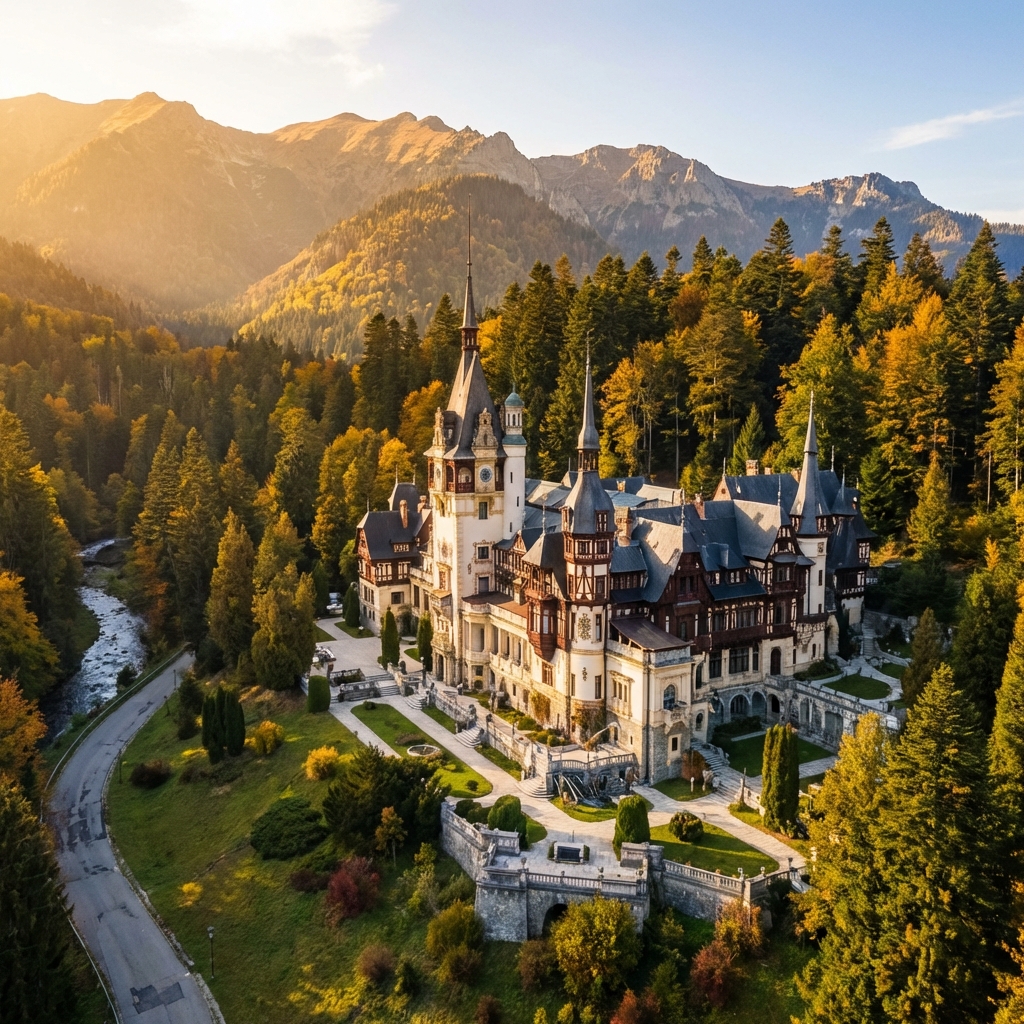
The Pearl of the Carpathians
Hidden in the dense pine forests of the Bucegi Mountains, Peleș Castle looks like a dream brought to life. It is not a medieval fortress designed for war, but a summer palace designed for art, luxury, and technology. With its sharp turrets, timber-framed facades, and intricate stone carvings, it is the supreme masterpiece of the German Neo-Renaissance style in Eastern Europe. Commissioned by King Carol I, the first King of Romania, it served as the cradle of the dynasty and a symbol of the country's modernization. It is widely regarded as one of the most beautiful castles in the world, a jewel box of craftsmanship that rivals the famous palaces of Bavaria.
Unlike the nearby Bran Castle (often associated with Dracula), Peleș is a place of light and refinement. Every inch of its 160 rooms is decorated with obsessive attention to detail, reflecting the King's personal taste and the enormous budget of the project. It stands as a monument to the brief but glorious Romanian monarchy.
History: A King's Vision
In 1866, Prince Carol of Hohenzollern-Sigmaringen (later King Carol I) visited the small village of Sinaia. He was so enchanted by the wild beauty of the scenery that he decided to build his summer residence there. Construction began in 1873 but was a colossal engineering challenge. To build on the swampy ground, the foundation had to be secured with oak piles, and the Peles Creek had to be diverted.
The castle was inaugurated in 1883, though work on the interiors continued until 1914. It was a modern marvel. Peleș was the first castle in Europe to be fully powered by electricity, generated by its own hydroelectric plant. It had central heating, an elevator, and even a central vacuum cleaner system (built in 1900!). It hosted emperors and kings, including Franz Joseph of Austria. After the communist takeover in 1947, the castle was seized by the state and closed for decades (Nicolae Ceaușescu rarely visited, reportedly because the museum staff told him a fungus was eating the wood, a clever lie to keep him away). It was reopened as a museum after the 1989 revolution and returned to the royal family, who lease it back to the state.
Architecture: A Global Collection
The exterior is a romantic mix of German and Swiss alpine styles, fitting perfectly into the mountain scenery. But the interior is a tour of the world.
The Hall of Honor
The Hall of Honor is the heart of the castle. Rising three stories high, it is paneled in walnut and ash wood, carved with an intricacy that resembles lace. The ceiling features a retractable stained-glass roof that could be opened electrically to ventilate the room or let in the cool mountain air. The walls are adorned with bas-reliefs and statues, creating a space of overwhelming grandeur. It was designed to impress foreign dignitaries and succeeds to this day.
The Weapon Room
King Carol was a military man, and his collection of arms and armor is one of the finest in Europe. The Weapon Room displays over 4,000 pieces, including German executioner swords, Ottoman muskets, and a full suit of armor for a horse. The display is not just historical; it is artistic, arranged in trophies and patterns on the walls.
The Theme Rooms
Each room has a distinct style. The Florentine Room features Murano glass chandeliers and bronze doors cast in Rome. The **Moorish Room** is a replica of a salon in the Alhambra, complete with a marble fountain and North African weapons. The **Turkish Salon** was used as a smoking room, filled with silk embroidery and low divans. The **Imperial Suite** was reserved for the Austrian Emperor. It is a dizzying display of eclecticism, showing the global reach of the King's taste.
The Gardens and Pelișor
The castle is surrounded by seven terraces decorated with statues of Italian marble, fountains, and stone balustrades. Just a few hundred meters away stands Pelișor Castle ("Little Peleș"). It was built for Carol's nephew and heir, King Ferdinand, and his wife, the famous Queen Marie. Pelișor is decorated in the Art Nouveau style, reflecting the Queen's artistic personality. It is more intimate and "cozy" than the grand palace next door, featuring the famous "Golden Room," where the Queen's heart was kept for a time. The entire estate is a royal enclave.
Visitor Information
Getting There
Peleș is located in Sinaia, about 120 km north of Bucharest (approx. 2 hours by car or train). The train ride from Bucharest North Station is scenic, winding through the Prahova Valley. From Sinaia station, you can walk up through the park (a steep 20-30 minute uphill walk) or take a taxi/bus. The walk is beautiful, passing through the forest and offering glimpses of the castle turrets.
Tours
The castle can only be visited by guided tour. There are usually two options: the Standard Tour (Ground Floor) and the Optional Tour (Ground + First Floor). It is highly recommended to take the extended tour to see the Imperial Suite. Tours are available in multiple languages. Lines can be very long in summer and on weekends, so arriving early is essential. Note that there is an extra fee for photography.
Practicalities
The castle is closed on Mondays (and Tuesdays in winter). Always check the official schedule. The temperature inside is kept cool to preserve the artwork, so bring a light jacket even in summer. Also, visitors are required to wear plastic shoe covers (provided) over their shoes to protect the precious carpets and parquet floors. There is a restaurant and cafe on the castle terrace with views of the mountains.
The Royal Collection and Legacy
Beyond its striking architecture, Peleș Castle is a monument to the cultural ambitions of King Carol I. He amassed an extraordinary collection of art that spans centuries and continents. The castle houses over 2,000 paintings, including works by masters such as Gustav Klimt, who along with his brother Ernst and Franz Matsch, was commissioned to paint the frescoes in the theater and the ceiling of the main staircase. This early commission played a significant role in Klimt's career. Additionally, the royal library is a treasure trove for bibliophiles, containing rare volumes with leather bindings engraved with gold letters. The legacy of Peleș extends beyond its walls; it transformed Sinaia from a quiet mountain village into an aristocratic resort town, attracting Romanian nobility who built their own lavish villas nearby. Today, the castle stands not merely as a museum, but as a proof of a pivotal era of modernization and artistic flourishing in Eastern Europe, preserving the spirit of a kingdom that forever changed the cultural scenery of Romania.