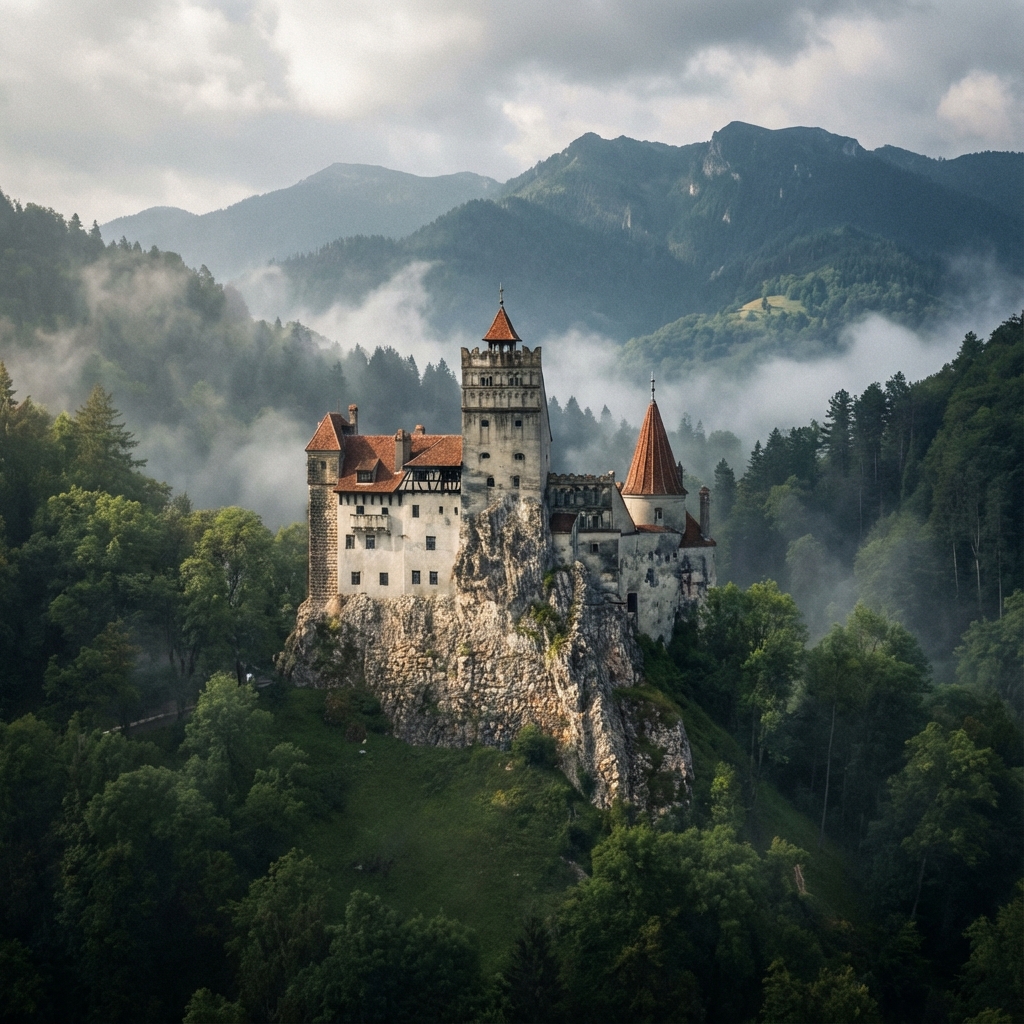
The Peasant Fortress of Transylvania
Perched atop a rocky limestone hill 200 meters above the town of Rasnov, the Rasnov Citadel (Cetatea Râșnov) is one of the most impressive and best-preserved fortified complexes in Romania. Unlike the nearby Bran Castle, which was a royal customs post and residence, or Peles Castle, which was a royal palace, Rasnov was a "peasant citadel." It was built, maintained, and defended by the common people of the town. Its purpose was simple: survival. Situated on the strategic trade route connecting Wallachia and Transylvania, the region was frequently invaded by Tatars and Ottomans. When the alarm was raised, the entire population of Rasnov would retreat up the hill, lock the gates, and live inside the citadel walls for weeks, months, or even years.
Because it had to shelter an entire community, the citadel is not just a military fort; it is a small, self-contained medieval village suspended in the sky. Walking through its ruins today offers a poignant glimpse into the resilience and communal spirit of the Transylvanian Saxons. It remains a reminder of the determination of ordinary people to protect their lives and culture against overwhelming odds. The citadel is one of the few places where you can truly understand the fear and uncertainty that defined medieval life on the frontier of Europe.
History: The Refuge on the Hill
The history of the site dates back to the Teutonic Knights, who built a wooden fortification here around 1211 to defend the southeastern border of the Kingdom of Hungary. After the Knights were expelled in 1225, the local Saxon community took over. Realizing the constant threat of invasion, they began transforming the wooden fort into a massive stone citadel.
The citadel saw its first major test during the Tatar invasion of 1241. Over the centuries, it withstood numerous sieges. Its defenses were so formidable that it was only forced to surrender once, in 1612, to Prince Gabriel Báthory—and even then, only because the attackers managed to cut off the water supply. This defeat taught the villagers a crucial lesson, leading to the digging of the famous well. The citadel was last used as a defensive refuge during the revolution of 1848. Afterward, it was abandoned and fell into disrepair until a major restoration project in the 2000s turned it into a major tourist attraction. Today, it is recognized as a monument of national importance.
Architecture: A Village Within Walls
The citadel is divided into two parts: the Lower Citadel (mostly just walls and a tower for cattle) and the Upper Citadel (the residential area). The architecture is simple and utilitarian, built with local stone and brick, reflecting the practical needs of its builders rather than the aesthetic desires of a king.
The Upper Citadel
Entering the Upper Citadel is like stepping into a ghost town. The narrow, cobblestone streets are lined with the ruins of over 30 small houses. These were the "refuge houses" owned by village families. There was a school, a chapel, and workshops, ensuring that life could continue during a siege. Some of these houses have been restored and now house souvenir shops, craft workshops, and a small museum displaying weapons, tools, and armor found on the site. The layout is dense and compact, maximizing the limited space on the hilltop.
The Defensive System
The citadel is protected by massive walls up to 5 meters high and 1.5 meters thick, reinforced by nine towers and two bastions. The entrance is a formidable barbican. The strategic position offers a 360-degree view, allowing lookouts to spot enemy dust clouds from miles away. Today, this means visitors get spectacular panoramic views of the Bucegi Mountains and the Piatra Craiului National Park, making it a favorite spot for photographers.
Legends: The Well and the Gold
The most famous story of Rasnov concerns its well. After the surrender of 1612 due to lack of water, the villagers decided they needed a water source inside the walls. Legend says that two Turkish prisoners captured during a later skirmish were tasked with digging the well. They were promised their freedom if they finished the job. It took them 17 years of digging through solid rock to reach water at a depth of 146 meters. The well was completed in 1640. The legend says the prisoners were killed despite the promise, but historical records suggest they may have been released. During excavations, verses from the Quran were found inscribed on the well walls, a record of their labor.
Another legend speaks of a treasure hidden deep in the well. It is said that during a hasty retreat, the nobles threw their gold and silver down the shaft to prevent the Ottomans from taking it. Treasure hunters have looked for it for centuries, but only old coins and pottery have been found. The mystery, however, continues to attract curious minds, adding an air of intrigue to the dark depths of the well.
Visitor Information
Getting There
Rasnov is located just 15 km southwest of Brasov and about the same distance from Bran Castle. It is an easy stop on the popular Brasov-Bran tourist route. Buses run frequently from Brasov. The proximity to Bran makes it easy to visit both in a single day, though Rasnov often offers a more authentic and less crowded experience.
The Funicular and Dino Park
To reach the citadel from the town center, visitors can take a steep 20-minute hike through the forest or ride the modern funicular (inclined elevator) that whisks you up the hill in a few minutes, offering great views of the town below. Rasnov is also famous for the "Dino Park" located in the forest near the citadel, an open-air museum with life-size dinosaur replicas, making it a favorite destination for families with children. Combining a history lesson at the citadel with a visit to the dinosaurs makes for a perfect family outing.
Status and Renovation
Note: As of recent updates (2022-2024), parts of the citadel have been undergoing extensive emergency consolidation and restoration works. While the outer courtyards and the garden are usually open, the inner residential core might be temporarily closed or have restricted access. However, the site still hosts events, medieval festivals, and markets, and the walk up is worth it for the exterior architecture and the views alone.