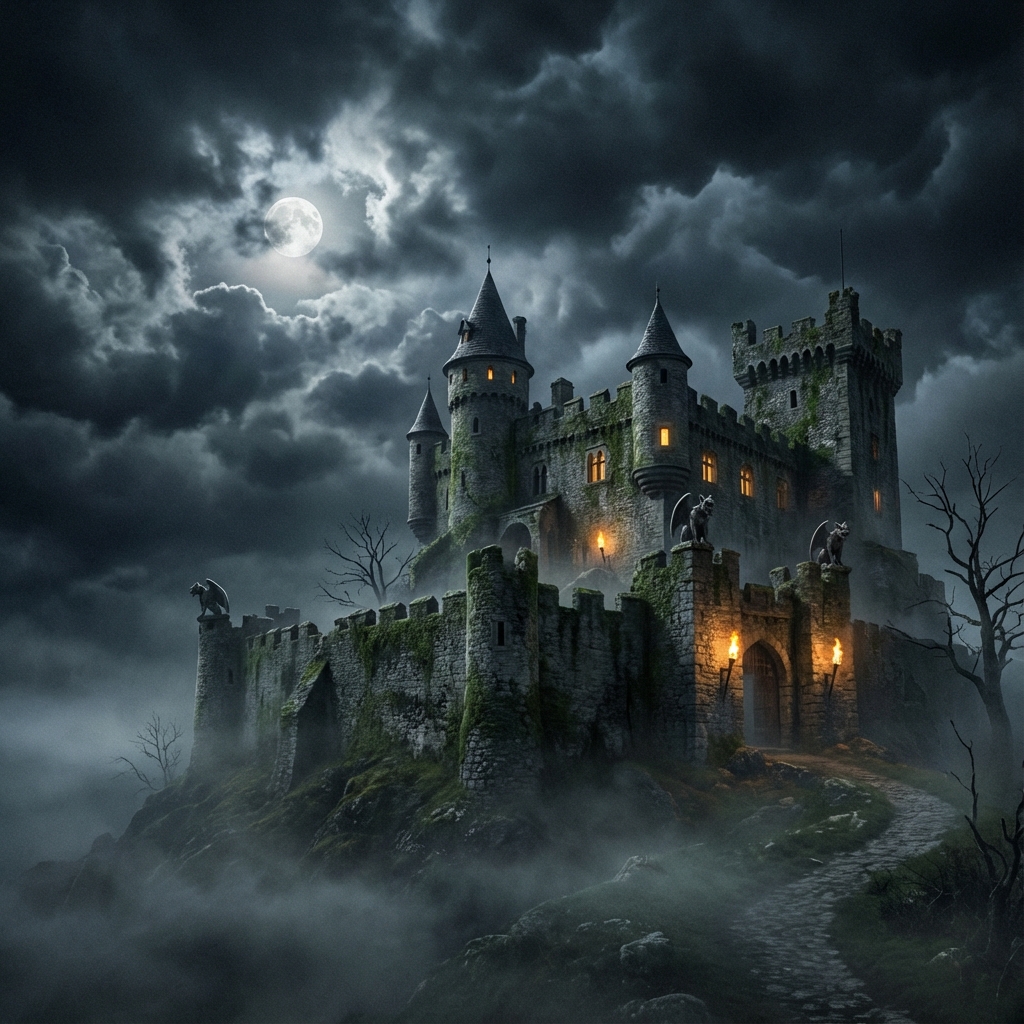
The White Giant of Slovakia
Rising like a bleached skeleton from the green rolling hills of eastern Slovakia, Spiš Castle (Spišský hrad) is a sight that defies scale. It is not just a castle; it is a sprawling fortified city in the sky. Covering over 41,000 square meters (making it one of the largest castle complexes in Central Europe), this UNESCO World Heritage site is a proof of the turbulent history of the region. Its blinding white limestone walls, perched on a travertine rock 634 meters above sea level, dominate the horizon for miles around.
Unlike the manicured palaces of Western Europe, Spiš is a raw, rugged ruin. It feels ancient and elemental. Walking through its vast courtyards, you can almost hear the clamor of the armies that once besieged it. It stands as a symbol of endurance, having survived invasions, fires, and centuries of abandonment.
The Travertine Fortress
The geography of Spiš is its greatest defense. The castle sits on a natural phenomenon: a travertine mound created by mineral springs over thousands of years. The steep cliffs on all sides made it a natural stronghold long before the first stone was laid. Archaeological evidence shows that the site was inhabited by the Celts and later by Slavic tribes who built crude hill forts here. But the stone giant we see today began its life in the 12th century as a border fortress for the Kingdom of Hungary.
Surviving the Mongol Horde
The castle's first great test came in 1241. The Mongol Golden Horde, led by Batu Khan, swept across Europe, leaving a trail of destruction. They burned villages and sacked cities, but when they reached Spiš, they stopped. The castle's new stone fortifications (built just in time) and its inaccessible position proved too much even for the feared Mongol cavalry. Spiš was one of the few strongholds that did not fall, saving the lives of the thousands of refugees cowering inside its walls.
The Three Castles
The complex is actually a combination of three distinct sections built over different eras:
- The Upper Castle: The oldest part, located at the very peak of the rock. It contains the Romanesque palace, the cylindrical donjon (keep), and the cistern. This was the final refuge.
- The Middle Castle: Added in the late 15th century, this area includes the 'Captain's House' and the main gate. It was the administrative heart of the fortress.
- The Lower Castle: A massive expansion added by the Zapolya family. This vast courtyard was designed to house the entire population of the surrounding area during times of war. Today, this open grassy space is often used for historical reenactments, falconry shows, and concerts.
The Noble Families
Over the centuries, the castle passed through the hands of Hungary's most powerful families. The Zápolya family (who would later produce kings of Hungary) transformed it from a grim fortress into a comfortable late-Gothic residence. Later, the Thurzó family added Renaissance touches, focusing on luxury rather than just defense. Finally, the Csáky family owned the castle until 1945. They were the ones who largely abandoned it in the early 18th century because it was simply too drafty and uncomfortable for modern living, preferring to build convenient manor houses in the villages below.
The Great Fire of 1780
The castle's doom came not from an enemy army, but from a spark. In 1780, a massive fire gutted the entire complex. The cause remains a mystery debated by historians. Some say it was a lightning strike that ignited the roof shingles. Others suggest it was caused by garrison soldiers distilling illegal fruit brandy (moonshine) in the cellar. Whatever the cause, the fire reduced the once-mighty palace to a roofless shell, and it has remained a ruin ever since.
The Legend of Hedvig
Every great castle needs a ghost, and Spiš has Hedvig. Legend says she was the sister of a castle lord who fell in love with a nobleman from a rival family. She secretly opened the gates to let him in, thinking he was coming for her. Instead, he brought his soldiers and captured the castle, killing the garrison. Realizing she had betrayed her people for a false lover, the grief-stricken Hedvig threw herself from the highest tower. It is said that on stormy nights, you can still see her white figure wandering the ramparts, searching for the keys to lock the gate she should never have opened.
A Hollywood Star
If Spiš Castle looks familiar, you might have seen it on the silver screen. Its epic scale and fantasy aesthetic have made it a favorite location for filmmakers. It was the primary filming location for the movie Dragonheart (1996) and played a major role in The Last Legion (2007) with Colin Firth.
Visitor Information
Spiš is located near the town of Spišské Podhradie.
- The Hike: You can park in the town below and hike up the steep path (approx. 45-60 minutes), which offers great views but is strenuous. Alternatively, there is a car park on the eastern side which is only a 10-minute walk from the main gate.
- Weather Warning: The castle is completely exposed. In summer, the white stone reflects the heat, making it an oven. In spring and autumn, the wind can be ferocious. Dress accordingly.
- Audio Guide: Highly recommended. The castle is a ruin, so without the guide (available via a mobile app), it can be hard to visualize what the empty rooms once looked like.
- Nearby: Don't miss the Spišská Kapitula (the 'Slovak Vatican') in the town below, a beautifully preserved ecclesiastical town that is also part of the UNESCO site.
Frequently Asked Questions
- Is it safe?
- Yes, conservation work is ongoing to stabilize the walls. However, visitors must stick to the marked paths as the terrain is uneven.
- Is it open all year?
- No. The castle typically closes during the winter months (December to March) due to snow and ice making the paths dangerous. It is best to visit between May and September.
The Archaeological Significance and Conservation
The vast ruins of Spiš Castle represent one of the most important archaeological sites in Central Europe, offering an unmatched window into the evolution of medieval military architecture and daily life. Ongoing excavations within the expansive complex continuously yield fascinating discoveries, from ancient weaponry and forged tools to delicate ceramics and remnants of everyday domestic life. These findings systematically piece together the complex puzzle of the castle's history, revealing how its inhabitants adapted to the harsh environment and the ever-present threat of siege over many centuries. Preserving such a monumental structure, exposed entirely to the fierce elements of the Slovakian climate, requires a Herculean conservation effort. Expert teams of stonemasons and historical architects work tirelessly to stabilize the crumbling limestone walls, using traditional techniques to prevent further decay without compromising the ruin's rugged authenticity. This careful balance between stabilization and preserving the romantic, desolate atmosphere of the site ensures that the stark, imposing silhouette of Spiš Castle remains safe for future generations to explore. The dedication to this colossal task underscores the immense cultural value of the castle, not just as a national symbol of Slovakia, but as a crucial piece of our shared European heritage.