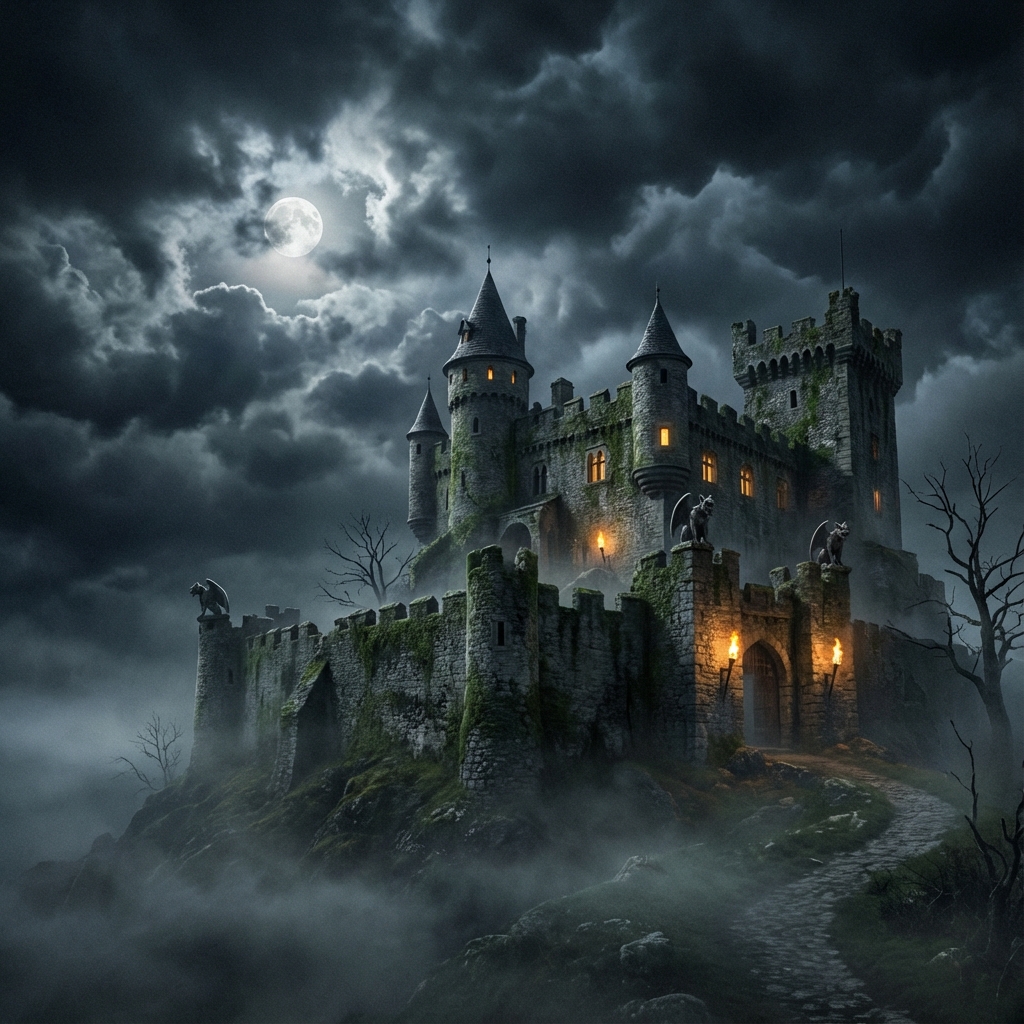
The Birthplace of King Arthur
Set against the dramatic backdrop of the North Cornwall coast, Tintagel Castle is a place where history and legend are inextricably intertwined. Perched on a rugged, wind-swept headland that juts into the Atlantic Ocean, the ruins invoke a sense of mystery that has captivated imaginations for centuries. While the physical remains are medieval, the spirit of the place dates back much further, to the mists of the Dark Ages and the enduring legend of King Arthur.
According to Geoffrey of Monmouth's 12th-century History of the Kings of Britain, Tintagel was the place where King Arthur was conceived. The story goes that Uther Pendragon, the King of Britain, fell in love with Igraine, the wife of Gorlois, Duke of Cornwall. With the help of the wizard Merlin, Uther was transformed into the likeness of Gorlois, allowing him to enter Tintagel and spend the night with Igraine. The result of this union was Arthur, the legendary king who would unite Britain. This tale transformed a remote Cornish headland into one of the most famous literary sites in the world.
This mythological connection was so powerful that in the 1230s, Richard, Earl of Cornwall (the brother of King Henry III), decided to build a castle here. It was not built for military necessity—the site is geographically isolated and has no strategic value—but rather as a statement of power and lineage. By building a castle at the legendary birthplace of Arthur, Richard was presenting himself as a successor to the ancient kings of Cornwall. The castle was designed to look archaic even when it was new, evoking a sense of ancient authority.
The Dark Age Settlement
While the Arthurian legend is fascinating, the archaeological reality of Tintagel is equally fascinating. Excavations have revealed that long before Earl Richard's medieval castle, Tintagel was a highly significant site in the 5th to 7th centuries AD—the period often referred to as the 'Dark Ages.' Far from being a backwater, Tintagel was a thriving, high-status settlement and a royal stronghold of the Kings of Dumnonia.
Archaeologists have uncovered thousands of fragments of imported pottery, including amphorae from the Mediterranean that once held olive oil and wine, and fine tableware from North Africa and Turkey. In fact, more imported pottery from this period has been found at Tintagel than at all other sites in Britain combined. This suggests that the rulers of Tintagel were wealthy, powerful, and connected to the wider Byzantine world at a time when much of Britain had fallen into economic decline.
Merlin's Cave
Below the castle ruins, carved by the relentless force of the Atlantic waves, lies a sea cave known as Merlin's Cave. This atmospheric cavern runs all the way through the island, reachable only at low tide. It is here, in the echo of the crashing waves, that the poet Alfred, Lord Tennyson, imagined the infant Arthur being washed ashore and caught by Merlin.
The cave adds a tangible layer of magic to the visit. Walking through the dark tunnel from the haven to the open sea, with the castle ruins towering hundreds of feet above, it is easy to see why this place became the anchor for Britain's greatest myth cycle. The face of Merlin has even been carved into the rock face near the cave entrance, watching over the pilgrims who come to seek the wizard.
The Great Hall and Medieval Garden
One of the most impressive parts of Earl Richard's castle was the Great Hall. Though only the foundations remain, they outline a building that was over 25 meters long, designed for feasting and entertaining. It is easy to imagine the Earl holding court here, surrounded by tapestries and minstrels, consciously emulating the court of Camelot.
Near the ruins of the hall, English Heritage has recreated a medieval garden. Based on plant remains found during excavations and medieval illustrations, the garden features plants that would have been grown for culinary, medicinal, and decorative purposes in the 13th century. It is a peaceful spot that offers a glimpse into the domestic life of the castle.
The Footbridge and the Island
For centuries, the only way to reach the 'island' part of the castle (which is actually a peninsula connected by a narrow, crumbling isthmus) was via a steep and treacherous path. However, in 2019, English Heritage unveiled a spectacular new footbridge. This cantilevered bridge spans the 190-foot gorge between the mainland and the island, recreating the land bridge that would have existed in the Middle Ages.
Crossing the bridge is a highlight of the visit, offering vertigo-inducing views of the cliffs and the sea below. Once on the island, visitors can explore the remains of the Great Hall, the medieval garden, and the early medieval buildings from the Dark Age settlement. At the highest point of the island stands a bronze sculpture of a ghostly male figure holding a sword—titled Gallos (Cornish for 'power')—which represents both the royal past of the site and the legend of Arthur.
Flora, Fauna, and Folklore
Beyond the history, Tintagel is a haven for wildlife. The cliffs are designated as a Site of Special Scientific Interest (SSSI). Visitors can spot seals bobbing in the water below, and seabirds such as razorbills, guillemots, and fulmars nesting on the cliff faces. The rare Cornish chough, with its distinctive red beak and legs, has also returned to the area.
Local folklore abounds. Apart from Arthur, the site is associated with the tragic love story of Tristan and Iseult. Some legends claim that the ghost of Merlin haunts the cave, and that on stormy nights, the wailing of the wind is actually the cries of the ancient wizard.
Visitor Information
Tintagel Castle is managed by English Heritage. Due to the site's popularity and the capacity of the bridge, timed tickets are often required, especially in the summer months. The site is located in the village of Tintagel, where visitors can also find the Old Post Office, a 14th-century manor house.
The terrain is steep and uneven, involving many steps, so sturdy footwear is recommended. However, for those who can make the climb, the reward is one of the most evocative and stunning historic sites in Europe—a place where the line between history and legend dissolves into the mist.