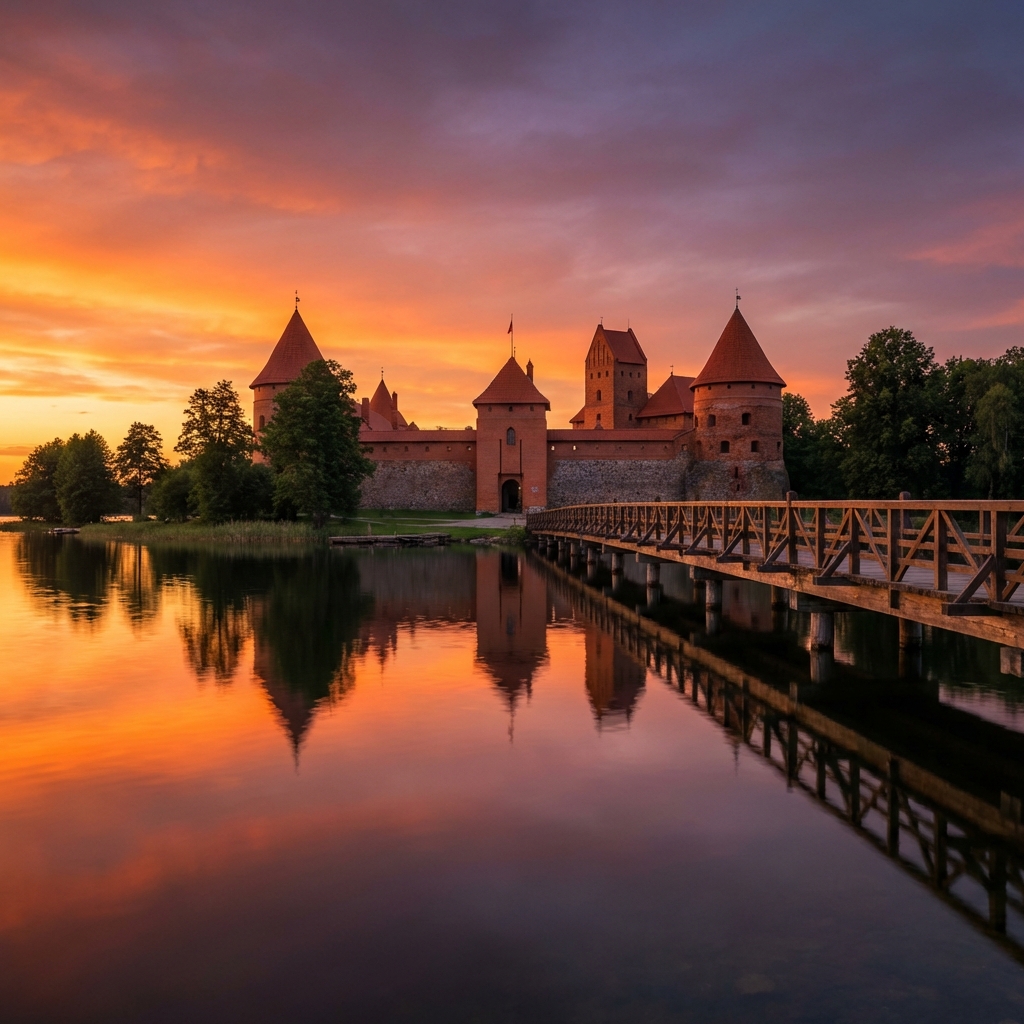
The Jewel of Lithuania
Resting on a small island in the middle of Lake Galvė, connected to the mainland by a long wooden bridge, Trakai Island Castle is one of the most photographed sites in the Baltics. It is the only island castle in all of Eastern Europe and serves as a potent symbol of Lithuanian identity. Its striking red-brick Gothic towers, reflecting in the deep blue waters of the lake, create a scene that feels lifted straight from a fantasy novel. But beyond its beauty, Trakai was once the political and military heart of the Grand Duchy of Lithuania, a medieval superpower that stretched from the Baltic Sea to the Black Sea.
The Grand Dukes: Kęstutis and Vytautas
The story of Trakai is the story of two great rulers. Construction began in the late 14th century under Grand Duke Kęstutis, who recognized the strategic value of the island location to defend against the Teutonic Knights—a fanatical German crusading order that was a constant existential threat to pagan (and later Christian) Lithuania. However, the castle was completed in 1409 by his son, Vytautas the Great, who is perhaps the most revered figure in Lithuanian history.
Vytautas made Trakai his primary residence and the de facto capital of the Duchy. He was a shrewd diplomat and a fierce warrior, famously leading Lithuanian forces to victory in the Battle of Grunwald (1410), which broke the power of the Teutonic Knights forever. Under his rule, the castle was not just a fortress but a glittering palace that hosted kings, emperors, and envoys from across Europe. It was here, in his beloved castle, that Vytautas died in 1430, marking the end of an era.
Medieval Architecture: A Masterpiece of Brick
The castle is divided into two main parts: the Ducal Palace (the U-shaped keep) and the Forecastle.
- The Ducal Palace: This was the residence of the Grand Duke. Its central courtyard, surrounded by wooden galleries, was designed to impress. The Great Hall (or Ducal Hall) features stellar vaulting and beautiful stained glass windows; historically, this is where treaties were signed and grand feasts were held. It was equipped with a sophisticated hypocaust heating system (warm air ducts under the floors), a luxury rare in medieval Europe.
- The Forecastle: This served as the main defensive line. It is surrounded by high walls and three massive defensive towers. The use of red brick was a deliberate choice, signaling wealth and modernity in a region where most fortifications were still made of timber and earth.
The Karaim Legacy
What makes Trakai truly unique is not just the castle, but the people who live in its shadow. In 1397, after a military campaign in the Crimea (Black Sea region), Vytautas brought back nearly 400 families of Karaims (a Turkic ethnic group practicing a unique form of Judaism) and settled them in Trakai. He trusted them implicitly and made them his personal bodyguards and the castle guards.
Remarkably, the Karaim community has survived here for over 600 years, preserving their language and culture. Trakai is the spiritual center of the Karaims in Lithuania. You can still see their traditional wooden houses along Karaimų Street, easily recognized by their three windows facing the street: legend says one is for God, one for the Grand Duke, and one for the family. No visit to Trakai is complete without tasting a kibinai (kybyn), a traditional Karaim pastry filled with chopped mutton and onion, which has become a national dish of Lithuania.
Ruin and Resurrection
Like many great fortresses, Trakai fell into decline. In the 17th century, during the wars with Muscovy (Russia), the castle was severely damaged and eventually abandoned. For centuries, it lay in ruins, its towers crumbling and its halls roofless, visited only by romantic poets and artists.
The reconstruction of Trakai is a fascinating story of national resilience. Restoration efforts began in the early 20th century but accelerated after World War II. It was a controversial project; the Soviet authorities were generally hostile to symbols of Lithuanian nationalism and feudal power. However, local architects and historians cleverly framed the restoration as a 'historical preservation' project rather than a glorification of the past. By the 1980s, the castle was fully rebuilt to its 15th-century glory, a rare example of a completed castle reconstruction in the Soviet Union. It became a symbol of Lithuanian pride during the drive for independence.
The Museum and Collections
Today, the castle houses the Trakai History Museum. As you wander through the winding rooms and spiral staircases, you will encounter diverse collections:
- The Treasury: Displays coins and silver from the golden age of the Grand Duchy, showing the vast wealth of the Lithuanian rulers.
- Hunting Trophies: The forests around Trakai were royal hunting grounds. The museum features a large collection of hunting gear and taxidermy.
- Medieval Warfare: You can see armor, swords, and crossbows used during the conflicts with the Teutonic Order. Inside the courtyard, there are often replicas of medieval torture devices (including cages and stocks) for those with a darker curiosity.
Trakai Historical National Park
The castle is the centerpiece of the Trakai Historical National Park, the only national park in Europe dedicated to a historical city. The park protects the unique cultural heritage formed by the harmonious interaction of nature and human history. Beyond the castle, the park encompasses 32 lakes and the ruins of the Peninsula Castle (another fortress built by Kęstutis). Legend says that the lakes were formed from the tears of a giant who lost his beloved. Another local legend claims that if you listen closely on a foggy night, you can hear the whinnying of Grand Duke Vytautas's favorite warhorse, still guarding his master's home.
Visitor Information
Trakai is located just 28 km (17 miles) west of Vilnius, making it an easy day trip.
- Getting There: Trains and buses run frequently from Vilnius to Trakai. From the station, it is a pleasant 20-30 minute walk through the town to the lake.
- On the Lake: In summer, Lake Galvė is full of activity. You can rent paddle boats, take a yacht tour around the castle, or even go paddleboarding. Seeing the castle from the water offers the best perspective of its fortifications.
- Winter Magic: If you visit in winter, the lake often freezes over completely. You can walk across the thick ice to the castle, a truly magical experience that gives you a sense of the castle's isolation.