The Iconic Fortress of County Clare
Bunratty Castle (Caisléan Bhun Raite, meaning 'Castle at the Mouth of the Ratty') is widely considered the most complete and authentic medieval fortress in Ireland. Standing proudly on the banks of the Ratty River in County Clare, this imposing 15th-century tower house is a national treasure. Unlike many ruins that dot the Irish countryside, Bunratty is a living monument—fully restored, furnished with genuine period antiques, and busy with activity just as it would have been at the height of its power. Its silhouette, against the backdrop of the grey Irish sky or lit up at night for a banquet, is one of the most enduring images of the Shannon region.
For visitors, Bunratty offers a dual experience: a trip deep into the aristocratic world of Gaelic chieftains and Earls within the castle walls, and a step back into the everyday lives of rural Irish folk in the surrounding Bunratty Folk Park. It is a place where history is not just observed but experienced, from the echo of footsteps on spiral staircases to the taste of mead at a medieval banquet.
A History Forged in Conflict
The site of Bunratty has been a strategic stronghold for over a thousand years, witnessing the rise and fall of Vikings, Normans, and Irish kings. Its position allowing control over the maritime commerce of the Shannon rendered it a prize worth fighting for.
The Early Settlements (970 – 1318)
Long before the current stone castle was built, the location was recognized for its strategic value. Around 970 AD, a Viking trading camp was established here, taking advantage of the river access to the Shannon Estuary. This settlement was eventually destroyed by the legendary High King of Ireland, Brian Boru, in his campaigns to drive the Norsemen out of Munster.
In the mid-13th century, the Norman lord Robert de Muscegros built the first defensive fortress—a motte-and-bailey castle. However, his tenure was short-lived. In 1276, the lands were granted to Thomas de Clare, a powerful Anglo-Norman noble. De Clare built the first stone castle on the site, a massive structure designed to control the region. But the local Irish clans were resilient. In 1318, during the chaotic Battle of Dysert O'Dea, the de Clare army was annihilated, and the castle was razed to the ground by the victorious O'Briens. For the next century, the site lay in ruins, a proof of the ferocity of the Gaelic resurgence.
The MacNamara Stronghold (1425)
The castle we see today was built around 1425 by the powerful MacNamara clan, rulers of the local kingdom of Clancullen. They constructed the current rectangular tower house, a masterpiece of 15th-century Irish engineering. It was built not just for defense, but to impress, featuring thick walls and murder holes, but also large windows on the upper floors for comfort.
The O'Brien Era: Kings of Thomond
By roughly 1500, the castle had passed into the hands of the O'Briens, the ruling dynasty of North Munster and the Kings of Thomond. Under the O'Briens, Bunratty reached its zenith. They expanded the castle and lavishly decorated it, hosting great feasts and gatherings. The O'Briens were adept at navigating the shifting political scenery of Tudor conquest. Murrough O'Brien surrendered his Gaelic royal title to Henry VIII in 1543 in exchange for the English title 'Earl of Thomond'. This political maneuvering allowed them to retain their lands and power well into the 17th century.
The Great Earl
The most famous resident was Donogh O'Brien, the 4th Earl of Thomond, known as the 'Great Earl.' He was a formidable figure who fought for the English Crown during the Nine Years' War. He transformed Bunratty into a center of administration and culture, remodeling the interior with decorative plasterwork and large windows that brought light into the medieval gloom. His ambition leveled the castle up from a fortress to a renaissance palace.
Decline and Restoration
During the Confederate Wars of the 1640s, the castle was besieged and taken. The O'Briens eventually moved to the more comfortable Dromoland Castle, leaving Bunratty to fall into decay. By the early 20th century, the roof had collapsed, and the great halls were exposed to the elements.
The castle's salvation came in 1954 when Standish Vereker, 7th Viscount Gort, purchased the ruin. Lord Gort was a passionate art collector. With the help of the Office of Public Works, he embarked on a massive restoration project. He reroofed the castle and filled it with his own priceless collection of medieval furniture, tapestries, and art—the Lord Gort Collection. Today, it houses over 450 items of medieval furniture and artifacts, making it one of the finest collections of its kind in Ireland. The castle opened to the public in 1960, not as a museum, but as a fully furnished home.
Architecture: The Ultimate Tower House
Bunratty is the classic example of an Irish tower house, but on a grand scale. Its design is rectangular, with a central block rising massive and sheer, flanked by four square corner towers.
- The Main Guard: This vaulted hall on the upper floor was the primary living and dining area for the Earl's soldiers and retainers. Today, it is set for a feast, with long tables and tapestries. Note the sheer size of the fireplace, capable of roasting an entire ox.
- The Great Hall: Located above the Main Guard, this vast, high-ceilinged room was the Earl's innovative audience chamber. It features a magnificent oak roof and fine plasterwork. It was here that the Earl would hold court, dispensing justice and receiving guests. The acoustics are superb, designed to carry the voice of the lord.
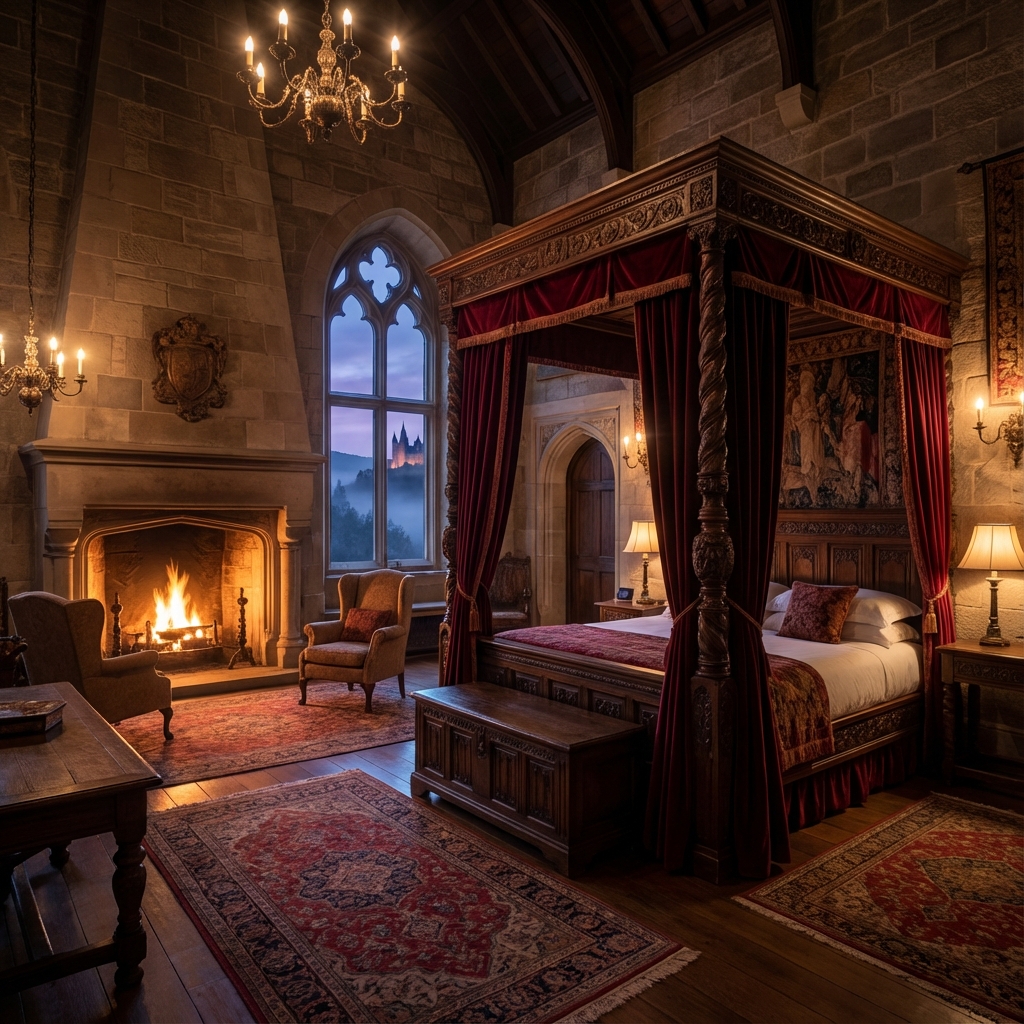
- The Earl's Bedchamber: A private sanctuary showing the luxury available to a Gaelic lord, featuring an ornate four-poster bed and fine textiles. The furniture here is particularly exquisite, dating back to the 15th and 16th centuries.
- The Chapel: A small but exquisite room with 15th-century stucco work, demonstrating the deep religious convictions of the residents. It provided a private space for the Earl's family to worship away from the main congregation.
- The Murder Hole: Above the main entrance, visitors can look up to see the 'murder hole,' through which defenders could pour boiling oil or stones on attackers who breached the outer gate.
- The South Solar: A sunny, private room used by the ladies of the castle for embroidery and music, offering a glimpse into the domestic life of the aristocracy.
The Bunratty Medieval Banquet
Since 1963, Bunratty has hosted one of Ireland's most famous evening experiences: the Medieval Banquet. Held year-round in the castle's Great Hall, this is more than just a dinner.
Guests are greeted by a piper in full regalia and offered a 'Bite of Friendship' (bread dipped in salt). They are then led to long oak tables where a four-course meal is served. In true medieval fashion, the only utensil provided is a dagger, and soup is drunk from a bowl. The evening is presided over by the 'Earl' and his 'Lady' (chosen from the guests), while the renowned Bunratty Castle Singers perform Irish harp music and medieval madrigals. While some may consider it touristy, the banquet offers a genuinely atmospheric way to experience the castle as it was intended—filled with music, food, and laughter.
Bunratty Folk Park
Surrounding the castle is the 26-acre Bunratty Folk Park, a 'living museum' that captures the essence of Irish life around the turn of the 20th century. Over 30 buildings have been rescued from demolition across Ireland and rebuilt here stone by stone.
Key Highlights of the Folk Park:
- Village Street: A complete reconstruction of a 19th-century village street, featuring a schoolhouse, a post office, a pub (fully operational!), a drapery, and a printworks. It vividly illustrates the social hub of rural Ireland. The pub, Mac's Public House, serves real pints and offers a cozy turf fire.
- Traditional Farmhouses: The park features houses from different social classes—from the simple one-room cottage of a landless laborer to the comfortable home of a wealthy strong farmer. Peat fires burn in the hearths, and the smell of baking soda bread often fills the air as costumed animators demonstrate traditional baking methods.
- Bunratty House: A fine Georgian residence built in 1804 for the Studdert family. It represents the lifestyle of the gentry, contrasting sharply with the peasant cottages. It is furnished in the Regency style and sits in its own walled grounds.
- The Walled Garden: Historically accurate gardens growing the fruit, vegetables, and flowers that would have been common in a Victorian country house. It uses heritage varieties of apples and pears.
- The Fairy Trail: A magical woodland walk designed for younger visitors, dotted with fairy houses and whimsical features, adding a touch of mythology to the history.
Visitor Information
Bunratty Castle is located in the village of Bunratty, conveniently situated between Limerick City and Ennis, just a short drive from Shannon Airport.
- Opening Hours: The castle and folk park are generally open daily from 9:00 AM to 5:30 PM. The banquets are held in the evenings (usually 5:30 PM & 8:45 PM) and require separate booking.
- Tickets: Admission includes access to both the Castle and the Folk Park. It is recommended to book online in advance to secure a slot.
- Accessibility: Due to its medieval nature, the castle interior has many steep spiral staircases and uneven floors, making it inaccessible for wheelchairs. However, much of the Folk Park is accessible, and there are transport loops available.
- Dining: There is a tearoom in the Folk Park serving lunch and cakes. The nearby village of Bunratty is famous for Durty Nelly's, one of Ireland's oldest and most iconic pubs, located right next to the castle bridge—perfect for a post-visit pint.
Frequently Asked Questions
- How much time should I spend there?
- To fully explore the castle and the folk park, allow at least 2.5 to 3 hours. There is a lot of ground to cover in the park.
- Is the banquet suitable for children?
- Yes, children are welcome. The atmosphere is fun and interactive, though the later sitting might be late for very young ones.
- Can I climb the towers?
- Yes, visitors can climb the spiral stairs to the battlements for panoramic views of the Shannon Estuary and the surrounding countryside.
- Is there parking?
- Yes, there is ample free parking available across from the castle and beside the Folk Park entrance.
- Are dogs allowed?
- Generally, only guide dogs are allowed in the park and castle.