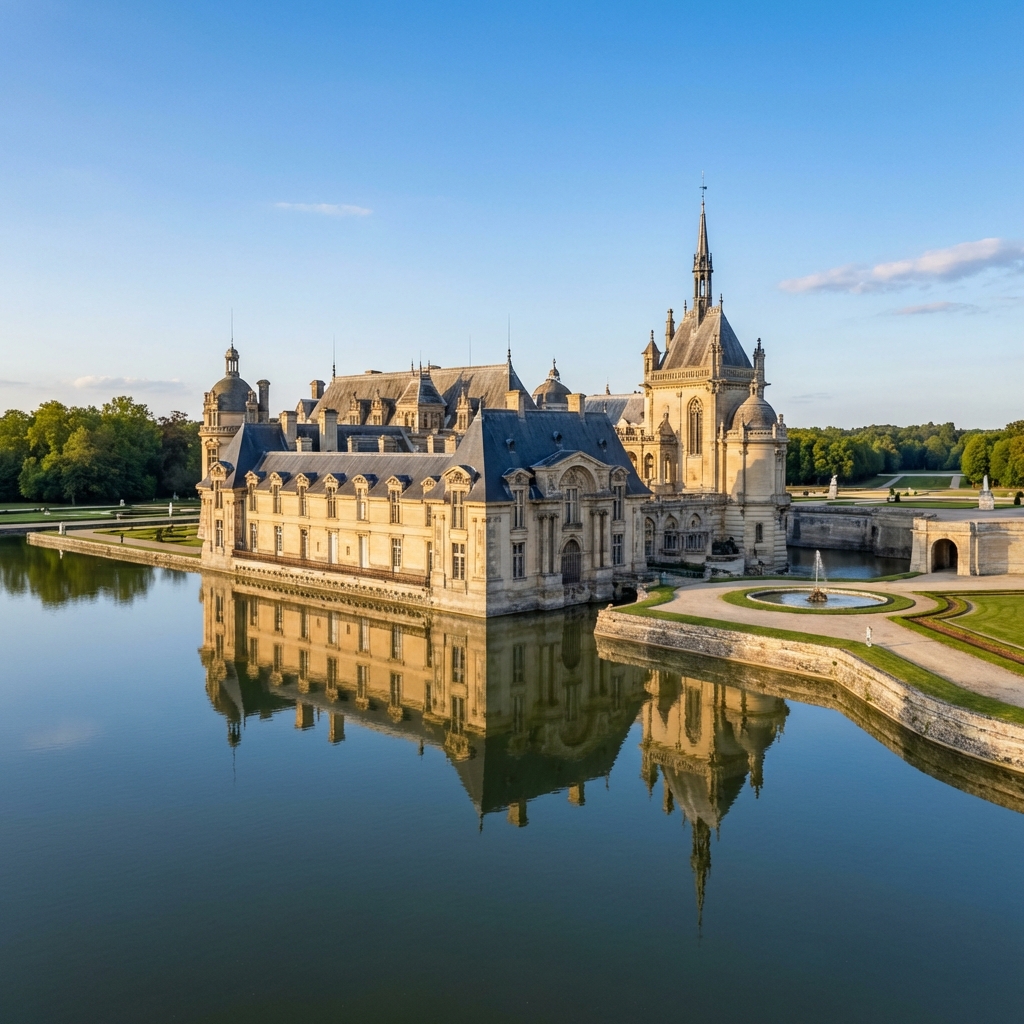
The Prince's Jewel Box
Floating on a vast artificial lake amidst a forest north of Paris lies the Château de Chantilly. It is one of the brightest jewels in the crown of French heritage, yet it remains surprisingly less crowded than Versailles or Fontainebleau. This is a mistake for any traveler, for Chantilly offers a triple threat: a magnificent fairytale castle, the finest collection of paintings in France outside the Louvre, and the grandest stables in all of Europe. It is the personal masterpiece of one man: Henri d'Orléans, the Duke of Aumale.
A Phoenix from the Ashes
The estate has a long history, dating back to the Middle Ages. It belonged to the powerful Montmorency and later the Condé families, cousins of the Kings of France. The 'Grand Condé' (Louis II) made Chantilly a rival to Versailles, hosting parties that dazzled Europe. However, the French Revolution was unkind to Chantilly. The main castle (the Grand Château) was razed to the ground, leaving only the smaller Petit Château (built in 1560) and the stables standing.
Enter Henri d'Orléans, Duke of Aumale (1822–1897). The fifth son of King Louis-Philippe, he inherited the estate at age eight. After years of exile in England following the 1848 Revolution, he returned to France a widower and childless, with a massive fortune and an obsession: to rebuild Chantilly. Between 1875 and 1885, he constructed the current Grand Château on the old foundations. He designed it not as a family home—his family was gone—but as a museum to house his incredible collection of art and books.
The Musée Condé: An Art Lover's Dream
Upon his death, the Duke bequeathed the entire estate to the Institut de France with strict conditions: nothing was to be sold, nothing was to be loaned, and—crucially—the layout of the paintings was never to be changed. This means that when you visit the Musée Condé today, you are seeing the galleries exactly as they looked in the 19th century.
The walls are crammed, salon-style, with masterpieces hung frame-to-frame. The Duke explicitly envisioned the museum as a fixed entity, a frozen snapshot of 19th-century taste. This creates an intense, immersive experience where you are surrounded by art on all sides, including the Rotunda which houses the masterpieces of the Italian Renaissance. You will find:
- Three paintings by Raphael (including the 'Three Graces').
- Works by Botticelli, Titian, and Poussin.
- A stunning collection of French Romantic art by Delacroix and Ingres.
The Library
The Duke was also the greatest bibliophile of his time. The Reading Room (Cabinet des Livres) is stunning, housing 19,000 volumes including 1,500 manuscripts. The most famous treasure here is the Tres Riches Heures du Duc de Berry, considered the most beautiful illuminated manuscript in the world. (Due to its fragility, a facsimile is usually on display).
The Great Stables (Les Grandes Écuries)
If the castle is a palace for art, the outbuilding is a palace for horses. Built in the 18th century by Louis-Henri de Bourbon (the 7th Prince of Condé), the Great Stables are a masterpiece of 18th-century architecture. The Prince famously believed in reincarnation and was convinced he would return as a horse, so he built stables fit for a king-horse.
The building is massive—186 meters long—and features a central dome rising 28 meters high. It could originally house 240 horses and 500 hounds. Today, it is home to the Museum of the Horse and a troop of equestrian artists who perform daily dressage demonstrations and spectacular shows under the dome. The horses here are treated like royalty, continuing the 300-year-old tradition.
The Gardens
The park at Chantilly is unique because it combines three distinct styles:
- The French Garden: Designed by André Le Nôtre (of Versailles fame) in the 17th century. It features vast water mirrors, fountains, and the Grand Canal, which is actually longer than the one at Versailles.
- The Anglo-Chinese Garden: A rustic, winding garden with a 'Hamlet' (Hameau) of mock-peasant cottages. This actually inspired Marie Antoinette to build her own Hamlet at Versailles.
- The English Garden: A romantic scenery with a Temple of Venus and Island of Love.
The Birthplace of Whipped Cream?
You cannot visit Chantilly without tasting Crème Chantilly. Legend holds that it was invented here by the famous maître d'hôtel François Vatel in 1671, during a banquet for Louis XIV. While sweetened whipped cream existed before, the event cemented the name.
Vatel is a tragic figure in culinary history. At that same banquet, fearing the fish delivery would not arrive in time, he committed suicide by running himself through with his sword. (The fish arrived moments later). Today, you can enjoy authentic Crème Chantilly—whipped by hand with vanilla and icing sugar—at the restaurant in the Hamlet or the 'La Capitainerie' restaurant in the castle's old kitchens.
Filming Location
The castle's beauty has made it a favorite for filmmakers. It stood in for the Château de Vaux-le-Vicomte in the Bond movie A View to a Kill (where Max Zorin has his horse sale). It was also the primary location for the movie Vatel starring Gérard Depardieu and Uma Thurman.
Visitor Information
Chantilly is in the Oise department, about 50km north of Paris.
- Getting There: Take a train from Gare du Nord to Chantilly-Gouvieux (approx. 25 mins). From the station, you can take a free shuttle bus (Navette), or enjoy a nice 20-minute walk through the forest.
- Tickets: A 'Domain Ticket' covers the château, the grounds, and the stables. It offers great value.
- Horse Shows: The equestrian shows in the stables are popular and require a separate or combined ticket. Booking in advance is recommended.
- Events: Chantilly hosts the 'Prix de Diane', one of the world's most prestigious horse races, at the adjacent Hippodrome every June. It is a day of high fashion and hats.
Frequently Asked Questions
- Is it better than Versailles?
- It is different. It is smaller, more intimate, and much less crowded. The art collection is actually superior to what remains inside Versailles.
- Can we ride the horses?
- No, the horses in the Great Stables are highly trained performers. However, there are riding centers nearby in the forest.
- How much time do I need?
- Allow a full day. The estate is huge. Morning in the château, lunch with whipped cream, afternoon in the stables and gardens.