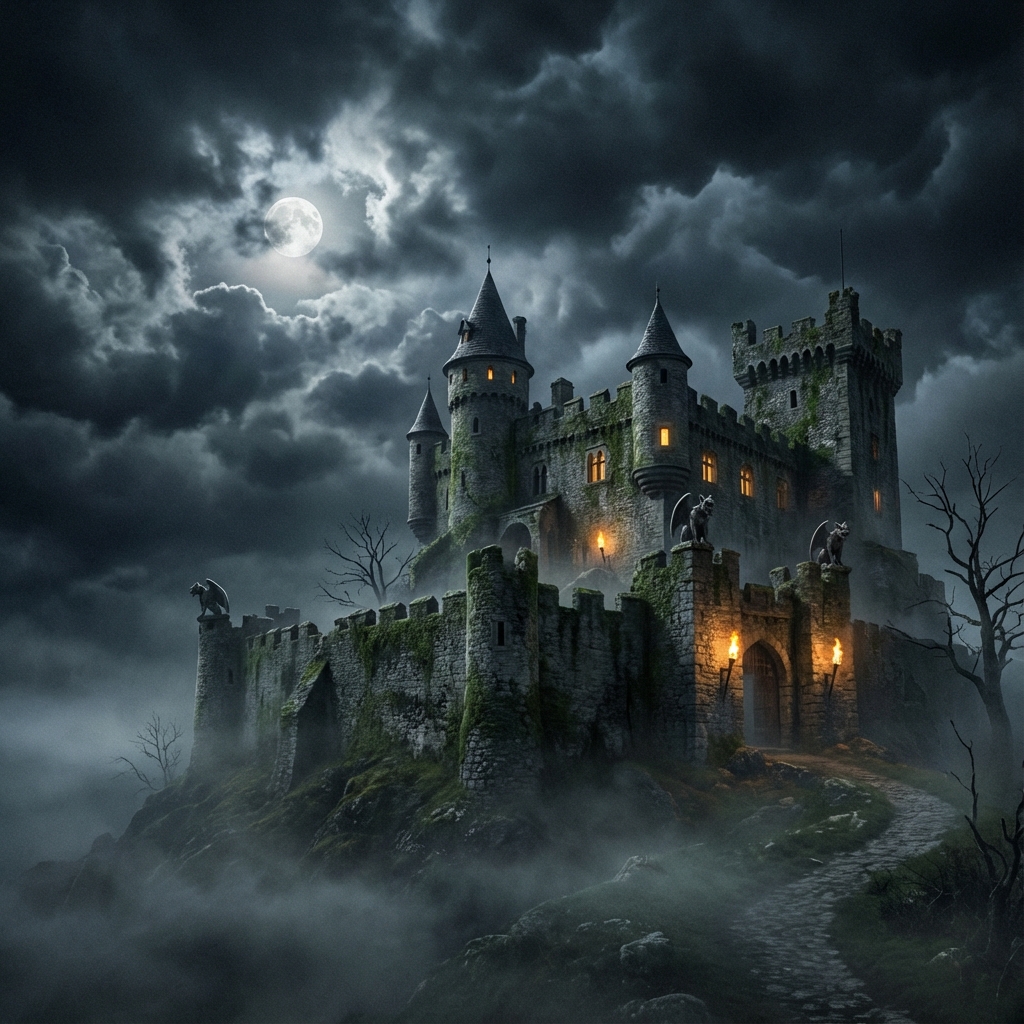
Scotland's Most Beautiful Castle
Set in the fertile valley of Strathmore in Angus, Glamis Castle (pronounced "Glams") is the archetype of a Scottish baronial castle. With its profusion of turrets, towers, and spires rising against the backdrop of the Grampian Mountains, it looks like a storybook illustration. It has been the ancestral seat of the Earls of Strathmore and Kinghorne since 1372. But Glamis is more than just a home; it is a place of legend. It is the fictional setting for Shakespeare's Macbeth, the childhood home of Her Majesty Queen Elizabeth The Queen Mother, and reputedly the most haunted castle in Scotland.
The castle has evolved over six centuries. What began as a medieval L-shaped tower house was transformed in the 17th and 18th centuries into a French-style château, though it retains a distinctly Scottish character with its red sandstone walls. It exudes an atmosphere of ancient majesty and deep mystery that few other buildings can match.
History: Royalty and Rebellion
The land was granted to Sir John Lyon by King Robert II in 1372. The family prospered, marrying into the royal line. The most famous resident in modern times was Lady Elizabeth Bowes-Lyon, who became Queen Elizabeth (wife of King George VI) and later the Queen Mother. She spent her childhood here, and her younger daughter, Princess Margaret, was born at Glamis in 1930—the first royal baby born in Scotland for 300 years. The castle is filled with mementos of her life.
The castle also has a darker history. In 1537, Lady Janet Douglas, Lady of Glamis, was accused of witchcraft and plotting to poison King James V. She was burned at the stake in Edinburgh, and the King seized the castle. It was returned to the family after the King's death, but the tragedy left a mark on the family history and fueled the ghost stories that surround the building.
Architecture: Scottish Baronial Splendor
Glamis is a masterpiece of the Scottish Baronial style. The central tower, the oldest part, has walls 16 feet thick. Over time, wings and turrets were added, creating a complex silhouette. The roofline is a forest of conical towers and chimneys.
The State Rooms
The interior is grand but welcoming. The Drawing Room** features a magnificent barrel-vaulted ceiling with plasterwork from 1621. The **Dining Room** is paneled in oak and can seat 30 guests. The **Crypt**, historically the lower hall of the original tower, is an atmospheric space where the Earls once received their tenants. It is armored with suits of mail and weaponry, and it is here that the ghost of Earl Beardie is said to play cards.
The Duncan's Hall
This is the room traditionally associated with the murder of King Duncan in Shakespeare's Macbeth. Although the historical King Duncan was not killed here (the castle didn't exist in the 11th century), the literary connection is powerful. Shakespeare likely knew of the castle and wove its atmosphere into his "Scottish Play." The room is guarded by a heavy iron yett (gate).
Legends: The Monster of Glamis
Glamis is famous for having "a ghost in every room." The most chilling legend is the **Monster of Glamis**. It is said that a deformed child was born to the family in the early 19th century. To hide the shame, the child was walled up in a secret room and fed through a slit in the wall. He allegedly lived for decades, prowling the ramparts at night. Guests have tried to find the secret room by hanging towels from every window they could find, only to realize from the outside that several windows were towel-less, hinting at a hidden chamber deep within the thick walls.
Another ghost is **Earl Beardie** (Alexander, 4th Earl of Crawford). Legend says he was playing cards on a Sunday and swore he would play until Doomsday if necessary. The Devil appeared and joined the game, winning the Earl's soul. Beardie is said to be heard shouting and rattling dice behind the walls of a bricked-up room.
The **Grey Lady** is believed to be the ghost of Lady Janet Douglas, seen kneeling in the family chapel or wandering the Clock Tower, still seeking justice for her execution. Her presence is said to be peaceful but sorrowful, a reminder of the injustice she suffered.
The Gardens
The castle is surrounded by stunning gardens. The **Italian Garden**, laid out by Countess Cecilia (the Queen Mother's mother), is formal and elegant with yew hedges and a raised terrace. The **Walled Garden** produces fruits and vegetables. The **Macbeth Trail is a woodland walk featuring wooden sculptures depicting scenes from the play (the three witches, King Duncan, etc.), blending nature with literature.
Visitor Information
Getting There
Glamis is located in Angus, about 12 miles north of Dundee and 25 miles northeast of Perth. It is accessible by car (A90 then A94). Public transport involves a bus from Dundee. The drive through the Strathmore valley is scenic.
Tours
Access to the castle is by guided tour only. The guides are excellent storytellers, bringing the family history and the ghost stories to life. Tours last about 50 minutes. Photography is generally not allowed inside the main rooms. The grounds can be explored independently. There is a restaurant and a gift shop on site.
Events
Glamis hosts many events, including the Scottish Transport Extravaganza and the Glamis Proms. It is a working estate, and you might see Highland cattle grazing in the fields nearby, completing the perfect Scottish picture. The combination of royal history, Shakespearean tragedy, and spine-chilling legends makes Glamis a unique destination. Don't forget to visit the exhibition dedicated to the Queen Mother to understand her deep connection to this place.
The Strathmore Estate and Surrounding Lands
Beyond the formidable walls and manicured immediate gardens, the wider Strathmore Estate surrounding Glamis Castle is a proof of centuries of careful land management and rural tradition. The estate spans thousands of acres of lush Angus countryside, encompassing fertile farmland, deep woodlands, and winding river valleys. For generations, the Earls of Strathmore have been not just lords of a castle, but stewards of this vast scenery, balancing agricultural productivity with the preservation of natural beauty. The ancient trees that line the grand avenues leading to the castle have witnessed hundreds of years of history, providing a habitat for diverse local wildlife, including red squirrels and roe deer. The estate also includes several historic tenant farms and scenic estate cottages, built from the same local stone, creating a cohesive architectural harmony across the scenery. Walking through the wider grounds, visitors can appreciate how interconnected the castle is with the rural economy of the region. The changing seasons bring different characters to the estate—from the lively green burst of spring to the haunting, beautiful mists of a Scottish autumn—ensuring that the setting of Glamis remains as stunning and dynamic as the history contained within its ancient stone walls.