The Enchanted Hill
Perched high on a solitary ridge of the Santa Lucia Mountains overlooking the Pacific Ocean, Hearst Castle is a monument to American ambition, limitless wealth, and artistic vision. Officially known as "La Cuesta Encantada" (The Enchanted Hill), this sprawling estate was the private residence of newspaper magnate William Randolph Hearst. It is a place of contradictions: a private home that looks like a European palace, a working ranch that housed a zoo, and a construction project that lasted 28 years yet was never truly finished.
A Creative Partnership: Hearst and Morgan
The story of Hearst Castle is the story of a unique and enduring partnership between a wealthy patron and a brilliant architect. In 1919, Hearst inherited the land from his mother, Phoebe Apperson Hearst. He had spent his childhood camping on this hill in tents with his family, but by his late 50s, he desired something more comfortable. He famously told the architect Julia Morgan, "Miss Morgan, we are tired of camping out in the open at the ranch in San Simeon and I would like to build a little something."
That "little something" grew into a castle with 165 rooms and 127 acres of gardens, terraces, pools, and walkways. Julia Morgan, the first woman to be licensed as an architect in California, was the engineering genius behind the vision. She designed the structures to withstand earthquakes (using reinforced concrete) while incorporating Hearst's massive collection of European antiques. For nearly three decades, they collaborated on every detail, from the placement of a specific tile to the framing of the ocean views.
Architecture and Collections
The estate consists of the main house, Casa Grande, which dominates the skyline with its twin bell towers, and three large guest cottages: Casa del Mar, Casa del Monte, and Casa del Sol. The architecture is a pastiche of Spanish Colonial Revival, Mediterranean Revival, and Gothic styles, modeled after cathedrals and palaces in southern Spain.
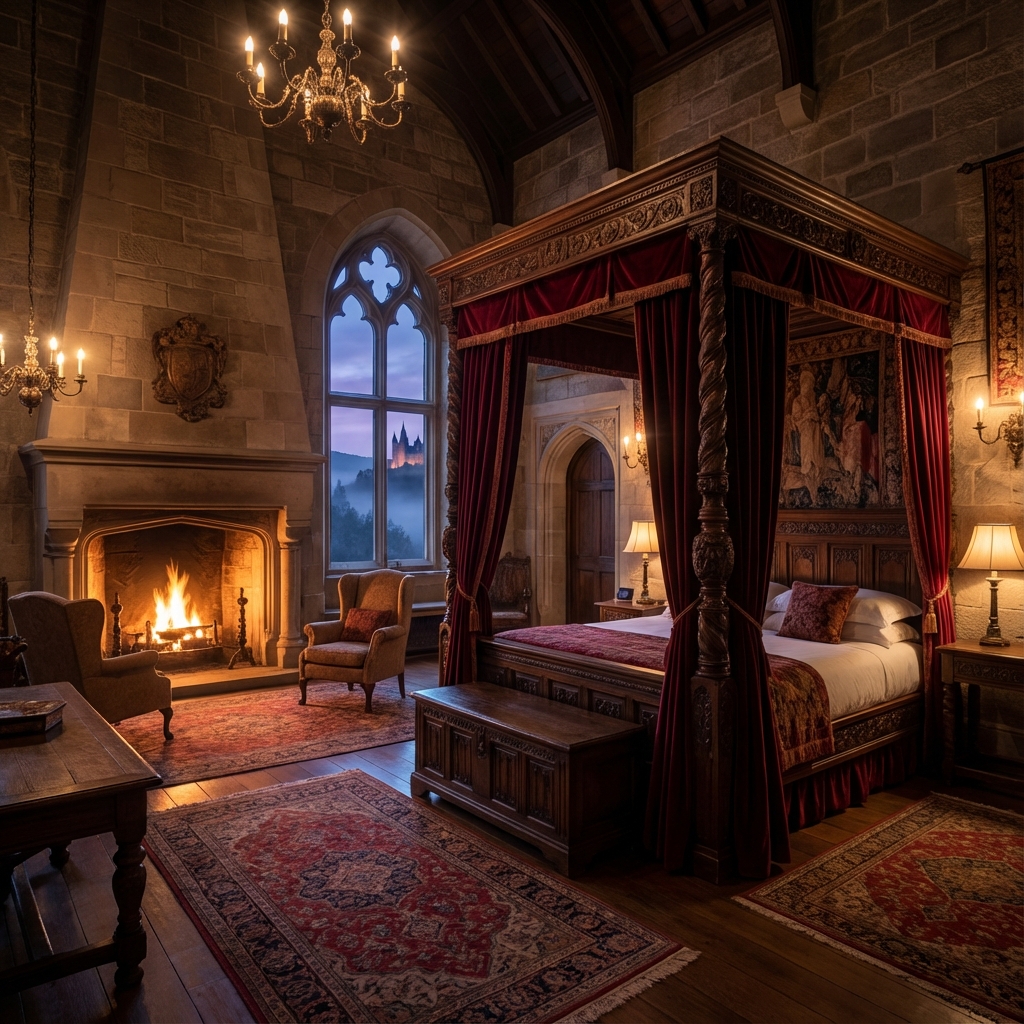
Hearst was a voracious collector who scoured Europe for art. He bought entire ceilings from Spanish monasteries, Gothic fireplaces from French chateaus, Greek vases, and medieval tapestries, and had them shipped to California. Morgan's challenge was to design rooms around these specific objects. As a result, the castle serves as a museum where the building itself is the display case.
The Gothic Study is the heart of Hearst's private suite. Located on the third floor of Casa Grande, it features a vaulted ceiling painted with intricate designs and filled with rare books. It was here that Hearst would preview the newspapers of his empire every night before they went to press, controlling public opinion across America from his remote hilltop fortress.
The Legendary Pools
Hearst Castle is world-famous for its two swimming pools, which are works of art in themselves.
- The Neptune Pool: Located outdoors, this pool is the centerpiece of the estate. It was rebuilt three times to suit Hearst's changing tastes. The final version is 104 feet long, filled with filtered spring water, and surrounded by ancient Roman columns and statues. It offers a sweeping view of the Pacific coastline and looks like a resurrected temple from antiquity.
- The Roman Pool: Located indoors, this pool is modeled after the ancient Roman baths of Caracalla. It is a stunning cavern of blue and gold. The entire room—walls, ceiling, and pool floor—is covered in mosaic tiles, fused with 22-karat gold leaf. The reflection of the marble statues in the still, dark blue water creates a surreal, dreamlike atmosphere. It was rarely used by guests, serving more as a showpiece of Hearst's extravagance.
Hollywood's Playground
In its heyday during the 1920s and 30s, Hearst Castle was the social hub of the Hollywood elite. An invitation to San Simeon was the most coveted ticket in town. Guests would arrive by private train or plane to spend weekends at "The Ranch." Regulars included Charlie Chaplin, Cary Grant, the Marx Brothers, Greta Garbo, Clark Gable, and Winston Churchill.
Despite the palatial surroundings, Hearst insisted on a certain informality, referring to the estate simply as "the ranch." Guests were free to enjoy the estate's amenities during the day—riding horses, playing tennis, or swimming—but everyone was expected to gather in the Assembly Room for cocktails at 7:30 PM sharp, followed by dinner in the Refectory. Hearst sat at the center of the long table, and the seating arrangement was a subtle indicator of one's current standing with the host. In a quirky juxtaposition of high and low culture, bottles of ketchup and mustard were placed on the long refectory tables alongside the antique silverware and candelabras, a reminder of the camping days.
The Zoo and Wildlife
Hearst created what was, at the time, the world's largest private zoo. The "Hearst Garden of Comparative Zoology" housed exotic animals including polar bears, lions, tigers, leopards, and chimpanzees in enclosures near the castle. The hillsides were fenced off to create a vast open-range preserve for grazing animals like camels, yaks, ostriches, and kangaroos.
While the zoo was dismantled in the 1930s due to financial difficulties, the legacy remains. Descendants of the original herd of zebras still roam the hillsides along Highway 1 near the castle. Seeing them graze alongside cattle is a surreal experience for drivers on the Pacific Coast Highway and a living reminder of the estate's eccentric past.
Visitor Information
In 1957, the Hearst Corporation donated the property to the State of California. Today, it is a State Historical Monument attracting millions of visitors. Access is only possible via guided tours, which start at the Visitor Center at the bottom of the hill. A bus takes visitors up the winding five-mile road to the castle, playing a narrated history along the way.
There are several tour options, but the Grand Rooms Tour is the recommended first-time experience, covering the Assembly Room, Refectory, Morning Room, Billiard Room, and Theater. Seasonal night tours are also available, where docents dress in 1930s period clothing, allowing visitors to experience the castle as if they were guests at one of Hearst's legendary parties.