A Romantic Fortress on Holy Island
Perched atop a volcanic plug known as Beblowe Crag, Lindisfarne Castle is one of the most distinct and atmospheric landmarks in Northumberland. It stands on Holy Island (Lindisfarne), a tidal island that is cut off from the mainland twice a day by the rising North Sea. While the island is famous for its ancient priory and the first Viking raid in 793 AD, the castle itself is a much later addition, a Tudor fort turned into an Edwardian holiday home. It sits like a ship stranded on a rock, its silhouette visible for miles.
The ride across the causeway to reach it is part of the adventure. As you cross the sands, with the sea visible on both sides, you leave the modern world behind and enter a place governed by the tides.
History: From Garrison to Gentleman's Retreat
The history of Lindisfarne Castle falls into two distinct halves: the military and the domestic.
The Military Fort (1550-1901)
Following the Dissolution of the Monasteries by Henry VIII, the priory on the island was closed. However, the strategic harbor needed protection from the Scots and the French. In 1550, stones from the ruined priory were used to build a fort on the highest point of the island. For 350 years, it was a rugged military garrison, housing soldiers and heavy guns. Its location was strategic but its accommodation was spartan and cold. It saw little action, though it was briefly captured by Jacobite rebels in 1715 (for one day). By the late 19th century, it was decaying and used by the coastguard.
The Lutyens Renovation (1901-Present)
The castle we see today is largely the vision of two creative geniuses: the Arts and Crafts architect Sir Edwin Lutyens and the garden designer Gertrude Jekyll. In 1901, the castle was bought by **Edward Hudson**, the wealthy owner of Country Life magazine. Hudson fell in love with the building's romantic isolation and hired his friend, Edwin Lutyens, to turn the decaying garrison into a comfortable gentleman's retreat. Lutyens' genius lay in his ability to modernize the castle without destroying its rugged character.
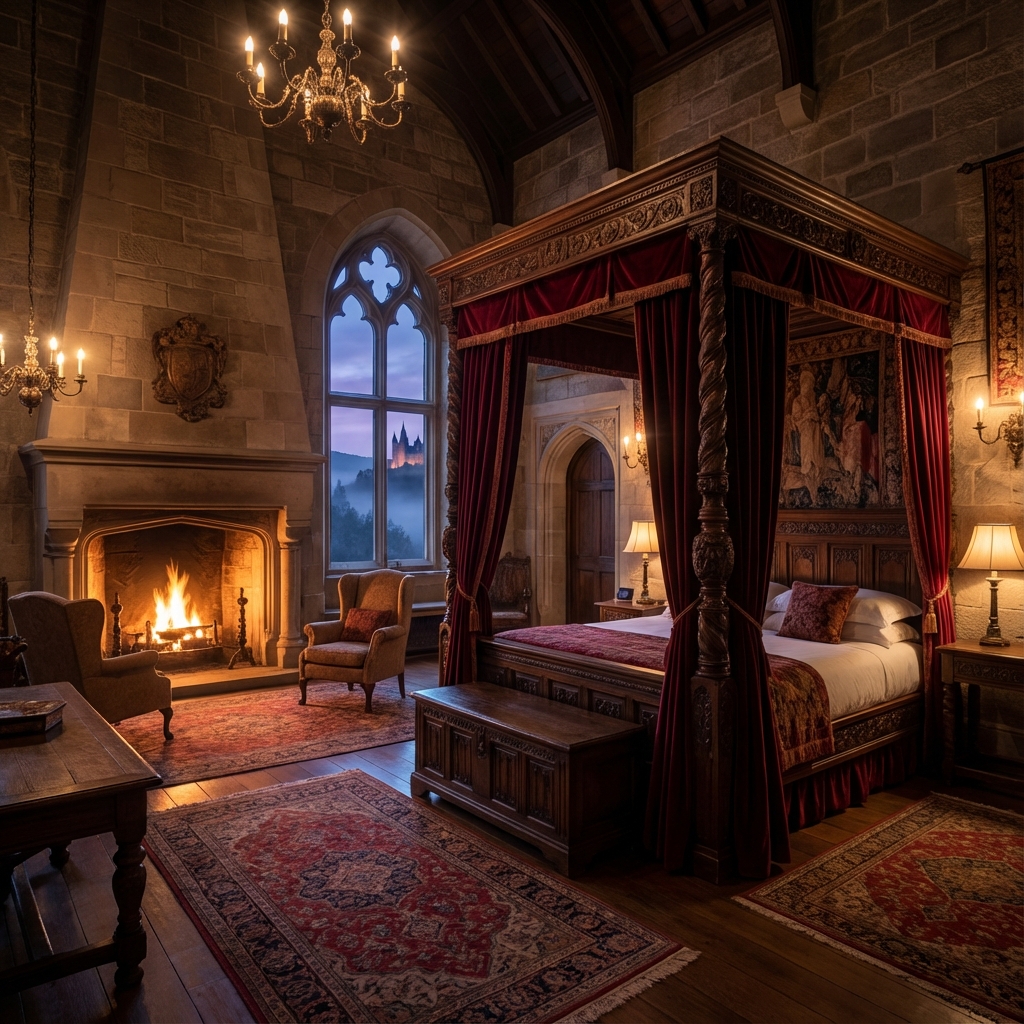
Lutyens introduced cozy features into the cold stone vaults. He created the **Ship Room** from an old store, using a recycled ship's beam to support the ceiling. The **Long Gallery** was designed to resemble the nave of a church, playing on the island's religious history. The furniture, much of it oak and heavy, was chosen or designed to fit the scale of the stone rooms. The result is a quirky, labyrinthine home where passageways twist and turn, following the erratic shape of the volcanic rock beneath. It feels ancient, yet domestic. The windows, deepened by Lutyens, frame specific views of the sea and the coastline like paintings.
Gertrude Jekyll's Walled Garden
A short walk from the castle lies the **Walled Garden**, designed by Lutyens' longtime collaborator, **Gertrude Jekyll**. Created in 1911 on the site of the fort's old vegetable patch, it was intended to provide a burst of color and softness against the grey stone and the wild, windswept coast.
Jekyll was a master of planting drifts of color. The garden is planted with hardy annuals, perennials, and heritage vegetables that can withstand the coastal gales. In summer, it is a riot of orange poppies, blue cornflowers, and sweet peas. It remains one of the few surviving examples of a Jekyll garden that is still planted according to her original plans. It is a small oasis of calm and beauty in a harsh scenery. The garden slopes downwards, protecting the plants from the worst of the wind, and the stone walls radiate heat to help them grow.
The Lime Kilns: Icons of Industry
Looming large near the castle are the massive 19th-century **Lime Kilns**. These industrial structures were used to burn limestone (quarried on the island) into quicklime for agricultural fertilizer and mortar. They are some of the best-preserved kilns in England and offer a glimpse into the island's industrial past, a sharp contrast to its spiritual and military history. They were once fueled by coal brought by ships, and the finished lime was exported from the jetty. Visitors can walk into the huge arches where the fires once burned, which feel like the naves of a brick cathedral.
Film and Culture
The stark, dramatic silhouette of Lindisfarne Castle has made it a favorite location for filmmakers. It famously stood in for the castle of 'Cul-de-Sac' in Roman Polanski's 1966 psychological thriller. More recently, it appeared in the 1971 version of Macbeth directed by Polanski, where its brooding atmosphere perfectly matched the tragedy of the play. It has also featured in TV series such as Cold Feet and Wolfblood. The isolation of the island, cut off by the tide, provides a natural suspense that directors love.
Visiting Lindisfarne
Visiting the castle requires careful planning due to the tides. **You must check the tide tables before you travel.** The causeway is submerged for several hours a day, and cars get stranded every year. It is dangerous to attempt to cross when the tide is coming in.
Getting There
Holy Island is accessible by a causeway from Beal. Park in the main village car park. The walk to the castle takes about 20 minutes along the harbor, or you can take the shuttle bus that runs from the car park to the castle. The walk is scenic, passing the ruined priory and the upturned boat sheds.
The Views
The **Upper Battery** offers spectacular panoramic views. To the south, you can see Bamburgh Castle standing on its own rock. To the east lie the Farne Islands. To the north, you can see the Cheviot Hills and the Scottish border. It is a perfect spot for photography, arguably offering one of the best coastal views in Britain.
Wildlife
The mudflats around the castle are a haven for birds, including pale-bellied brent geese which migrate here from the Arctic in winter. Grey seals are often seen basking on the sandbanks at low tide. The "song" of the seals—a haunting howling noise—can often be heard from the castle walls, adding to the atmospheric nature of the site.