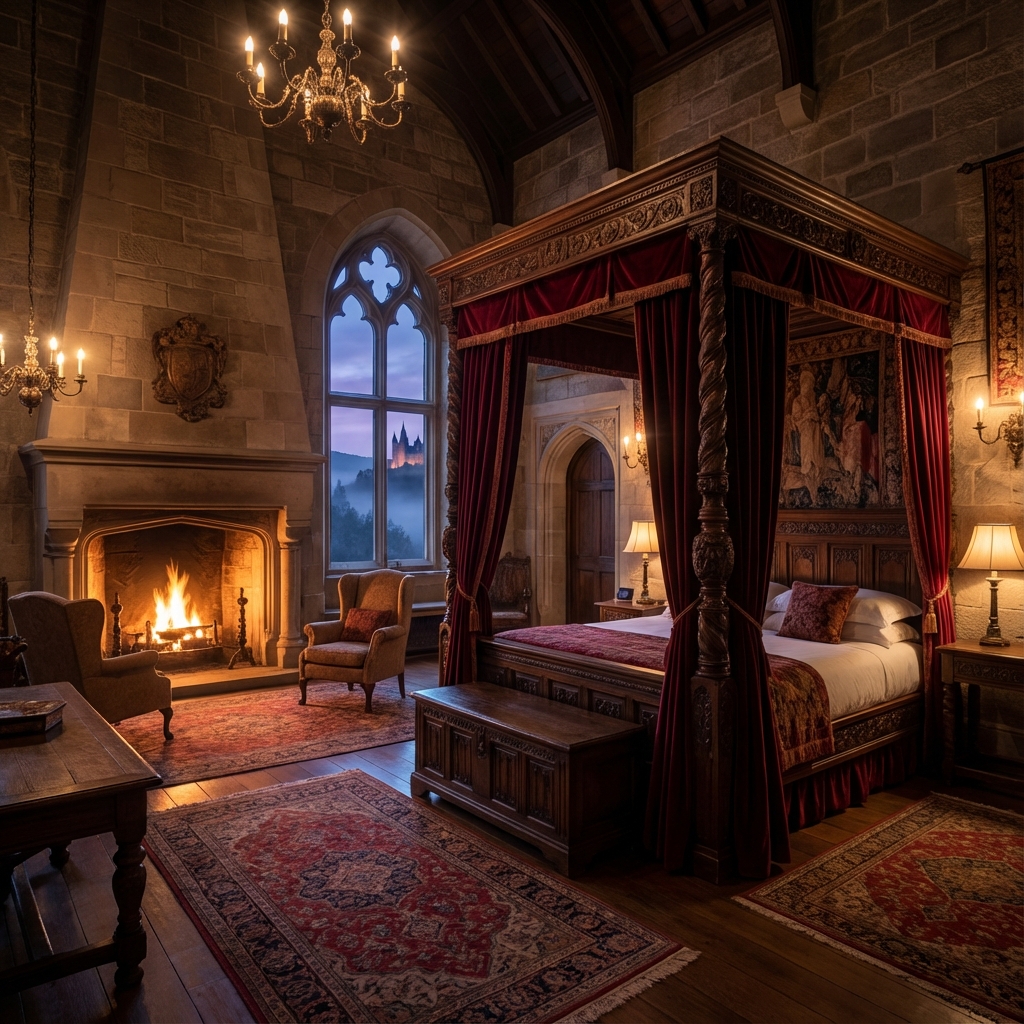
The Birthplace of the Tudor Dynasty
Standing on a rocky ridge surrounded on three sides by the Pembroke River, Pembroke Castle is one of the most formidable fortresses in Wales. It is a place of sheer scale and military might, a Norman powerhouse that dominated West Wales for centuries. But its greatest claim to fame is not just its walls, but a single event that happened within them. On a cold winter's day in 1457, a 13-year-old widow named Margaret Beaufort gave birth to a son in one of the castle towers. That boy was Harri Tudur—better known to history as King Henry VII, the founder of the Tudor dynasty and the father of the infamous Henry VIII.
Today, Pembroke Castle is a Grade I listed monument and one of the largest privately-owned castles in Wales. It offers a fascinating mix of medieval military architecture, royal history, and even prehistoric mystery, thanks to the vast cavern that lies beneath its foundations.
From Wooden Palisade to Stone Fortress
The first castle at Pembroke was built in 1093 by Arnulf de Montgomery, a Norman baron. It was a simple "motte and bailey" structure made of wood and earth. Despite its flimsy materials, it was surprisingly effective, withstanding a siege by the Welsh almost immediately. However, the stone colossus we see today is largely the work of William Marshal, the Earl of Pembroke.
William Marshal (c. 1146–1219) is often called "The Greatest Knight." He served five English kings, was a champion jouster, and was arguably the most powerful man in the kingdom next to the monarch. When he acquired Pembroke in 1189 through marriage, he set about transforming it into a state-of-the-art stone fortress. He built the Great Keep and the inner ward, using the latest military technology he had seen during his travels and crusades.
The Great Keep: A Masterpiece of Defense
The crowning glory of Marshal's castle is the Great Keep. Built around 1200, it is a massive cylindrical tower that stands over 75 feet (23 meters) high. Unlike the square keeps of earlier Norman castles (like the White Tower in London), a round keep has no vulnerable corners for miners to attack and offers better angles of fire.
The walls are nearly 20 feet (6 meters) thick at the base. But the most remarkable feature is the roof. It is a stone dome, a massive architectural achievement for its time. It was likely used as a fighting platform and possibly a water catchment system. Visitors today can climb the spiral staircase to the top for a stunning view of the town and the coast.
The Wogan Cavern
Beneath the castle lies a secret that predates the Normans by millennia. A large natural limestone cave, known as the Wogan, opens directly onto the river. It has been used by humans since the Paleolithic era; flint tools and bones of mammoths have been found there.
During the Middle Ages, the Wogan was incorporated into the castle's defenses. A spiral staircase was cut through the rock to connect the cave to the castle above. This allowed the garrison to be resupplied by boat from the river, even when the castle was besieged from the land. It was a vital lifeline that made Pembroke nearly impossible to starve out.
The Tudor Connection
The Wars of the Roses saw the castle change hands multiple times between the Yorkists and the Lancastrians. It was during this turbulent period that Jasper Tudor, the Earl of Pembroke and half-brother to King Henry VI, brought his young sister-in-law, Margaret Beaufort, to the safety of the castle. She was only 13 years old and pregnant.
Henry VII was born in the Henry VII Tower (formerly a guard tower). It is a humble setting for the birth of a dynasty that would change England forever. Henry spent his early childhood at Pembroke before being forced into exile in Brittany. He would not return until 1485, when he landed nearby at Mill Bay, marched to Bosworth Field, and claimed the crown.
The Civil War and Ruin
Pembroke Castle's military career ended in the 17th century during the English Civil War. At first, the town and castle declared for Parliament. However, in 1648, the garrison commander John Poyer switched sides to the Royalists because he hadn't been paid. This led to the Second Civil War.
Oliver Cromwell himself came to besiege Pembroke. The siege lasted seven weeks. It only ended when Cromwell's artillery managed to smash the castle's water pipe, cutting off the supply. After the surrender, Cromwell ordered the castle to be "slighted" (destroyed). The barbican towers were blown up, and the front walls were demolished. The castle remained a ruin until the 20th century.
Restoration and the Philipps Family
In 1928, the ruins were bought by Major-General Sir Ivor Philipps. He embarked on a massive restoration project, rebuilding the walls and gatehouses. His family still owns and manages the castle today, maintaining it as a major tourist attraction.
Legends of the Castle
Like any good Welsh castle, Pembroke has its ghosts. The most poignant legend is that of the "White Lady." She is said to be a woman who threw herself from the windows of the Northern Hall after seeing her lover killed in a duel or battle. She is often seen gliding along the cliff path or near the dungeon tower.
Another story involves the Wogan cave. Local folklore claims a dragon or a "gwiber" (wyvern) once lived in the cave, terrorizing the countryside until it was slain by a local hero. While unlikely, the dark, echoing cavern certainly feels like the sort of place a dragon would hide.
Planning Your Visit
Pembroke is located in Pembrokeshire, South West Wales. The castle dominates the Main Street.
- The Exhibition Rooms: Several towers contain excellent tableaux and exhibitions explaining the history. You can see life-size models of medieval soldiers, a recreation of Henry VII's birth, and a display about the Civil War siege.
- The Map of Wales: In the center of the castle courtyard is the largest map of Wales in the world. It is painted on the ground and marks the location of every major castle and cathedral in the country. It's great for kids to run around on and plan future trips.
- Events: The castle is a hub for community events, hosting rock concerts, Christmas markets, and "Knight School" for children during the holidays.
- Falconry: On selected days, falconry displays are held in the grounds, allowing you to see birds of prey flying against the backdrop of the Norman walls.
Pembroke Castle is a place of beginnings and endings. It saw the birth of the Tudor dynasty and the end of the Civil War in Wales. Walking its walls, with the wind blowing in from the Irish Sea, you can feel the weight of history in every stone.