The Guardian of the Moselle
Dominating the scenery of the Moselle Valley, Reichsburg Cochem (Cochem Imperial Castle) is the quintessential image of a German river castle. Perched on a steep hill more than 100 meters above the winding river, its silhouette of slate-roofed towers, battlements, and oriel windows is visible for miles. Surrounded by steep, terraced vineyards that produce the region's famous Riesling, it watches over the colorful town of Cochem below. While it looks like a perfect medieval fortress, what visitors see today is largely a 19th-century dream of the Middle Ages, a romantic reconstruction that tells a story of destruction and rebirth.
It is not just a monument; it is a survivor. For 180 years, it was a hollow ruin, a scar on the hill. Its resurrection in the 1870s transformed it into a comfortable summer residence for a wealthy Berlin family, blending neo-Gothic architecture with Renaissance luxury. It stands as a prime example of the 19th-century "Castles of the Rhine" romanticism.
History: Emperors and Entrepreneurs
The original castle dates back to the early 11th century (around 1000 AD). It was a "Toll Castle," used to collect taxes from ships passing on the river. In 1151, King Konrad III occupied the castle and declared it an "Imperial Castle" (Reichsburg), placing it under direct royal administration. For centuries, it was a pawn in the power struggles of the Holy Roman Empire, guarding the imperial estates along the Moselle.
Disaster struck in 1689. During the Nine Years' War (War of the Palatine Succession), the troops of the French King Louis XIV, famously known as the "Sun King," invaded the Rhineland. They captured Cochem, looted the castle, set it on fire, and blew up the keep. The proud fortress was reduced to rubble, a victim of the scorched-earth policy.
It remained a ruin until 1868, when Louis Ravené, a wealthy Berlin steel merchant and art lover, bought the site for a nominal fee. Ravené was part of the romantic movement that sought to revitalize German history. He didn't want an archaeological reconstruction; he wanted a comfortable, modern holiday home that looked like a medieval castle. The rebuilding was completed in 1877. In 1942, the Ravené family was forced to sell it to the Nazi government. After the war, it became the property of the state and eventually the town of Cochem.
Architecture: Neo-Gothic Romance
The architecture is a prime example of the Neo-Gothic style (Historicism). The architects incorporated the few remaining medieval walls (like the "Witches Tower") into a new, fantastical structure. The main tower, with its four corner turrets, is the focal point. One of the most striking features is the massive mosaic of St. Christopher on the facade of the keep. Saint Christopher is the patron saint of travelers, and his image overlooks the river, symbolically protecting the boats below. The lively colors of the mosaic are a distinctive landmark.
The Interiors
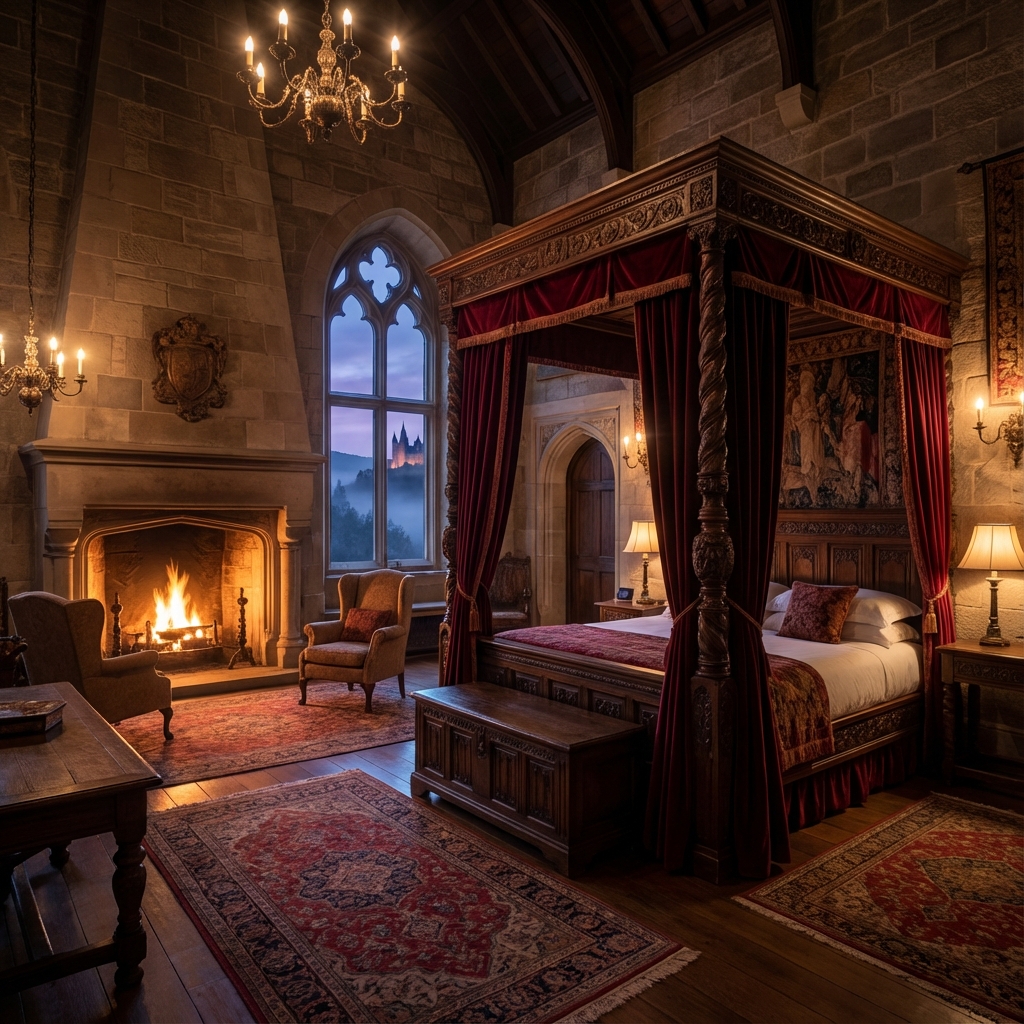
Unlike the cold stone halls of a real medieval fort, the interiors of Reichsburg Cochem are warm and luxurious. Ravené filled the rooms with a valuable collection of Renaissance and Baroque furniture, wood carvings, and paintings. The Dining Hall features a magnificent coffered ceiling and heavy oak sideboards. The Knights' Hall (Rittersaal) is the largest room, with a ribbed vault ceiling supported by massive pillars. It is decorated with paintings of classical virtues. One curious feature is the "Mermaid Chandelier" made of antlers and a carved mermaid figure—visitors rub her belly for good luck.
The Secret Passage
Like any good castle, Cochem has a secret passage. It supposedly leads from the castle down into the town. While the full length is likely a legend, there are hidden staircases and passages within the thick walls that allowed servants (or the family) to move unseen between floors.
Legends: The "Knippchen"
The most famous legend of the castle involves a trick. In the medieval period, a group of knights planned to attack the castle. The Lord of Cochem was away, and the defense was left to the women. The women realized they were outnumbered. In a stroke of genius, they put on the men's armor and stood on the battlements, making a lot of noise and banging their shields. The attackers, seeing what looked like a massive, fresh garrison, decided the castle was too well-defended and retreated. The hill where they camped is still called the "Knippchen" (a local term for a small hill), and the story celebrates the cunning of the Cochem women.
Visitor Information
Getting There
Cochem is located in the Rhineland-Palatinate state, easily reachable by train from Koblenz or Trier. The train ride along the Moselle is one of the most scenic in Germany. From the town center, you can hike up to the castle (about 15-20 minutes, steep but rewarding) or take the "Reichsburg Shuttle" bus in the summer.
Tours and Feasts
The castle can only be visited by guided tour (approx. 40 minutes). Tours are available in German and English. The guides are known for their humor and storytelling. For a more immersive experience, the castle offers "Knights' Feasts" (Rittermahl) on Friday and Saturday evenings. Guests are treated to a medieval banquet with mead and wine, entertained by minstrels and jesters, and even "knighted" by the castellan. It is a touristy but incredibly fun way to experience the atmosphere.
The Falconry
There is also a falconry center at the castle, offering flight demonstrations with eagles, falcons, and owls. Watching these birds soar over the valley with the castle as a backdrop is a highlight for many visitors. The combination of history, nature, and wine makes Cochem a perfect destination.
The Moselle Wine Region
No visit to Reichsburg Cochem is complete without exploring the wine culture of the Moselle Valley. The steep, slate-terraced vineyards surrounding the castle produce some of Germany's finest Rieslings—lean, mineral, and aromatic. The local cooperative, the Cochemer Winzergenossenschaft, offers tastings in the town below. The combination of the castle's silhouette reflected in the river, the rows of terraced vines rising to the battlements, and a glass of crisp local Riesling in hand defines the Rhineland experience. Many visitors combine the castle with a river cruise along the Moselle, watching the scenery unfold from the water—arguably the finest way to appreciate how the castle once dominated this strategic stretch of the river.