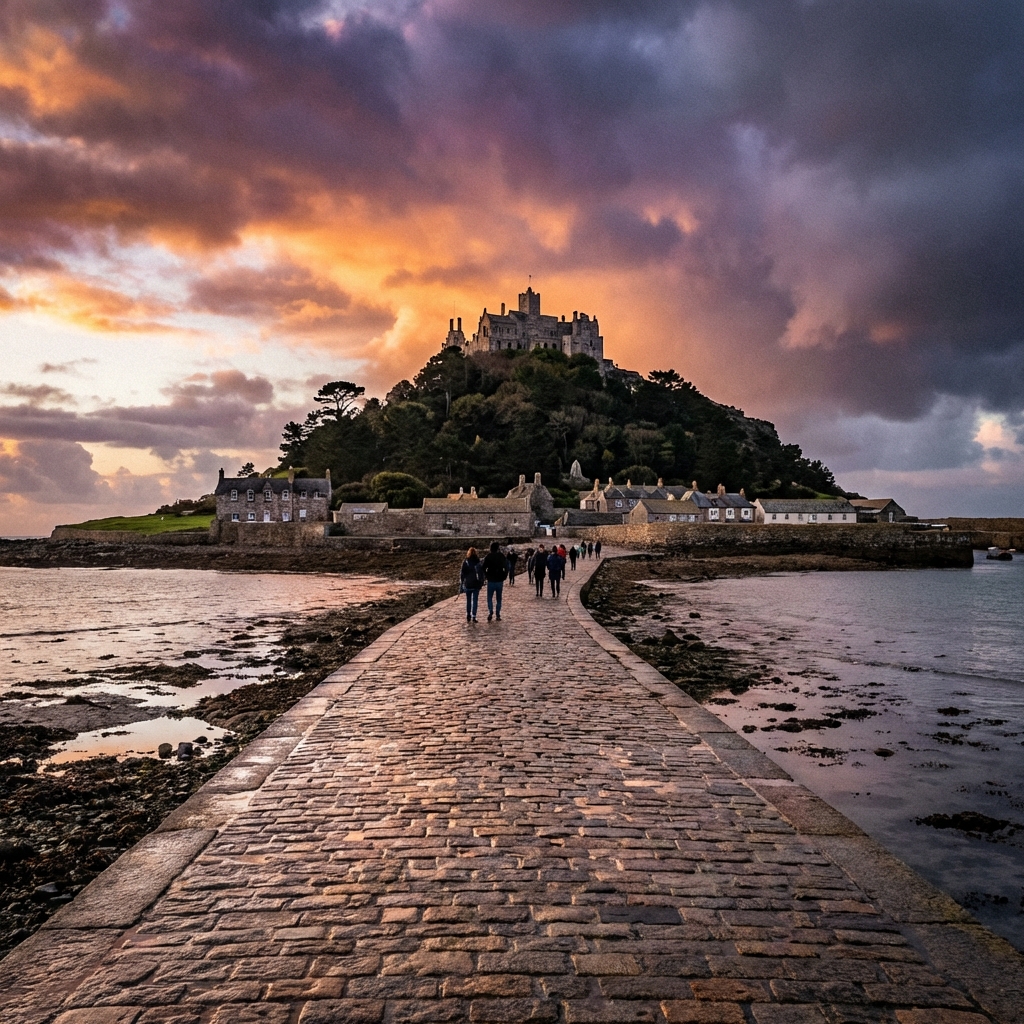
The Tidal Jewel of Cornwall
Rising dramatically from the waters of Mount's Bay, just off the coast of Marazion in Cornwall, St Michael's Mount is a place of magic, myth, and history. It is a tidal island—a granite crag crowned with a medieval church and castle that looks like something out of a fairy tale. For thousands of years, it has drawn pilgrims, giants, and soldiers. Today, it draws travelers from around the world who come to witness the daily miracle of the tide revealing the ancient granite causeway that connects the island to the mainland.
Often confused with its larger French 'cousin', Mont Saint-Michel in Normandy, St Michael's Mount shares a similar conical shape and Benedictine history. In fact, for centuries, the Cornish mount was a priory belonging to the French abbey. However, after the dissolution of the monasteries by Henry VIII and the English Civil War, it evolved into a fortress and eventually a grand family home.
The St Aubyn Legacy
Since 1650, the St Aubyn family has called the Mount home. Colonel John St Aubyn, a Parliamentarian during the Civil War, was appointed Captain of the Mount, and eventually bought it. For over 350 years, his descendants have lived within these stone walls, transforming a grim fortress into a comfortable (albeit unusual) residence. In 1954, the 3rd Lord St Levan gave the island to the National Trust to ensure its preservation, but the family retained a 999-year lease to live in the castle. Lord St Levan and his family still live there today, managing the island in partnership with the Trust.
The Legend of Cormoran the Giant
Before knights and monks, folklore says the Mount was the home of Cormoran, a fearsome giant. Cormoran had six fingers on each hand and six toes on each foot. He terrorized the mainland, wading across the water to steal cows and sheep from the farmers to satisfy his enormous appetite.
One moonlit night, a local boy named Jack swam across to the island. He dug a deep pit near the giant's cave and covered it with sticks and straw. As the sun rose, Jack blew his horn to wake the giant. Enraged and groggy towards the intruder, Cormoran rushed down the hill and fell straight into the pit. This feat earned the boy the legendary title of 'Jack the Giant Killer'.
The Giant's Heart
As you walk up the steep cobblestone path to the castle, keep your eyes on the ground. You will find a small, heart-shaped stone set amongst the granite setts. Legend has it that this is the heart of Cormoran. It is said that if you stand on it and listen closely, you can still hear the giant's heartbeat—though skeptics might say it's just the pounding of the waves!
Inside the Castle
The climb to the top is steep, but the castle interiors are worth the effort. They are a fascinating mix of the domestic and the monastic.
- The Chevy Chase Room: The former refectory of the monks, this is the most spectacular room in the castle. It features a plaster frieze dating from the 17th century that depicts hunting scenes ('Chevy Chase' refers to a medieval ballad about a hunt, not the actor!).
- The Blue Drawing Room: A refined 18th-century salon with Chippendale furniture and strawberry hill gothic decor. It feels world's away from the rugged cliffs outside.
- The Map Room: Here you can see the table and chairs used by Queen Victoria and Prince Albert when they visited the Mount unannounced in 1846. The steward, flustered by the Royal surprise, only had a simple lunch to offer them.
- The Armoury: A small collection containing weapons captured from Napoleon's forces, and even a piece of the Emperor's coat worn at the Battle of Waterloo.
The Hanging Gardens
Despite being battered by salt spray and Atlantic gales, the gardens of St Michael's Mount are a botanical miracle. They thrive thanks to the 'Gulf Stream effect'—warm ocean currents that create a microclimate free from frost. The granite rock absorbs heat during the day and releases it at night.
Creating a garden on a vertical cliff face is an extreme sport. The gardeners here have to abseil down the rock face to weed the terraces! You will find aloe, agave, lavender, and other Mediterranean plants clinging to the cliff. The Walled Garden, originally the monks' vegetable patch, now blooms with vivid colors. Note that the garden has limited opening hours due to the fragility of the stone terraces.
Visitor Information
Visiting the Mount requires checking the tide times, which change daily.
- Low Tide: When the tide is out, you can walk across the ancient granite causeway from Marazion beach. It takes about 10-15 minutes. The cobbles can be wet and uneven, so wear good shoes.
- High Tide: When the water covers the causeway, you must take a boat. Small motorboats ferry passengers back and forth for a small fee. This adds a sense of adventure to the arrival.
- The Village: The island has a small village at its base with a harbor, a café, and shops. This area usually remains free to access (depending on the season), while the castle and gardens require a ticket.
- Accessibility: The path to the castle is steep, uneven, and cobbled. It is not suitable for wheelchairs or pushchairs. There is a 'Summit Chair' vehicle for those with limited mobility, but it must be booked weeks in advance.
Frequently Asked Questions
- Is it a real island?
- Yes, but it is a 'tidal island'. It is connected to the land for about 4 hours during low tide and surrounded by water for the rest of the day.
- DO people really live there?
- Yes, about 30 people live permanently on the island. This includes the St Aubyn family in the castle and island staff (boatmen, gardeners, maintenance crew) who live in the village cottages.
- Can I bring my dog?
- Dogs are allowed in the village and harbor area but are NOT allowed in the castle or the gardens (except assistance dogs).