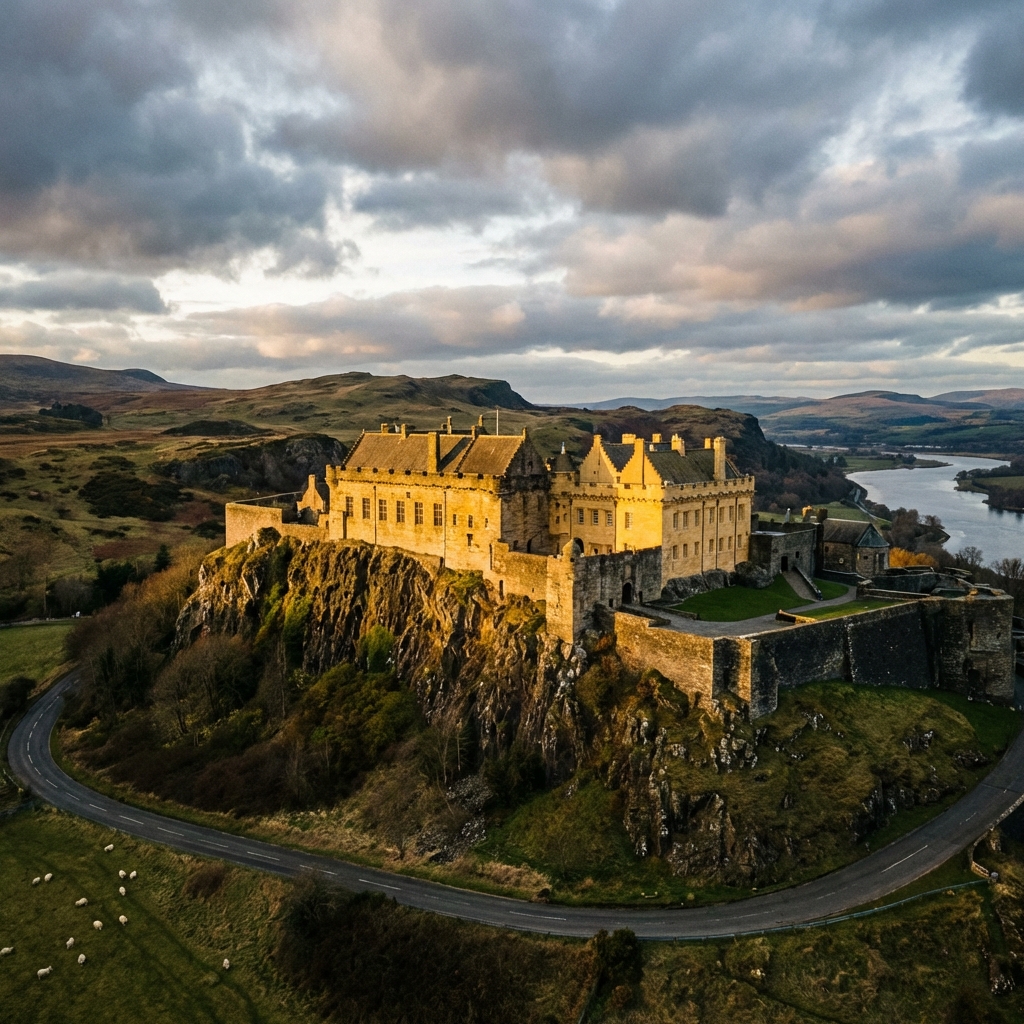
The Key to the Kingdom
Stirling Castle is arguably the most strategically important real estate in Scottish history. Strategists have long said, "He who holds Stirling, holds Scotland." Sitting invincibly on top of a 250-foot volcanic crag (Castle Hill), it blocks the only viable route between the Lowlands and the Highlands. If you wanted to march an army north or south, you had to pass Stirling.
Because of this, it has seen more war than almost any other place in Britain. It has been besieged **26 times**—more than Edinburgh Castle. It was the prize fought over by William Wallace and Robert the Bruce. But it wasn't just a fortress; it was a home. It was the childhood sanctuary of **Mary, Queen of Scots** and the favorite residence of the Stuart Kings, who turned it from a grim military outpost into a flamboyant Renaissance Palace filled with art, color, and music.
The Brutal Murder of the Earl of Douglas
In 1452, Stirling Castle witnessed one of the most shocking violations of hospitality in medieval history: a King murdering a guest with his own hands.
King James II was threatened by the growing power of the Black Douglases, a noble family that rivaled the Crown itself. He invited the **8th Earl of Douglas**, William, to Stirling for dinner to negotiate. To convince him to come, the King issued a signed "Safe Conduct" pass, guaranteeing his safety.
They dined in a small chamber now known as the **Douglas Room**. After the meal, the King demanded that Douglas break his alliance with other rebel lords. Douglas refused. In a fit of explosive rage, the King shouted, "If you will not break the bond, this shall!" and drove his dagger into the Earl's neck. The King's courtiers then swarmed in, stabbing the Earl 26 times before grabbing his bleeding body and hurling it out of the window into the garden below.
Today, visitors can stand in the Douglas Room and look out of the very window where the Earl met his end. In 1797, workmen digging in the garden below found a human skeleton, believed to be the unfortunate Earl.
The Battle of Bannockburn
The view from the castle ramparts is more than just scenic; it is a tactical map of Scottish independence. Looking south, you can clearly see the field of **Bannockburn**.
In 1314, King Robert the Bruce faced the massive army of King Edward II of England here. Despite being outnumbered three to one, Bruce used the terrain (which you can see from the walls) to trap the English cavalry in the marshy ground of the Bannock Burn. It is said that Edward II's wife watched from the castle walls as her husband's army was slaughtered in the mud. The victory secured Scotland's independence for centuries. Nearby, you can also see the **National Wallace Monument**, commemorating William Wallace's victory at Stirling Bridge in 1297.
The Stirling Heads: Scotland's Crown Jewels
One of the most unique features of Stirling is the ceiling of the King's Inner Hall. It is adorned with huge, brightly colored oak medallions known as the **Stirling Heads**. These are arguably as valuable as the Crown Jewels.
Carved around 1540 for King James V, these meter-wide portraits depict a mix of real and mythical figures: Roman Emperors, Hercules, Kings, Queens, and even court jesters. They were designed to send a message to powerful foreign visitors: the Scottish King was a man of culture, Renaissance learning, and European power. The heads you see on the ceiling today are painstakingly hand-carved replicas (the paint colors are based on microscopic analysis of the originals), while the surviving 16th-century originals are displayed in the special gallery upstairs. Getting eye-to-eye with these intense wooden faces is a highlight of the visit.
The Great Hall
The **Great Hall**, built by James IV around 1503, is the largest medieval banqueting hall in Scotland. For centuries, it was disrespected—used as a military barracks, split into floors, and painted grey. But a massive £12 million restoration project brought it back to its 1500s glory.
The most striking feature is the color. The outside is rendered in **"King's Gold,"** a rich, yellow lime wash that would have glittered in the sun, visible for miles around. Inside, the hammer-beam roof (a masterpiece of carpentry without a single nail) has been restored. It is heated by five enormous fireplaces, which were needed to roast whole oxen during the wild feasts of the Stuart court.
The Unicorn Tapestries
In the Queen's Inner Hall (the private chamber of Mary of Guise), the walls are lined with the **Hunt of the Unicorn** tapestries. These are a marvel of modern craftsmanship. They are hand-woven recreations of a famous set of medieval tapestries now held in the Cloisters in New York.
A team of weavers worked at Stirling Castle for **13 years** (from 2001 to 2015) to create them. They checked every detail, from the dye plants to the weave density, to ensure they are exactly as a Queen would have seen them in 1540. The result is an explosion of color and symbolism that dispels the myth that medieval castles were drab and grey.
The Chapel Royal
This elegant building was constructed in a rush. King James VI wanted a suitable venue for the baptism of his son, Prince Henry, in 1594. He had the old chapel torn down and this new, Italianate masterpiece built in just **seven months**. It was one of the first Protestant churches built in Scotland. The interior is decorated with a delicate frieze painted by Valentine Jenkin in 1628. It stands on the site where **Mary, Queen of Scots** was crowned in 1543. She was just nine months old and famously howled crying throughout the ceremony—a tragic omen for the difficult life that lay ahead of her.
Visitor Tips
- Guided Tours: Do not just wander around. Join one of the guided tours (included in the ticket price) that leave every 30 minutes. The guides are exceptional storytellers who bring the grim history to life with humor.
- The Walk: The castle is at the top of the town. It is a steep, cobbled walk up from the train station. If you have mobility issues, take a taxi or the local bus service to the top.
- Regimental Museum: The castle also houses the museum of the Argyll and Sutherland Highlanders. It's a treasure trove of military history, including the "Thin Red Line" at Balaclava.
- Unicorn Café: The café has a rooftop terrace with arguably the best view in Scotland. It's a perfect spot for a coffee after the steep climb.