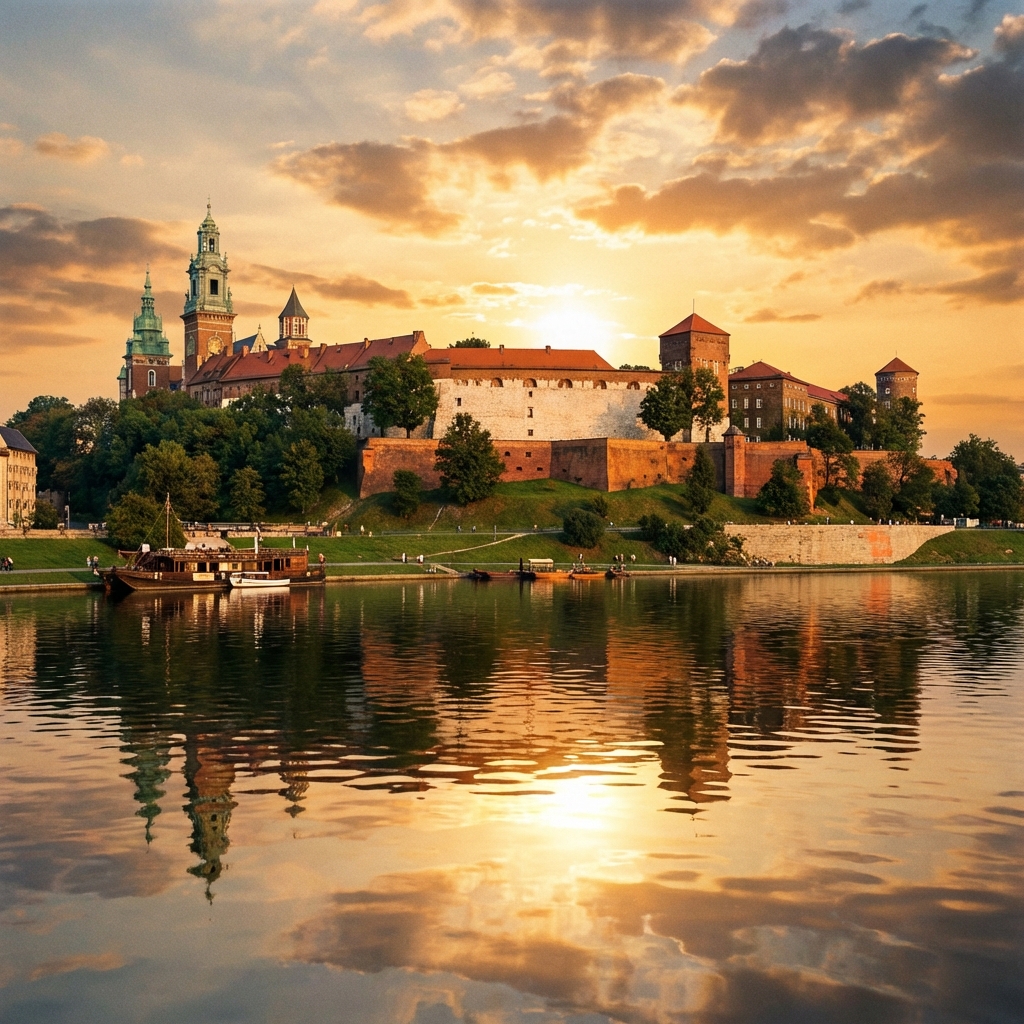
The Heart of Poland
Wawel Royal Castle (Zamek Królewski na Wawelu) is more than just a castle; it is the spiritual and political heart of Poland. Perched on a limestone hill rising above the Vistula River in Kraków, it has witnessed the coronation of Polish kings, the height of the Polish-Lithuanian Commonwealth's power, and the tragedies of partition and war. For centuries, this was the seat of the monarchs who ruled one of the largest and most diverse empires in Europe. Even when the capital moved to Warsaw in 1596, Wawel remained the place of coronation and burial, cementing its status as a national sanctuary. Walking up the Wawel Hill is like walking through the entire history of the Polish nation.
The Dragon's Den: Legend vs. History
Before history, there was legend. Beneath Wawel Hill lies a natural limestone cave known as the Dragon's Den (Smocza Jama). According to the oldest chronicle by Wincenty Kadłubek (13th century), a fearsome dragon known as holophagos (the whole-eater) once lived here, terrorizing the local population and demanding weekly tributes of cattle (and virgins). The legendary Prince Krakus (founder of Kraków) is credited with defeating the beast. A later, more popular version of the tale credits a clever shoemaker's apprentice named Skuba. He stuffed a sheepskin with sulfur and tar and left it for the dragon. The beast devoured it and, burning with thirst, drank from the Vistula River until he burst.
Today, visitors can descend a spiral staircase from the castle fortifications into the cool, damp cave, emerging at the riverbank where a bronze statue of the dragon stands. Every few minutes, it breathes real fire, delighting tourists and keeping the legend alive.
Renaissance Splendor
While the castle has Romanesque and Gothic origins, its current appearance is largely the result of a magnificent Renaissance reconstruction in the 16th century. King Sigismund I the Old brought Italian architects (like Bartolomeo Berrecci and Francesco Fiorentino) to Kraków to transform the gloomy medieval fortress into a light-filled palatial residence. The highlight is the Arcaded Courtyard, one of the finest examples of Renaissance architecture outside Italy. Its three tiers of elegant arches and slender columns create a harmonious space that hosted tournaments, court ceremonies, and masques. The layout of the courtyard, with its distinctively high second floor (piano nobile), influenced castle design across Central Europe.
The Wawel Tapestries: An Odyssey
The castle interiors are a treasure trove of art, but none are more significant than the Wawel Tapestries (Arrasy). Commissioned by King Sigismund II Augustus in Flanders between 1550 and 1560, this collection of 136 colossal tapestries is one of the largest and most valuable in the world. They depict biblical scenes (like Noah's Ark and the Tower of Babel), exotic animals, and "grotesques" with the royal arms.
Their history is as dramatic as the scenes they depict. Looted by Tsarist Russia in 1795, they were returned to Poland in 1921, only to be threatened again by the Nazi invasion in 1939. In a daring operation, they were evacuated down the Vistula on coal barges, then via truck and train through Romania, France, and England, finally crossing the Atlantic to Canada. They spent the war hidden in a secure facility in Quebec and were only returned to Wawel in 1961, an event celebrated as a symbol of Poland's survival.
The Royal Apartments and Treasury
The State Rooms are filled with Italian furniture, Dutch paintings, and elaborate friezes. The Crown Treasury and Armoury house the regalia of the Polish kings, including the Szczerbiec (the Jagged Sword), the coronation sword used since 1320. It is a miracle that these artifacts survived, as the Prussian army looted the Crown Jewels in 1795 and melted most of them down for coin. The treasury displays what remains, along with gifts from foreign potentates, including a stirrup of the Grand Vizier from the Battle of Vienna (1683). The armoury features a vast collection of winged hussar armour, the legendary Polish cavalry that dominated the battlefields of the 17th century.
The Senator's Hall
The largest room in the castle is the Senator's Hall. This was the venue for important state ceremonies, royal weddings, and sessions of the Senate. The walls are covered in Cordovan leather and decorated with the largest of the Wawel tapestries. A balcony for musicians overlooks the hall, suggesting the lively balls that once took place here.
The Royal Gardens
Recent archaeological work has restored the Royal Gardens to their Renaissance glory. Located on the eastern terrace, these gardens were a private retreat for the royal family, filled with medicinal herbs, roses, and boxed hedges. They offer a quiet respite from the crowds and a beautiful view over the Vistula River, allowing visitors to imagine the kings and queens taking their evening strolls here centuries ago.
The Sigismund Bell
Climbing the Sigismund Tower of the Wawel Cathedral offers a close-up view of the Sigismund Bell, the most famous bell in Poland. Cast in 1520 from captured enemy cannons, it weighs nearly 13 tons and requires 12 strong men to ring it. It is only rung on major national and religious holidays. Touching the clapper of the bell is said to bring good luck in love, making it a popular spot for couples.
The Wawel Chakra
A curious modern legend draws esoteric believers to Wawel. It is said to be one of the world's seven main 'chakras' or centers of spiritual energy (along with places like Delphi and Jerusalem). Believers claim that a powerful energy emanates from the corner of the courtyard near the ruins of St. Gereon's Chapel. Although the church authorities and museum staff dismiss this as 'New Age nonsense' and have even blocked access to the specific wall at times, you will often see people leaning against the wall in that corner, meditating or seeking to absorb the 'good vibes.' It adds a layer of mystical intrigue to the historical site.
Visitor Information
Wawel Hill is open daily from 6:00 AM until dusk, and walking the grounds is free. However, the exhibitions (State Rooms, Royal Private Apartments, Treasury, etc.) require separate tickets, and visitor numbers are limited each day. It is highly recommended to book in advance online, especially in summer. The complex also includes the Wawel Cathedral, the coronation and burial place of Polish monarchs, poets, and national heroes. The climb up the Sigismund Bell Tower offers a stunning view of the Old Town. A visit to Wawel is a trip through the soul of Poland.