A Fortress of Three Eras
Cardiff Castle is not just a single building; it is a timeline of Welsh history carved in stone. Located right in the heart of the capital city, it is a site where three distinct epochs collide: the practical military engineering of the Roman Empire, the brute force of the Norman conquest, and the limitless wealth and imagination of the Victorian industrial age. Few places in the world allow you to walk through 2,000 years of history in a single afternoon, but Cardiff Castle delivers exactly that.
The Roman Walls
The history of the site begins around 50 AD, shortly after the Roman invasion of Britain. The Romans recognized the strategic importance of the location at the mouth of the River Taff and built a fort here. It served as a naval base and a stronghold against the fierce Silures tribe of South Wales. While the wooden structures of the first fort are long gone, the massive stone walls of the final 4th-century fort still exist. In fact, they form the foundation of the current castle walls. You can clearly see a line of red stone separating the original Roman work from the later reconstructions. It is a tangible link to the days when legionaries marched where modern shoppers now walk.
The Norman Keep
After the Romans left, the site fell into disuse until the Normans arrived in the 11th century. Robert Fitzhamon, a Norman lord, recognized the value of the old Roman defenses and built a motte-and-bailey castle within the ancient walls. The motte (a large artificial earth mound) still dominates the castle green, topped by a formidable stone shell keep built in the 12th century. This keep was the last line of defense, a stark and functional military structure designed to withstand sieges. Visitors today can climb the steep steps to the top of the keep for panoramic views of the city and the Principality Stadium, contrasting the medieval skyline with the modern one.
The Victorian Fantasy Palace
While the Roman and Norman elements are impressive, the true showstopper of Cardiff Castle is the work done in the 19th century. In 1868, the 3rd Marquess of Bute, John Crichton-Stuart, came of age. He was one of the richest men in the world, thanks to the coal exports from the Cardiff docks. He was also a scholar, a linguist, and a romantic obsessed with the Middle Ages. He hired the eccentric and brilliant architect William Burges to transform the castle lodgings into a residence fit for his gothic dreams.
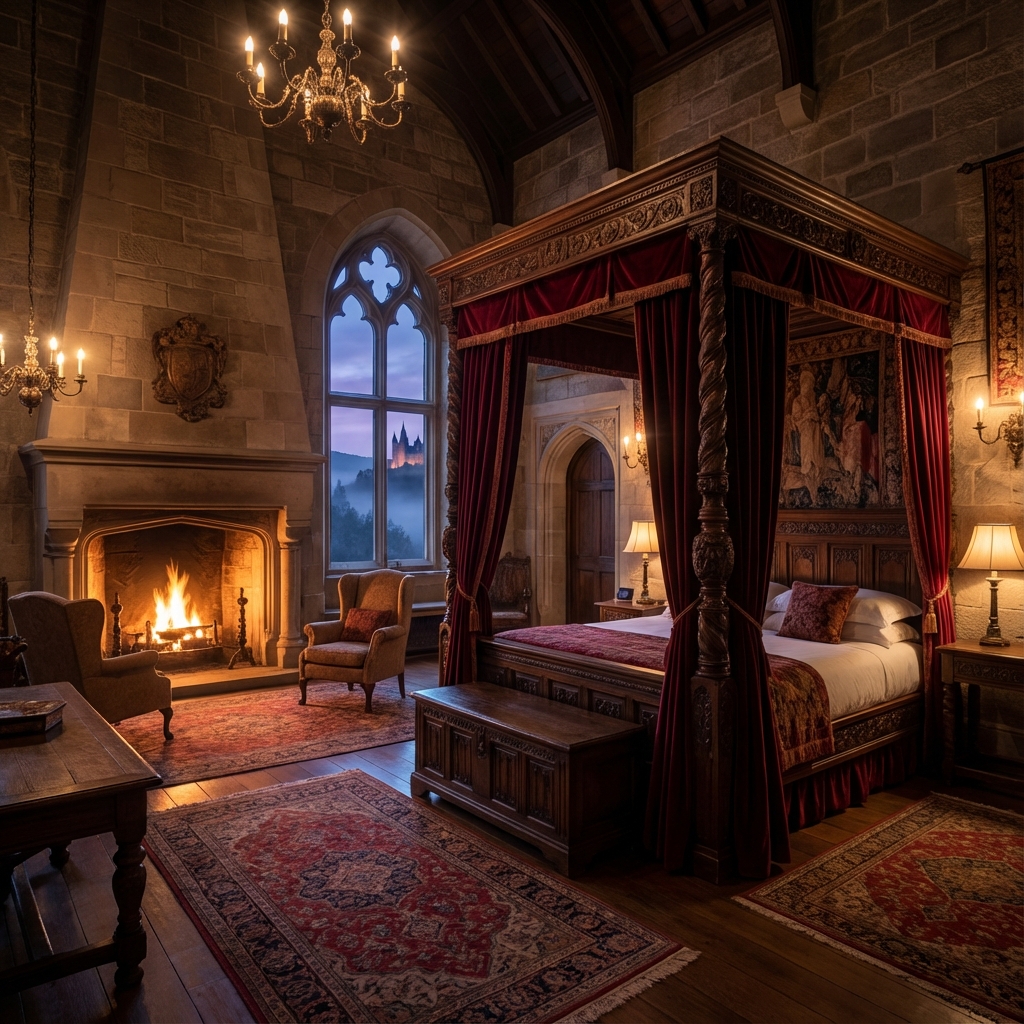
What Bute and Burges created is a masterpiece of the Gothic Revival style. They didn't aim for historical accuracy; they aimed for a romanticized, colorful, and lavish vision of what the Middle Ages should have been. Every inch of the interior is covered in decoration: murals, stained glass, marble, gilding, and intricate wood carving. Each room has a theme and tells a story:
- The Arab Room: Perhaps the most stunning room in the castle. Inspired by Bute's travels in the Middle East, it features a mesmerizing stalactite ceiling covered in gold leaf ($8 million worth in today's money). It is a jewel box of Islamic-inspired design.
- The Banqueting Hall: The largest room in the castle, designed to look like a medieval great hall. The walls are lined with murals depicting the history of the castle, and the fireplace is a massive structure depicting Robert, Duke of Normandy, peering out from behind prison bars (he was famously imprisoned in the castle for 8 years).
- The Library: A scholar's paradise. The bookcases are carved with animals and plants, and the desks were specially designed for Bute's studies. It is a warm, rich room that reflects the Marquess's intellectual interests.
- The Nursery: A room designed for the Bute children, decorated with tiled murals of famous fairytales like Jack and the Beanstalk, Red Riding Hood, and The Invisible Prince. It is charming and whimsical, showing a softer side to the grand design.
- The Roof Garden: A hidden gem at the top of the tower. It features a fountain with beavers and tiled walls depicting Hebrew stories, a private sanctuary for the family high above the city.
The Bute Park Connection
Adjacent to the castle lies Bute Park, a massive expanse of green space that was once the private pleasure garden of the Marquess. It was gifted to the city in 1947. The park is an arboretum of national significance, containing rare trees from all over the world. It provides a stunning green corridor along the River Taff, allowing you to walk from the castle keep deep into the countryside without leaving the city limits. The 'Animal Wall' on the castle's boundary is a favorite feature, with stone sculptures of lions, apes, and seals appearing to climb over the wall onto the pavement.
The Wartime Tunnels
The castle has a more somber chapter in its history as well. During World War II, the thick medieval walls provided sanctuary for the people of Cardiff. Tunnels were dug into the castle ramparts to serve as air-raid shelters. These were not damp, dark holes; they were fitted with bunks, kitchens, and first-aid posts, capable of sheltering over 1,800 people. Today, these tunnels have been recreated with atmospheric soundscapes, allowing visitors to experience the tension and camaraderie of the Blitz.
Visiting the Castle
Cardiff Castle is one of Wales' premier tourist attractions. It is open year-round, and a ticket gives you access to the grounds, the Norman Keep, the Roman walls, the Firing Line Museum (a museum of the Welsh soldier), and the wartime tunnels. However, to see the spectacular Victorian apartments, you usually need to join a guided house tour (or pay a small supplement). This is highly recommended; the stories told by the guides bring the eccentric Marquess and his architect to life.
The castle also hosts major events throughout the year, from jousting tournaments and food festivals to large outdoor concerts. Its location in the city center makes it incredibly accessible—you can finish a tour of the castle and be in a modern shopping center or a rugby pub within two minutes. It is the beating heart of Cardiff, a symbol of the city's endurance and its transformation from a Roman outpost to a coal metropolis and finally to a modern capital.