The Floating Jewel of the Loire
Floating elegantly on the waters of the Indre River, a tributary of the Loire, the Château d'Azay-le-Rideau is often described as a "faceted diamond set in the Indre." It is one of the purest and most harmonious examples of early French Renaissance architecture. Unlike the sprawling magnitude of Chambord or the bridge-spanning drama of Chenonceau, Azay-le-Rideau captivates with its intimacy, its delicate proportions, and its poetic setting. The castle stands on a small island, its foundations rising directly from the riverbed, creating a perfect water mirror that reflects its turrets, dormer windows, and slate roofs—a scene that has inspired writers like Balzac to call it "a diamond cut with facets."
It represents a pivotal moment in art history, standing at the crossroads where the defensive traditions of the French Middle Ages met the artistic refinement of the Italian Renaissance. The result is a residence that was never meant for war, but solely for pleasure, prestige, and the celebration of beauty.
History: Ambition and Exile
The history of Azay-le-Rideau is a tale of meteoric rise and sudden fall. The site originally held a medieval fortress burned down during the Hundred Years' War (earning the town the nickname "Azay-le-Brûlé" or Azay the Burnt). The land was acquired in 1510 by Gilles Berthelot, a wealthy financier and the Mayor of Tours, who rose to become the Treasurer-General of the Finances of France under King Francis I.
Wanting a residence that reflected his high status, Berthelot began construction of the current château in 1518. However, his duties kept him often at court, so the supervision of the work fell largely to his wife, Philippa Lesbahy. She is credited with the castle's refined style and the introduction of the new Italian architectural concepts. For nearly a decade, the castle took shape, incorporating the salamander (the emblem of Francis I) and the ermine (the emblem of Queen Claude) into its decor to show loyalty.
But the dream was cut short. In 1527, a corruption scandal involving the King's finances swept through the court. Berthelot's cousin was executed, and fearing for his own life, Berthelot was forced to flee into exile. The castle, still unfinished (the plan was likely intended to be a closed quadrilateral, but only two L-shaped wings were built), was confiscated by the King. It passed through various hands over the centuries, hosted Louis XIII, and eventually was bought in 1791 by the Marquis Charles de Biencourt. The Biencourt family owned it for over a century, saving it from the ravages of the French Revolution and restoring it with great care, turning the grounds into the magnificent English-style park seen today.
Architecture: A Renaissance Hybrid
Azay-le-Rideau is celebrated for how it smoothly blends two worlds. From the French Gothic tradition, it keeps the steep slate roofs, the vertical emphasis, the machicolations (though here purely decorative), and the round corner turrets. From the Italian Renaissance, it adopts symmetry, the alignment of windows (fenestration), and the use of pilasters and horizontal moldings.
The Grand Staircase
The château's most innovative feature is the grand central staircase (L'Escalier d'Honneur). In medieval French castles, stairs were typically spiral and enclosed in towers outside the main building. At Azay, the staircase is straight (a novelty at the time) and integrated into the center of the corps de logis. It is open to the outside through loggias (balconies) with innovative coffered ceilings decorated with medallions of the Kings and Queens of France. This design allowed the owners to see and be seen, turning the act of moving between floors into a theatrical event.
Interiors and Restoration
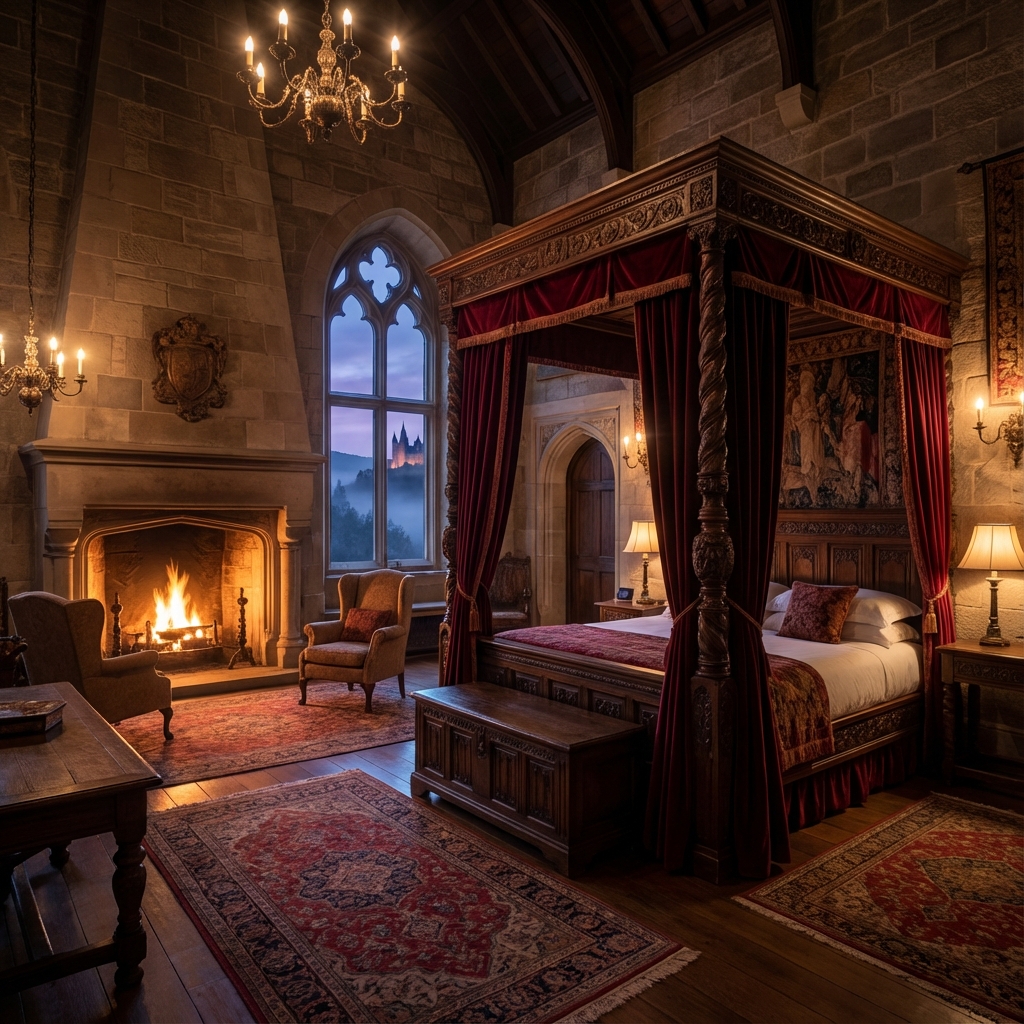
The interiors of Azay-le-Rideau have undergone a massive restoration project (completed around 2017). The rooms are furnished to reflect the 16th and 19th centuries, honoring both the Berthelot founders and the Biencourt restorers. Highlights include the King's Bedroom (where Louis XIII stayed), adorned with Renaissance tapestries, and the 19th-century salons which feel warm and lived-in, complete with billiard tables and comfortable armchairs. The kitchen, with its massive fireplace and copper cookware, provides a glimpse into the culinary life of the chateau.
The Attic: A Masterpiece of Carpentry
One of the hidden gems of the castle is the attic, which is open to visitors. It houses the original 16th-century timber roof frame (the "charpente"). Made of oak felled from the nearby forests in 1518, the wood has been perfectly preserved. It is a stunning example of medieval carpentry, known as a "philbert" roof, and visitors can walk beneath the beams to appreciate the craftsmanship that has held the heavy slate roof up for 500 years.
The English Garden and Water Mirror
The castle's setting is as important as the stone structure itself. In the 19th century, the Biencourt family drained the surrounding marshes and created a scenery garden in the English style. They planted exotic species like sequoias, cedars, and ginkgo biloba, creating winding paths that offer carefully curated views of the château. The most famous feature is the "Water Mirror" on the south facade. The river was widened and slowed to create a reflecting pool. Modern restoration has cleared the vegetation that once obscured this view, returning the castle to its original concept of a building floating on water.
Legends: The Burnt Castle
While the current castle is a place of peace, its predecessor has a violent legend. In 1418, the future King Charles VII passed through the town and was insulted by the Burgundian guard occupying the old fortress. In retaliation, he ordered the castle stormed, the garrison executed (350 men were reportedly drowned or hanged), and the village burned to the ground. This event haunted the site for a century until the Berthelots arrived to build something beautiful over the ashes of war.
Visitor Information
Access
Azay-le-Rideau is located about 25 km southwest of Tours. It is easily accessible by car via the A85 motorway. There is also a train station (Gare d'Azay-le-Rideau) which is about a 20-minute walk from the castle, with connections to Tours and Chinon. The walk from the station takes you through the charming village, which is worth exploring in its own right.
Opening Times
The castle is open every day of the year except January 1st, May 1st, and December 25th. Hours vary, generally opening at 9:30 AM and closing between 5:00 PM (winter) and 7:00 PM (summer). Last admission is usually one hour before closing.
The Visit Experience
A typical visit takes about 1.5 to 2 hours. Audio guides are available and highly recommended to understand the architectural nuances. During the summer months (July and August), the castle often hosts "Nocturnes," special evening openings where the gardens are illuminated by thousands of candles and lanterns, creating a magical atmosphere. The combination of the illuminated white stone and the dark water creates a scene straight out of a fairy tale.