The Red Giant of Alsace
Rising from the dense, dark forests of the Vosges mountains like a titan of red sandstone, the Château du Haut-Kœnigsbourg is one of the most visited monuments in France. At an altitude of 757 meters, it dominates the scenery, offering a commanding view that stretches across the Rhine plain to the Black Forest in Germany and, on a clear day, as far as the Swiss Alps. Its silhouette—a jagged line of towers, bastions, and steep slate roofs—is instantly recognizable. It is a textbook example of a medieval mountain fortress, designed to see and be seen, to intimidate and to protect.
However, Haut-Kœnigsbourg is not just a relic of the Middle Ages. It is also a monument to the complex and often painful history of Alsace, a region that has oscillated between France and Germany for centuries. The castle as we see it today is largely a reconstruction from the early 20th century, a project driven by the German Emperor Wilhelm II to legitimize his rule over the territory. It is a place where medieval stone meets modern political ambition. The structure itself tells the story of this tug-of-war, with French fleur-de-lis and German eagles often found in close proximity.
History: From Ruins to Resurrection
The site has been occupied since Roman times, but the first mention of a castle dates to the 12th century. It was built by the Hohenstaufen dynasty to watch over the strategic trade routes of salt, wine, silver, and wheat that traversed the region. For centuries, it was a prize fought over by dukes, bishops, and robber barons, known as the Tiersteins, who used it as a base to raid passing merchants.
Its decline began in the 17th century. During the Thirty Years' War, the castle was besieged by Swedish troops in 1633. After holding out for 52 days, the starved garrison surrendered. The Swedes looted the castle and set it on fire. For the next two and a half centuries, the "High King's Castle" (the literal translation of its name) lay in ruins, reclaimed by the forest, a romantic spot for hikers and poets who admired its melancholic beauty.
The turning point came in 1871, when Alsace was annexed by the newly formed German Empire. The ruins were gifted to Kaiser Wilhelm II in 1899 by the town of Sélestat. The Emperor saw an opportunity. He wanted to create a symbol of the glorious German past and the permanence of German rule in Alsace. He commissioned the architect Bodo Ebhardt, a specialist in medieval fortification, to restore the castle to its pre-1633 state.
The restoration (1900–1908) was monumental. Using modern technology (steam engines, electricity) disguised as medieval craftsmanship, Ebhardt rebuilt the walls, towers, and interiors. While critics at the time mocked it as a "kitschy" fantasy, modern historians praise Ebhardt's scientific approach. He based his work on archaeological evidence and archival records, though he did add some romantic flourishes (like the height of the donjon) to please the Emperor.
Architecture: A Lesson in Defense
A visit to Haut-Kœnigsbourg is a trip through a complete medieval defensive system. The castle is divided into three sections: the Lower Garden, the Outer Ward, and the High Castle (Upper Ward).
The Grand Bastion
The most imposing feature is the Grand Bastion on the western side. Since this was the most vulnerable point (facing the mountain slope), it was heavily fortified. It is a massive artillery platform with walls up to 9 meters thick, designed to withstand cannon fire. It offers the best views of the surrounding area and was designed to house heavy artillery pieces.
The Upper Ward
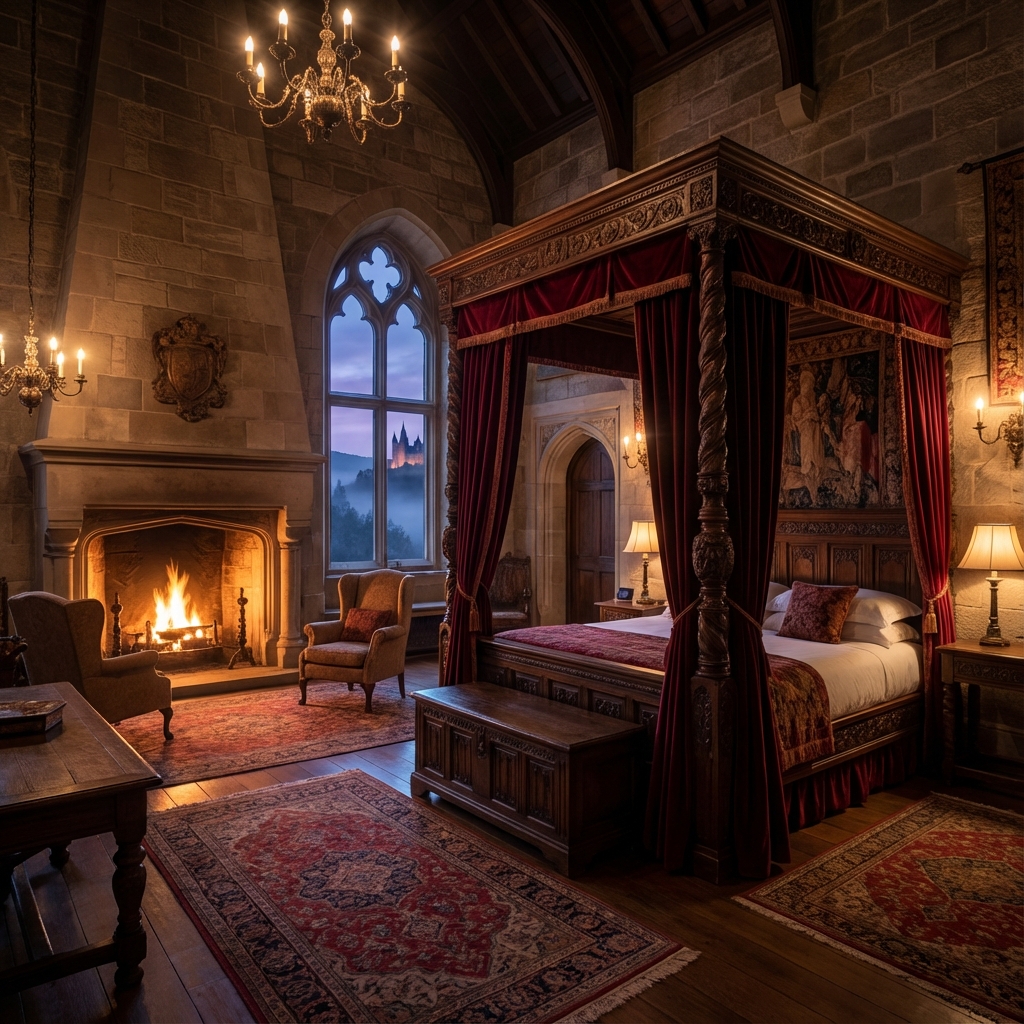
The residential part of the castle is a maze of spiral staircases, wooden galleries, and stone halls. The architecture is a mix of Romanesque and Gothic styles. The restoration included every detail, from the wrought-iron door handles to the tiled stoves (Kachelofen) that heat the rooms. The Inner Courtyard is particularly atmospheric, with its covered well, timber-framed galleries, and the tall hexagonal stair tower.
The Kaiser's Room
The Kaiser's Room (Salle du Kaiser) is the centerpiece of the interior. It is decorated with frescoes of the Imperial Eagle and the coats of arms of the Holy Roman Empire, a clear political statement by Wilhelm II linking his Second Reich to the First Reich. The ceiling is adorned with a massive eagle with the motto "Gott mit uns" (God with us). It was intended as a banquet hall for the Emperor's visits, though he rarely stayed here.
Legends: The Ghostly Nurse
Like any proper castle, Haut-Kœnigsbourg has its legends. One tells of a "White Lady" or a ghostly nurse who wanders the battlements at night. She is said to be the spirit of a woman who tried to save her sick child during the Swedish siege but failed due to the lack of food and medicine. Her weeping is said to foretell a coming storm or disaster.
Another legend concerns the castle's well, which is 62 meters deep. It is said that a secret tunnel leads from the bottom of the well to the village below, allowing the lords to escape or smugglers to bring in supplies during a siege. While no such tunnel has been found, the well itself is a marvel of engineering, cut through solid granite.
Visitor Information
Getting There
The castle is located in Orschwiller, about 26 km north of Colmar and 55 km south of Strasbourg. It is a popular day trip from both cities. A shuttle bus (Navette du Haut-Kœnigsbourg) runs from the Sélestat train station to the castle, which is convenient for those without a car. If driving, be prepared for a winding mountain road and busy parking lots in the summer.
Tours
The castle is open all year round, except for January 1st, May 1st, and December 25th. Self-guided tours are the norm, with information pamphlets available in many languages. Audio guides are highly recommended to understand the nuances of the restoration. There are also guided tours in French, and occasionally in English and German. The visit involves a lot of walking and stair climbing, so comfortable shoes are essential. Photography is allowed, and the views from the Grand Bastion are some of the best in Alsace.
The Medieval Garden
Just outside the walls, there is a recreated medieval garden. It grows plants that were used in the Middle Ages for medicine, dyeing cloth, and cooking. It is a peaceful spot to rest after exploring the martial stone giant and offers a fragrant counterpoint to the cold stone walls.