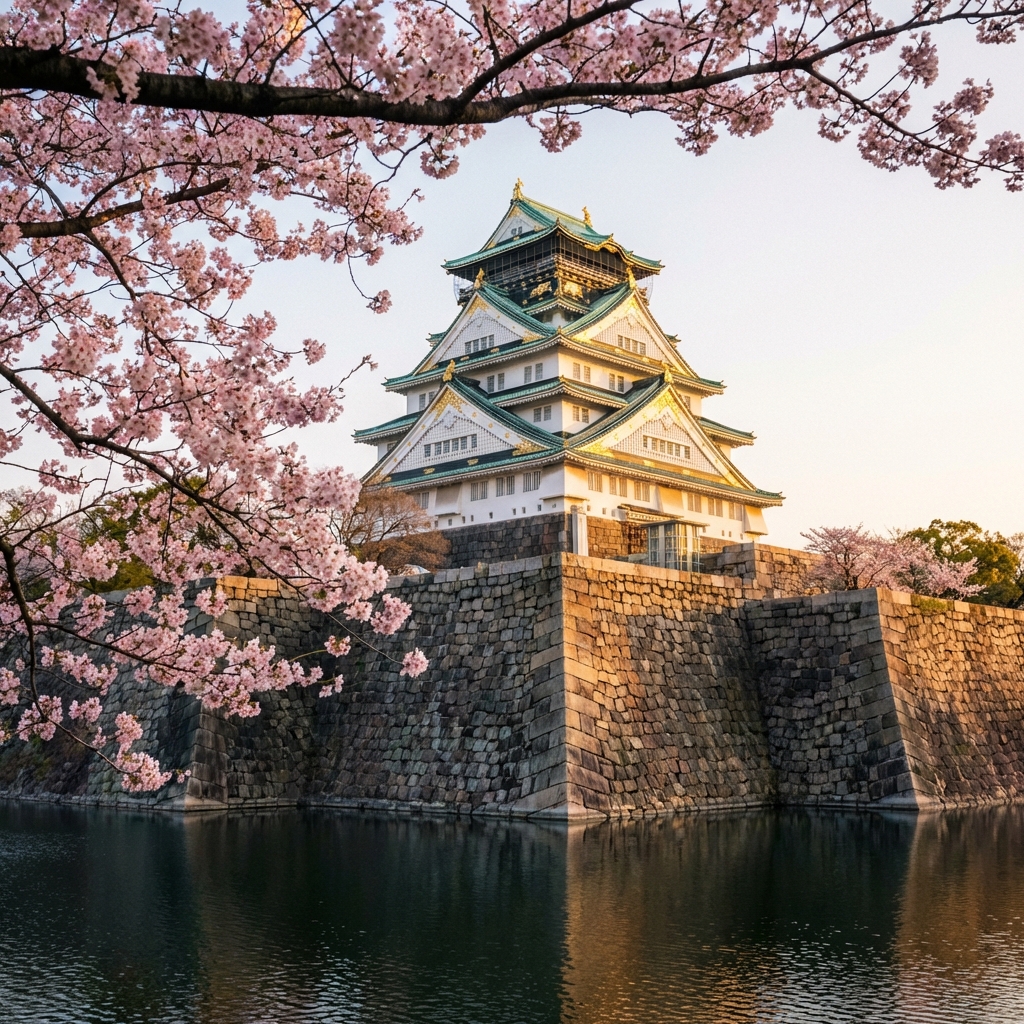
The Golden Symbol of Unification
Osaka Castle (Osaka-jo) is more than just a fortress; it is the enduring symbol of Osaka and one of Japan's most historically significant sites. With its five stories on the outside and eight stories on the inside, it towers over the city on a massive stone foundation, its white walls and golden ornaments gleaming in the sun. It was originally built by Toyotomi Hideyoshi in 1583, intended to be the strongest and most luxurious castle in Japan. Hideyoshi, the "Great Unifier," wanted to display his power after bringing the warring states under his control, and he spared no expense. Thousands of laborers worked day and night to construct it, and gold leaf was applied liberally to the interior and exterior to impress visitors and rivals alike.
History: A Legacy of Fire and Stone
The history of Osaka Castle is a dramatic saga of destruction and rebirth, mirroring the turbulent history of Japan itself. The site was originally the location of the Ishiyama Hongan-ji temple, the headquarters of a powerful warrior monk sect that resisted Oda Nobunaga for over a decade. After Nobunaga destroyed the temple in 1580, his successor Toyotomi Hideyoshi chose the strategic location for his new base.
The Siege of Osaka (1614-1615)
The most famous event in the castle's history is the Siege of Osaka. After Hideyoshi's death, power shifted to Tokugawa Ieyasu, who established the Edo Shogunate. The Toyotomi clan, led by Hideyoshi's son Hideyori, remained a threat to Tokugawa's rule. In the winter of 1614, Tokugawa attacked with an army of 200,000 men. The castle's defenses held, but a peace treaty was negotiated that required the filling of the outer moats. The following summer, Tokugawa attacked again. With its defenses compromised, the castle fell. The Toyotomi clan perished in the flames, ending their lineage, and the castle was reduced to ashes.
The Tokugawa Reconstruction
The castle we see today is actually the third iteration. The original Toyotomi castle was completely destroyed in 1615. The second castle was built by the Tokugawa shogunate in the 1620s. Interestingly, the Tokugawa builders did not just repair the old castle; they buried the original foundations under new, higher walls and built a new keep to physically and symbolically bury the memory of the Toyotomi. This second castle stood for only a few decades before being struck by lightning and burning down in 1665. For centuries, only the ruins and the stone walls remained.
The Modern Keep
The current main keep is a concrete reconstruction completed in 1931. It was built thanks to donations from the citizens of Osaka to commemorate the Emperor's enthronement. Miraculously, it survived the heavy bombing of World War II that flattened much of the surrounding area, though it suffered some damage. A major renovation in 1997 gave it a fresh look, restoring the golden tiger ornaments and the white plaster walls to their original splendor, making it the glistening icon it is today.
Architecture: A Fortress of Giants
While the keep is a modern museum, the stone walls, moats, and several turrets are original structures from the Edo period (17th century) and are designated as Important Cultural Properties. The scale of the fortifications is staggering.
The Massive Stones
The castle is famous for its colossal granite walls. The stones used are enormous, some weighing over 100 tons. The largest stone in the entire complex is the Tako-ishi (Octopus Stone), located near the Sakura-mon Gate. It is estimated to weigh 108 tons (some sources say 130). It is a mystery how these stones were transported from quarries miles away and fitted so precisely without modern machinery. The sheer size of the fortifications reminds us that this was a military fortress designed to be impregnable.
The Gates and Turrets
Visitors enter the main bailey through the Sakura-mon Gate (Cherry Gate). The thick wooden doors are reinforced with iron plates. Other notable structures include the Ote-mon Gate (Main Gate), the Tamon Yagura (a long, corridor-like turret used to defend the gate), and the Sengan Yagura (Thousand-Kan Turret), which dates back to 1620. Legend says it was named "Thousand-Kan" because the defenders offered that much money to anyone who could capture it.
Inside the Main Keep: A Museum of History
The interior of the main tower is a modern, eight-story history museum dedicated to the life of Toyotomi Hideyoshi and the history of Osaka Castle. Unlike many Japanese castles which are empty wooden structures, this one is filled with artifacts.
- 1st-7th Floors: The exhibits include authentic samurai armor, weapons, folding screens, and letters written by Hideyoshi himself. Detailed dioramas and 3D holograms explain the Siege of Osaka and the life of the samurai in vivid detail. Visitors can even try on a replica samurai helmet and surcoat for a photo.
- 8th Floor: The top floor features an observation deck that offers a panoramic view of Osaka city. It is a great spot to see the contrast between the ancient castle grounds and the modern skyscrapers of the Osaka Business Park.
Osaka Castle Park and Cherry Blossoms
The castle is surrounded by Osaka Castle Park, a vast green space of over 100 hectares in the middle of the city. It is especially popular during the cherry blossom season (hanami) in early April, when thousands of people gather under the 3,000 cherry trees (some sources say up to 4,000) to picnic and celebrate. The park is one of Japan's "Top 100 Cherry Blossom Spots."
The park also houses the Nishinomaru Garden, a paid garden with 600 cherry trees and a tea house, offering a classic view of the castle keep rising above the pink blossoms. It is particularly beautiful during the evening illuminations.
The Time Capsule
Near the castle keep, visitors might notice a strange metal lid on the ground. This marks the location of two time capsules buried during the Osaka Expo '70. The capsules contain over 2,000 items from 20th-century daily life, including seeds, clothing, and even a Sanyo television. The lower capsule is intended to remain buried for 5,000 years, to be opened in the year 6970. It is a poignant message to the future from a city that has risen from the ashes time and time again.
Visitor Information
Opening Hours
Osaka Castle is open daily from 9:00 AM to 5:00 PM (last entry at 4:30 PM), with extended hours during cherry blossom season and Golden Week. It is closed December 28th through January 1st.
Getting There
The castle is easily accessible by train. The closest stations are Osakajokoen Station (JR Loop Line) and Tanimachi 4-chome Station (Subway). From the station, it is a pleasant 15-20 minute walk through the park to the main keep.
Tips for Visitors
There can be long lines to enter the main keep, especially on weekends and holidays. Arriving early is recommended. The museum is one-way, starting from the bottom and working up (or taking the elevator to the top and walking down). For a different perspective, you can take a 'gozabune' (golden pleasure boat) ride in the moat to see the massive walls from the water level.